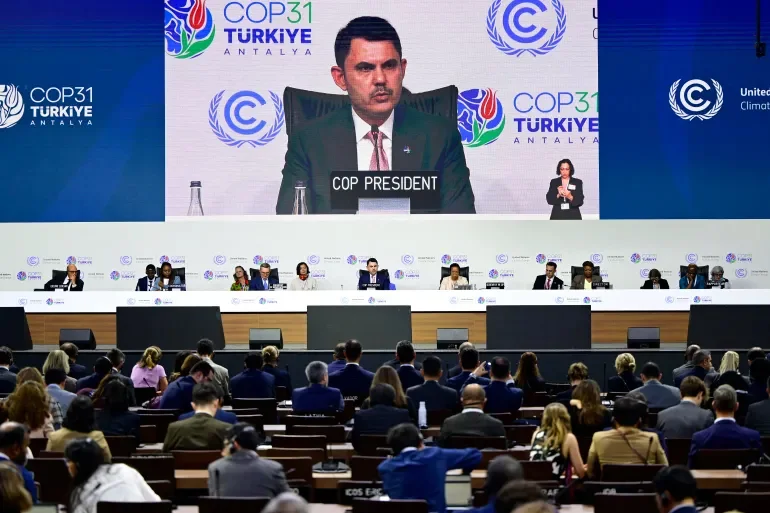
The two-week 31st UN Climate Change Conference (COP31), hosted in Antalya, Turkey under the leadership of Turkish Environment Minister and COP31 President Murat Kurum, formally outstripped its scheduled Friday closing date with no sweeping cross-party political deal in place, as nearly 200 participating nations remain deadlocked over core provisions of the final negotiating text. Negotiators will reconvene for a second day of crunch talks on Saturday, with rifts widening across three high-stakes priority areas: the global clean energy transition, dedicated climate finance for vulnerable low-income nations, and collective action to curb runaway global warming.
During a late-night plenary session on Friday, delegates only managed to resolve a handful of low-stakes procedural technical issues, making no headway on the overarching binding political framework. Kurum acknowledged to reporters that negotiating teams were “within touching distance of a compromise” but had not yet aligned on all outstanding sticking points, with a revised draft text slated for release Saturday morning. The entire process is operating under mounting external pressure, as a growing bloc of nations warns that weak, watered-down commitments will fail to address accelerating climate hazards and the urgent need to slash global greenhouse gas emissions.
The most intractable point of contention centers on explicit references to phasing out fossil fuels — oil, natural gas and coal — that formed a historic cornerstone of the 2023 COP28 Dubai agreement. After sustained pushback from Saudi Arabia and a coalition of major oil and gas exporting economies, all prior language mandating an accelerated phase-down of fossil fuel use was stripped from the latest draft released Thursday. The European Union has publicly cautioned that the summit risks devolving into a “fossil fuel-friendly talkfest” that abandons the 2023 COP28 breakthrough, while a cross-regional coalition including Panama, France and multiple small island developing states is demanding the explicit fossil fuel phase-out language be reinstated. Panamanian Environment Minister Juan Carlos Navarro went a step further, threatening to walk out of negotiations entirely if the final text makes no mention of fossil fuel cuts, calling the omission an “unforgivable betrayal” of communities on the frontlines of climate collapse.
Climate finance for developing nations has emerged as a second explosive flashpoint. An earlier draft had included a non-negotiable $120 billion annual funding target to support low-income countries adapting to worsening climate impacts including extreme droughts, catastrophic floods and record heatwaves, but that concrete figure was entirely erased from the revised text. African delegations, led by Ghanaian Environment Minister Zanetor Agyeman-Rawlings, emphasized that the continent is not attending the summit to beg for charity, but to claim its rightful share of resources as communities that have contributed less than 3% of historical cumulative emissions yet bear 75% of the costs of climate breakdown. The latest proposals only reference a vague commitment to triple adaptation finance by 2035, with no binding dollar amount, and push most detailed funding implementation plans off to future negotiating sessions, leaving vulnerable nations with no clear timeline for accessing promised support.
A third controversial proposal targeting a 35% global share of electricity in total final energy consumption by 2035 has also split delegates, as the draft text does not require that this expanded electricity supply come exclusively from renewable or zero-emission sources. Critics warn the vague language would allow nations to hit the target by building new coal and gas power plants, rather than accelerating the shift to wind, solar and other clean energy. Additional divisions have flared over rules for carbon capture and storage technology: oil and gas producing nations frame it as a critical transitional tool for hard-to-abate industrial sectors, while critics including Vanuatu’s Climate Minister Ralph Regenvanu dismiss it as a costly, unproven greenwashing tactic designed to extend fossil fuel production rather than deliver real structural decarbonization.
These deadlocked negotiations unfold against a backdrop of increasingly grim scientific projections, which confirm the world is on track to blow past the 1.5°C warming threshold enshrined in the Paris Agreement within the next seven years without immediate, steep emission cuts. The absence of the United States, the world’s largest historical greenhouse gas emitter, for the second consecutive COP has further complicated diplomatic efforts, while broader geopolitical tensions including regional conflicts in the Middle East and global cost-of-living crises have pushed climate action down national priority lists for many major economies.
Frustration is boiling over among vulnerable developing nation delegations, who argue wealthy historical polluters are shirking their legal and moral responsibilities to deliver promised climate support. Leading environmental advocacy groups have gone so far as to label COP31 the most under-ambitious and ineffective climate summit in the 30-year history of the UN process, warning that a weak, non-binding final deal will widen the gap between global climate pledges and real-world action. As delegates enter their marathon Saturday negotiating session, Kurum faces the unprecedented challenge of forging a compromise that balances competing national economic interests, upholds core climate justice principles and keeps the 1.5°C warming target within reach.