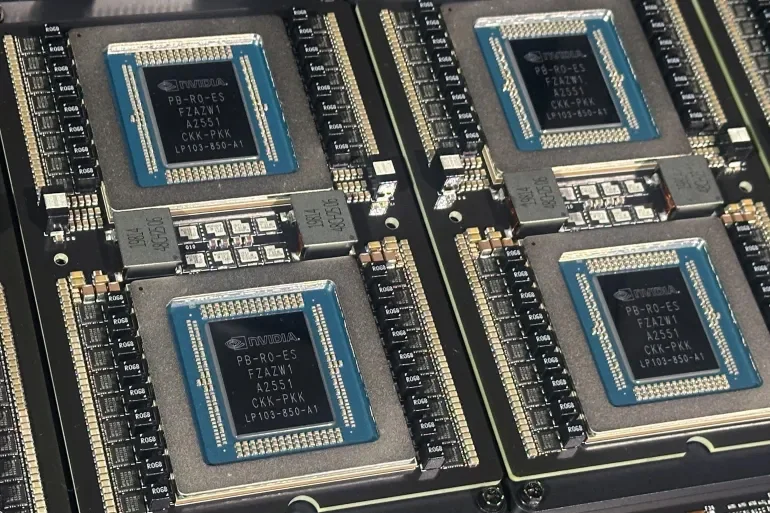
On November 17, U.S. authorities unveiled sweeping new updates to long-standing advanced semiconductor export restrictions, designed to close a critical loophole that allowed Chinese firms to access top-tier American AI computing power via third-country cloud data centers, even as direct shipments of cutting-edge chips to China remain banned. Issued by the U.S. Department of Commerce’s Bureau of Industry and Security (BIS) on a preceding Monday, the revised rules impose mandatory additional licensing requirements for all exports, re-exports, and transfers of state-of-the-art semiconductors to Indonesia, Malaysia, Singapore, Thailand, and Brazil. Washington framed the expansion as a necessary response to the rapid global growth of cloud computing, which enables remote access to high-performance server capacity without the physical shipment of restricted hardware to end-users in sanctioned jurisdictions including China, Russia, Iran, and Cuba. Under the new regulatory framework, cloud service providers that deliver substantial remote computing capacity to entities in restricted countries are also required to implement rigorous end-user verification protocols to prevent unauthorized diversion of U.S.-origin semiconductor technology. The rollout of the tightened controls runs parallel to a high-profile, ongoing joint criminal and administrative investigation by the U.S. Commerce and Justice Departments into alleged circumvention of existing chip export rules, centered on Singapore-based data center operator Megaspeed International. BIS first launched inquiries into the firm in 2024 after identifying suspicious activity linked to potential diversion of sensitive semiconductor technology, and in May 2025, U.S. investigators requested top AI chipmaker Nvidia to submit full records of both direct and indirect chip deliveries to Megaspeed. Nvidia subsequently added Megaspeed to its internal restricted sales list in June 2025, halting all shipments to the firm. Later that same month, BIS agents partnered with Singaporean law enforcement to conduct an on-site inspection of Megaspeed’s Ocean Financial Centre headquarters, during which then-company CEO Alice Huang was interviewed, after which the U.S. Department of Justice took over leadership of the expanding criminal probe. No formal finding of wrongdoing against Megaspeed has been issued to date, though U.S. authorities have pledged to fully investigate and prosecute any confirmed violations of export control laws. The high-stakes probe has triggered cascading repercussions for Nvidia, the world’s leading producer of AI training chips. Co-founder and long-serving CEO Jensen Huang stepped down from his position as board chair on November 12, following widespread public fallout over reports of his personal relationship with Alice Huang, and unsubstantiated claims that she maintained ties to Chinese intelligence services. Reuters confirmed on November 17 that it could not independently verify the unproven espionage allegations against Alice Huang, which remain under active review by U.S. intelligence agencies. Chinese foreign ministry officials have formally rejected all claims of state-linked espionage related to the case. Singapore’s Ministry of Home Affairs completed its parallel domestic probe and found insufficient evidence to pursue criminal charges against Alice Huang for alleged false statements related to server purchases, though she received a formal official warning for intentionally providing misleading information about her role at Megaspeed and has been barred from re-entering the city-state. Investigations into Megaspeed and six other associated individuals remain active. Megaspeed has publicly stated that it operates in full compliance with all applicable regulations, confirmed Alice Huang formally departed the firm on August 30, 2025, and pledged full cooperation with all ongoing international inquiries. The new U.S. export rules have prompted immediate responses from affected Southeast Asian and Latin American governments. Singapore announced it is conducting a full detailed review of the new regulatory provisions, holding consultations with impacted local tech firms, and engaging in ongoing dialogue with U.S. authorities to clarify the scope and practical implementation of the new rules, while reaffirming its longstanding policy of not allowing its territory to be used as a conduit for evading other nations’ legal and regulatory requirements. Singapore and the U.S. have also agreed to continue coordinated information sharing and joint consultations related to the Megaspeed investigation. Malaysian authorities, meanwhile, have launched their own targeted reviews of potential transshipment violations of advanced semiconductors, to verify that chips declared for domestic use in Malaysia are not being rerouted to restricted jurisdictions. The Malaysian government emphasized that it remains fully committed to welcoming foreign direct investment in its fast-growing data center sector, but will not permit its territory to be exploited to bypass international export control rules. Beijing has issued a sharp public condemnation of the expanded U.S. restrictions, with the Chinese Ministry of Foreign Affairs labeling the measures as illegitimate economic coercion that constitutes unwarranted U.S. interference in normal technology collaboration and commercial trade between China and third-party nations. Chinese officials argued that the new rules will undermine the growth of China’s domestic technology sector and disrupt the stability of global semiconductor supply chains, and confirmed that Beijing will roll out necessary defensive measures to safeguard its legitimate national interests. The regulatory expansion lands at a particularly delicate juncture in U.S.-China bilateral relations, as both sides work to maintain a fragile tentative trade detente even as their fierce, decades-long competition for technological dominance, particularly in the fast-evolving AI and advanced semiconductor sectors, continues to escalate. Ultimately, the updated U.S. regulatory framework marks a significant expansion of Washington’s export control strategy, moving beyond targeting direct physical chip shipments to explicitly restrict the indirect flow of U.S.-origin AI computing power across global cloud infrastructure networks.