The 49th ASEAN Summit, hosted in Manila from November 15 to 17, 2024, concluded without a breakthrough in decades-long negotiations with China over a binding Code of Conduct (CoC) for the contested South China Sea, Philippine Foreign Secretary Theresa Lazaro announced in official briefings over the weekend and subsequent Monday. While negotiators have reached provisional consensus on roughly 80% of the draft CoC text, several high-stakes, core sticking points remain unresolved, pushing the finalization timeline past the Philippines’ 2024 ASEAN chairmanship target. The next phase of negotiations will be stewarded by Singapore, which is set to assume the rotating ASEAN chairmanship in 2027.
Outstanding unresolved issues include the critical question of whether the CoC will carry legally binding force, the exact geographic scope of the agreement, and the precise definition of several highly sensitive terminology points that have divided China and the 10 ASEAN member states. Lazaro emphasized that the delay does not equate to a failed process, noting that negotiations have entered their final stretch, with parties committing to continue constructive talks to deliver a substantive, effective agreement as soon as feasible. For over 20 years, the CoC has been framed as a foundational framework to prevent isolated maritime incidents from escalating into full-blown military conflict in one of the world’s most strategically vital waterways, where an estimated third of global international trade transits annually.
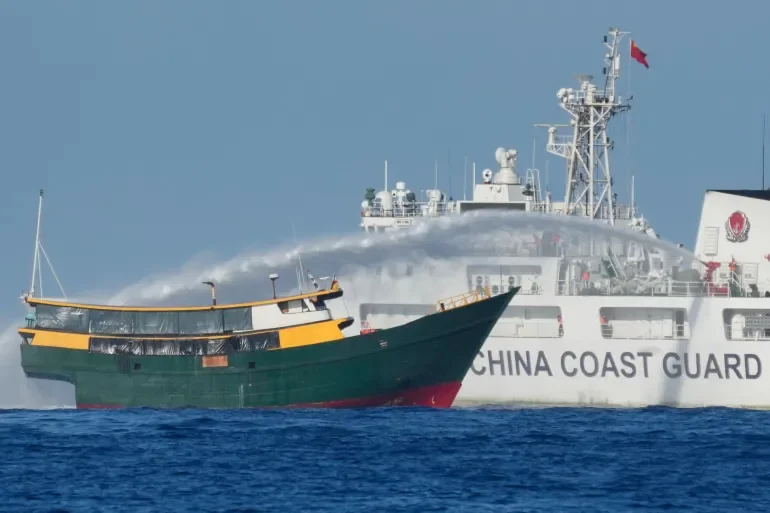
Long-running overlapping territorial claims in the South China Sea have fueled persistent regional tensions: China lays claim to nearly 90% of the water body via its historical nine-dash line, a claim that directly conflicts with exclusive economic zone assertions from ASEAN members Brunei, Malaysia, the Philippines, and Vietnam. Tensions have spiked sharply between Beijing and Manila in recent years, with the Philippines repeatedly accusing the Chinese Coast Guard of deploying water cannons to disrupt Filipino resupply missions to its stationed personnel in disputed waters, including a widely documented March 5, 2024, incident where the Philippine supply vessel Unaizah May 4 was targeted by Chinese water cannon fire, as captured in AP press imagery. Beijing in turn has accused Manila of unauthorized incursions into its sovereign maritime territory. A 2016 UN-backed international arbitral tribunal ruling dismissed the legal basis of China’s sweeping historical claims to the South China Sea, a decision Beijing has consistently rejected. During the Manila summit, all ASEAN member states and China reaffirmed their commitment to avoid unilateral actions that could escalate existing disputes, in a bid to foster a more conducive environment for ongoing CoC negotiations.
Parallel to the South China Sea talks, ASEAN leaders announced they would extend existing restrictions on Myanmar’s political representation at the bloc’s top-tier meetings, following a lack of tangible progress in implementing the 2021 ASEAN Five-Point Consensus, a landmark agreement designed to end widespread violence in Myanmar and pave the way for a negotiated political settlement after the country’s February 2021 military coup ousted the democratically elected government led by Aung San Suu Kyi. Under the extended measures, Myanmar will only be permitted to send non-political career diplomats to attend ASEAN summits and foreign ministerial meetings, with full political representation barred until Naypyidaw demonstrates verifiable, sustainable progress on de-escalating ongoing armed conflict, ending targeted attacks on civilian populations and public infrastructure, and delivering on the terms of the Five-Point Consensus. The bloc emphasized that the door for full Myanmar re-engagement remains open, with incremental, step-by-step contact to be maintained across lower-level sectoral and ministerial ASEAN forums, where Myanmar will retain full participation rights.
The Philippines assumed the 2024 ASEAN chairmanship after the role was reassigned from Myanmar in 2021 in response to the country’s deepening political and humanitarian crisis. Singapore will take over the rotating chairmanship in 2027, inheriting stewardship of the South China Sea CoC negotiations alongside the full ASEAN regional agenda. The three-day Manila summit also included separate high-level dialogues between ASEAN leaders and key global partner nations including China, the United States, Japan, India, South Korea, and Australia, covering shared priorities ranging from regional security architecture, cross-border economic integration, and managing rising geopolitical frictions across the Indo-Pacific.