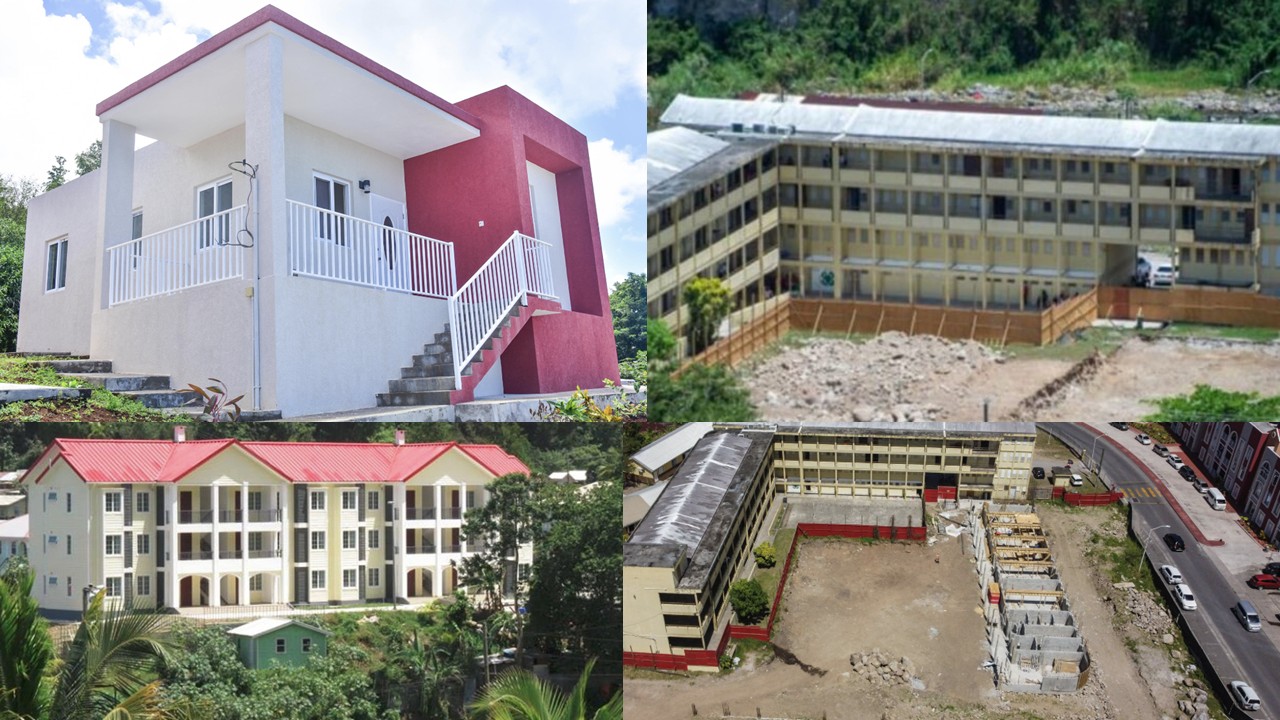
During a recent sitting of Dominica’s Parliament, Opposition Senator Delbert Paris mounted a rigorous challenge to the administration’s reported spending figures for two high-priority public projects: the national affordable housing scheme and the ongoing Dominica Grammar School redevelopment, pushing for far stricter fiscal accountability and clear, accessible financial disclosures for all public works initiatives. Paris opened his address by explicitly endorsing the core public policy goals behind both programs, noting that expanding access to safe, dignified housing for vulnerable residents and upgrading critical educational infrastructure were universally shared priorities across party lines, before laying out a series of startling discrepancies he identified in the tabled 2025–2026 supplementary appropriation bill. Official parliamentary financial records show the Ministry of Housing and Urban Development started the 2025–2026 fiscal year with an original capital budget of roughly $18.43 million, and had recorded revised actual expenditure of around $11.8 million as of mid-2026, yet the new supplementary funding request allocated a staggering $63.1 million to the same ministry. The most glaring mismatch Paris highlighted was tied to the flagship Modern Resilient Housing Development Programme: the supplementary bill earmarked $32.59 million for the initiative, even though only $1.3 million in revised spending had been logged for the project by the end of June 2026. “There is no logical way to reconcile that massive gap without full, detailed breakdowns of how these new funds will be deployed,” Paris told fellow lawmakers, stressing that parliamentary oversight bodies could not fulfill their constitutional duty to review public spending without granular, verifiable data to explain such extreme variances between actual spending and new budget requests. The opposition legislator also turned a critical eye to the government’s previously publicized delivery targets for new housing units, referencing a formal 2024 commitment that 210 completed homes would be handed over to eligible residents by January 2026. Paris demanded the administration publish clear, verified figures for how many units had actually been delivered by that January deadline, as well as the number of additional completed homes turned over to beneficiaries between January and June 2026. He explicitly warned against the common administrative practice of counting partially built, unfinished housing units as completed deliverables, noting that taxpayers deserved to see tangible, functional results matching the rapidly rising public investment in the housing program. Shifting his scrutiny to the Dominica Grammar School capital upgrade project, Paris pointed out another extreme fiscal mismatch: the supplementary appropriation bill requested an extra $7.7 million in funding for the school redevelopment, even though revised actual expenditure on the project as of the end of June 2026 stood at a mere $140,000. Alongside demanding a full explanation for the nearly $7.6 million gap between recorded spending and the new funding request, Paris revived longstanding public calls for accountability over a widely reported roof collapse incident at the school construction site earlier in the project timeline. He pressed the government to release the full, unredacted report from the official investigation into the collapse, clarify which parties bore legal and operational responsibility for the structural failure, and explain how construction funds had been managed in the lead-up to the incident, noting he expected the Minister of Education to address all these outstanding unanswered questions in upcoming parliamentary proceedings. Wrapping up his address, Paris laid out a broader framework for responsible public investment oversight, arguing that the success of state-led development projects should never be measured solely by how much money is spent, but by three core metrics: operational efficiency, adherence to announced timelines, and the delivery of tangible, measurable benefits to ordinary Dominican citizens. “Spending totals only tell us how much public money has been allocated or consumed,” Paris emphasized. “They tell us nothing on their own about whether those scarce public resources were spent wisely, or whether they delivered the value for money that every taxpayer in this country is entitled to.” The senator concluded by noting that he remained fully supportive of all major national development initiatives, including the ongoing international airport construction project and the broader national housing program, and that robust support for national progress and unwavering demands for full fiscal transparency were not opposing political positions, but non-negotiable, complementary responsibilities for every elected representative serving the Dominican public.