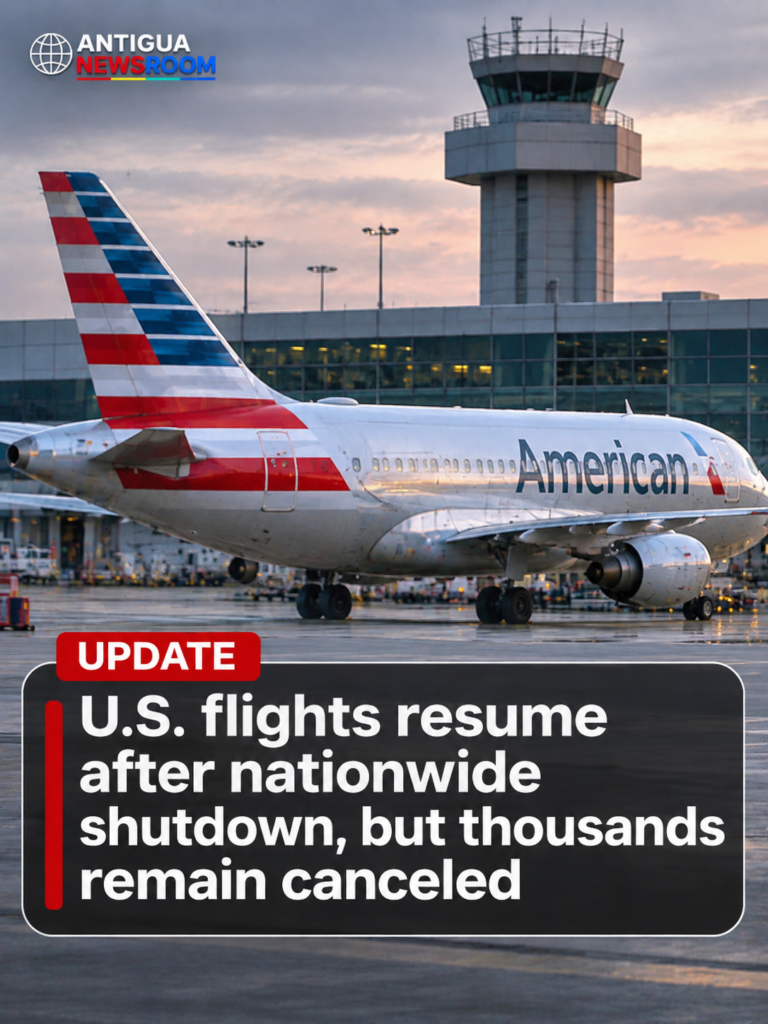
On the evening of Friday, November 13, the U.S. Federal Aviation Administration (FAA) formally lifted a sweeping nationwide ground stop that had barred all departing domestic flights for more than four hours, clearing the way for carriers to restart operations following one of the most severe air traffic disruptions to hit the United States in decades. The full reopening of U.S. airspace was confirmed at 8:15 p.m. Eastern Time, after agency officials completed rigorous stability testing of core air traffic management systems to verify no residual safety risks remained.
The cascade of disruptions unfolded earlier that Friday afternoon, when critical radar and communication infrastructure across multiple air traffic control centers began outputting inconsistent, unreliable data. U.S. Transportation Secretary Sean Duffy explained at a White House press briefing that the root cause of the glitch was overloaded switches and routers operating on the country’s long-aging air traffic control network, prompting regulators to impose the full departure halt as a strict precautionary measure to avoid safety risks. Duffy emphasized that at no point did the FAA lose full radar or communications functionality, and every one of the thousands of aircraft already in flight at the onset of the incident landed without incident safely across U.S. airports.
Even with the ground stop fully rescinded, the U.S. commercial aviation sector faces a steep, multi-day climb back to normal operations, with thousands of passengers confronting widespread last-minute cancellations, multi-hour delays, and missed connecting itineraries. Major U.S. carriers including American Airlines, Delta Air Lines, and United Airlines all reported heavy operational impacts. American Airlines stated it was prioritizing international routes and services to smaller non-hub cities as part of its phased recovery strategy, while Delta warned that repositioning aircraft, flight crews, and gate assignments back to their pre-disruption scheduled positions would require significant time.
The ripple effects of the U.S. air traffic chaos are spilling over to international travel as well, with travelers flying between the United States and Antigua and Barbuda, as well as passengers connecting through major U.S. hubs to reach other Caribbean destinations, facing elevated risks of itinerary changes and extended waits. No official count has been released for the exact number of flights specifically serving Antigua and Barbuda that were disrupted by the incident.
The high-profile system failure has reignited longstanding industry and regulatory concerns over the deteriorating state of U.S. air traffic control infrastructure. Secretary Duffy explicitly called on Congress to allocate roughly $50 billion in dedicated funding to fully modernize the decades-old network, noting that obsolete hardware and outdated software directly contributed to the overload incident. For its part, the U.S. Department of Homeland Security confirmed that ongoing investigations, supported by the National Security Agency, have uncovered no evidence to date that the disruption was caused by a malicious cyberattack, though full reviews of the incident remain active.
Friday’s multi-hour ground stop marks the second nationwide departure halt in less than two years, following a 90-minute system malfunction that disrupted U.S. flights in January 2023. Independent aviation analysts project that residual schedule disruptions could persist for three to five days, though federal transportation officials are optimistic the system will return to full normal functionality well ahead of the peak Thanksgiving holiday travel surge scheduled for later in November. All travelers with itineraries to, from, or transiting through U.S. airports are being strongly advised to confirm their flight status directly with their carrier before arriving at airport terminals, as carriers continue working through a massive backlog of displaced aircraft and passengers.