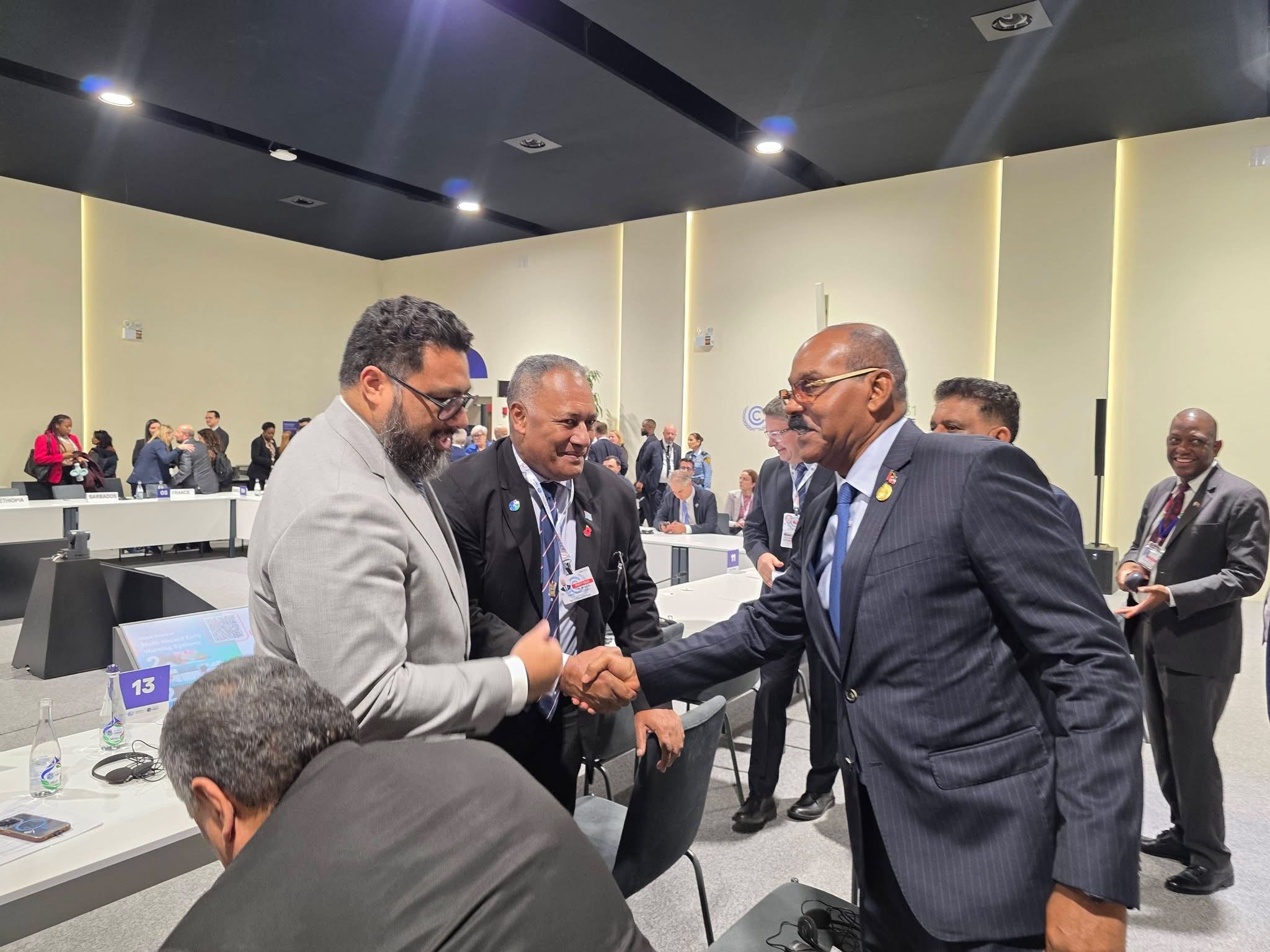
During a high-level global gathering focused on the United Nations’ “Early Warnings for All” initiative, Antigua and Barbuda’s Prime Minister Gaston Browne issued a formal, urgent appeal to the international community to ramp up targeted, long-term investment in end-to-end early warning infrastructure, rigorous climate scientific research, and continuous environmental monitoring for Small Island Developing States (SIDS) worldwide.
Browne grounded his call in the searing, lived disaster history of the Caribbean: he recalled the 2017 twin hurricanes Irma and Maria, which reduced nearly 90% of Barbuda’s built environment to rubble and forced the full evacuation of the island’s entire resident population, alongside 2024’s Hurricane Melissa, which inflicted catastrophic damage on Jamaica and surrounding Caribbean nations. These events, he emphasized, are not isolated incidents but a preview of escalating climate risks as shifting El Niño and La Niña weather patterns create increasingly unpredictable storm trajectories, coastal flood events, and sea level fluctuations across tropical island regions.
While Antigua and Barbuda has already aligned its national policy with UN Secretary-General’s 2027 target to deliver universal early warning coverage to all at-risk communities, Browne highlighted that SIDS face systemic, underfunded gaps that block meaningful progress. Unlike basic forecasting tools or public alert communication networks, the foundational data infrastructure for SIDS remains critically underdeveloped: vast swathes of coastal and marine territories lack long-term, consistent datasets tracking storm surges, accelerating sea level rise, and shifting coastal ecosystem conditions. “We cannot design adequate preparedness plans for hazards we do not measure systematically,” Browne noted, stressing that early warning investments cannot stop at hardware, but must prioritize sustained scientific research and ongoing environmental observation.
To close these gaps, Browne called for targeted operational support for specialized regional institutions, including the University of the West Indies Centre of Excellence for Oceanography and the Blue Economy, and the SIDS Centre of Excellence and its associated Global Data Hub, established under the Antigua and Barbuda Agenda for SIDS. These specialized bodies, he argued, are uniquely positioned to coordinate cross-island data collection and standardize monitoring protocols for the entire SIDS bloc, but currently lack the funding, advanced technology, and sustained operational backing to deliver on their full potential.
The Prime Minister also pushed global development partners to move beyond rhetorical pledges and accelerate the disbursement of accessible, predictable, primarily grant-based climate financing, with resources deployed to vulnerable nations well before disasters strike, rather than being reserved for post-storm recovery. He further emphasized that international support must extend far past the 2027 Early Warnings for All target, to ensure systems are maintained, updated, and accessible to every marginalized coastal community long-term. “The success of this global initiative will never be measured by the number of promises signed in conference rooms,” Browne concluded, “it will be measured by how many timely warnings reach remote island households, how many lives we spare, and how many hard-won community livelihoods we protect from preventable climate destruction.” Antigua and Barbuda formally reaffirmed its commitment to collaborating with all UN agencies, regional bodies, and global funding partners to advance this shared resilience agenda for SIDS.
Antigua and Barbuda Calls for Greater Investment in Early Warning Systems for SIDS