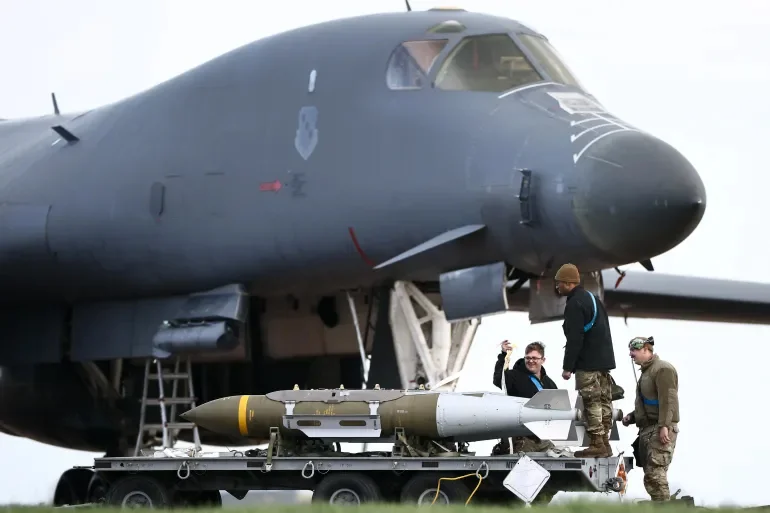
Rising frictions and open conflict with Iran have thrown decades of long-standing U.S. overseas military strategy into uncharted territory, as once-reliable forward operating bases that served as core security guarantees for Washington’s allies now find themselves high-priority targets for Iranian retaliatory strikes. For generations, American military installations scattered across Europe and the Middle East functioned as critical strategic hubs: they allowed U.S. forces to deploy rapidly to crisis zones across multiple continents, while serving as a tangible security umbrella for host nations aligned with Washington. That long-held dynamic has been completely upended by Iran’s proven capacity to strike these bases with affordable drones and precision-guided missiles, turning assets that once projected strength into high-risk liabilities.
This shift has created an unprecedented dilemma for host governments: while U.S. troop presence was once framed as a shield against external aggression, it now exposes their national territory to potential blowback whenever Washington becomes embroiled in regional conflict. Recent operational shifts in the United Kingdom offer a clear illustration of this evolving security landscape. In early November, U.S. forces carried out a large-scale redeployment of military hardware from British Royal Air Force sites, with flight tracking data confirming at least 10 KC-135 aerial refueling tankers and multiple Osprey tiltrotor transport aircraft departed RAF Mildenhall in eastern England on November 9 and 10, bound for alternate bases in Germany, Spain, and Scotland. The moves followed widespread intelligence reports of an elevated Iranian threat, though U.S. military officials have declined to confirm the specific trigger for the redeployments, noting that routine cross-base equipment transfers occur regularly for a range of operational reasons. Security protocols at RAF Mildenhall and the nearby RAF Lakenheath have been elevated to FPCON Charlie, the second-highest U.S. military threat level, reserved for scenarios with credible indicators of imminent hostile action.
The redeployment follows an earlier pullout of U.S. B-1 Lancer strategic bombers from RAF Fairford in southwest England, a site that had been actively used for American operational sorties targeting Iran. That withdrawal was initiated after British domestic security services uncovered an active suspected terror plot targeting the base. Concerns over potential attacks on UK military sites intensified further this week, after U.S. federal prosecutors unsealed indictments against three men accused of orchestrating a coordinated network of nearly 20 planned terror attacks across the U.S. and Europe, including the alleged plot targeting RAF Fairford. Court documents allege the suspects were directed by a ringleader incarcerated in a New York state prison, who coordinated operatives through intermediaries and encrypted communications. All charges remain unproven in court, and Iranian officials have categorically denied any state involvement in the alleged conspiracy, which comes on the heels of multiple related arrests carried out by British law enforcement earlier this year in connection with the Fairford security probes.
The vulnerability of U.S. forward bases is even more starkly documented across the Persian Gulf region, where Iran has launched repeated strikes on host nations hosting American military assets, including Kuwait, Qatar, Bahrain, the United Arab Emirates, Saudi Arabia, Jordan, and Iraq. A U.S. Department of Defense Inspector General’s report, cited by Al Jazeera, found that hundreds of structures and facilities at U.S. military sites across the Gulf were damaged or completely destroyed in the first four months of active hostilities with Iran. Targeted damage included U.S. aerial refueling tankers stationed in Saudi Arabia, early warning radar systems at Qatar’s Al Udeid Air Base, communications infrastructure at the U.S. Fifth Fleet headquarters in Bahrain, and extensive structural damage to American installations across Kuwait. These strikes have demonstrated that even heavily fortified, large-scale military complexes are no longer inherently invulnerable to modern low-cost drone and precision missile attacks.
A core driver of this shifting military balance is Iran’s massive investment in mass-produced, affordable unmanned aerial vehicles, which can deliver significant destructive impact at a fraction of the cost of the interceptor missiles Western nations typically deploy to shoot them down. This cost asymmetry creates a persistent, resource-draining challenge for U.S. defense planners, who must allocate increasingly large budgets to base air defense while adversarial forces can inflict meaningful damage with relatively low-tech, low-investment systems. Security teams also face expanding risks from insider sabotage and small-cell coordinated attacks, requiring constant vigilance not just against cross-border missile and drone incursions, but also against potential local infiltration and proxy operatives embedded within host communities.
These developments have forced Washington into a complex, high-stakes strategic balancing act. Overseas bases remain irreplaceable for projecting global military power and enabling rapid response to international crises, but their concentration in a small number of well-known locations creates a sprawling network of high-value, easily targeted liabilities. Partial mitigation measures, such as shifting some military assets to alternate sites including Israel, only redistribute rather than eliminate the risk, as those new locations also remain within range of Iranian strike capabilities. Expanded reliance on Israeli bases also risks further straining long-standing U.S. diplomatic and security partnerships with Arab Gulf states, which are prioritizing economic stability and regional de-escalation and have little incentive to be drawn into a prolonged, full-scale confrontation with Iran.
Spillover effects from these tensions are already rippling through global maritime commerce: while traffic through the strategically critical Strait of Hormuz showed tentative signs of recovery in October, Reuters data recorded 37 separate attacks on commercial shipping vessels during the month, keeping persistent pressure on global energy supply chains and regional economic stability. For U.S. allies across Europe and the Middle East, the once-unquestionable value of hosting American military forces is now the subject of urgent public and governmental debate, as policymakers weigh the promised security benefits against the rapidly escalating risks of being dragged into unplanned regional conflicts. The ongoing redeployments of aircraft and hardware are far more than isolated operational adjustments: they represent the opening of a fundamental reassessment of the entire future framework of U.S. overseas military presence, and the long-term willingness of allied nations to continue hosting American forces on their sovereign territory.
Amerikaanse bases niet langer vanzelfsprekend veilig