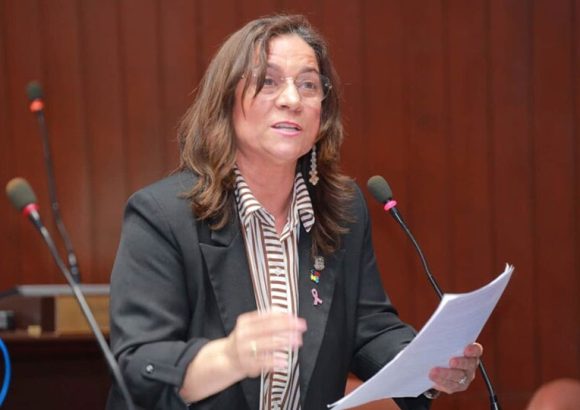
In a formal announcement made during a scheduled session of the Dominican Republic’s Chamber of Deputies, ruling Partido Revolucionario Moderno (PRM) representative Maribel Almánzar de Ogando has officially pulled her proposed identity document reform bill from legislative consideration, following explicit pushback from her party’s senior leadership. The draft legislation was initially designed to establish a targeted, special administrative pathway for Dominican citizens who had previously held valid national identity cards but encountered persistent bureaucratic barriers when attempting to renew their credentials, stemming from historical record irregularities or unsubstantiated administrative questions about their nationality status.
Almánzar moved immediately to refute widespread circulating claims that the bill was covertly structured to streamline national ID issuance for undocumented foreign residents, a criticism that gained traction among opposing legislators and segments of the public in recent weeks. The lawmaker emphasized that the core intent of the proposal was to strengthen protections for Dominican nationality, rather than undermine it, by resolving longstanding administrative bottlenecks that had left thousands of eligible citizens locked out of accessing official identification required for voting, banking, healthcare, and other essential public services.
The withdrawn framework laid out a structured case-by-case investigatory process for all applicants under the special mechanism: individuals able to provide verifiable proof of Dominican citizenship would be issued standard official national ID cards, while confirmed foreign nationals would be routed through existing regular immigration processing protocols aligned with their legal residency status. One particularly debated provision outlined a temporary, restricted official document marked “nationality not determined” for edge cases where electoral authorities could not immediately confirm an applicant’s citizenship status; this document was explicitly drafted to exclude voting eligibility, to prevent any potential misuse for electoral participation.
Almánzar openly acknowledged that this specific ambiguous clause sparked widespread public confusion, fueling unsubstantiated allegations that the legislation would create loopholes to formalize undocumented migrants, or even advance a hypothetical political unification agenda between the Dominican Republic and neighboring Haiti—claims she repeatedly and firmly rejected as baseless. She added that her decision to withdraw the bill was also influenced by a recent formal resolution released by the Central Electoral Board (JCE), the country’s leading electoral administrative body, which already addresses a subset of the issues her proposal targeted, most notably ID renewal barriers for citizens aged 60 and older.
The PRM party leadership formally opted to endorse the newly rolled out JCE administrative measure instead of advancing the legislative bill, leading Almánzar to step back from the proposal to align with her party’s collective position. In her floor remarks, she extended gratitude to fellow legislators and ordinary citizens who had voiced support for the original initiative, and pledged that she would continue advocacy work to resolve remaining gaps in the ID renewal system that leave eligible Dominican citizens stranded without valid official documentation. “There are still countless Dominicans facing unnecessary, unfair hurdles to renewing their national ID cards, and that issue will not be dropped on my watch,” she told the chamber, noting she would continue to consult directly with affected residents to develop targeted, consensus-driven policy fixes moving forward.