As of November 12, the political standing of Suriname’s Minister of Justice and Security Harish Monorath has become nearly untenable, following a cascading series of legal, financial, and procedural controversies tied to his prior tenure at the Telecommunication Authority Suriname (TAS).
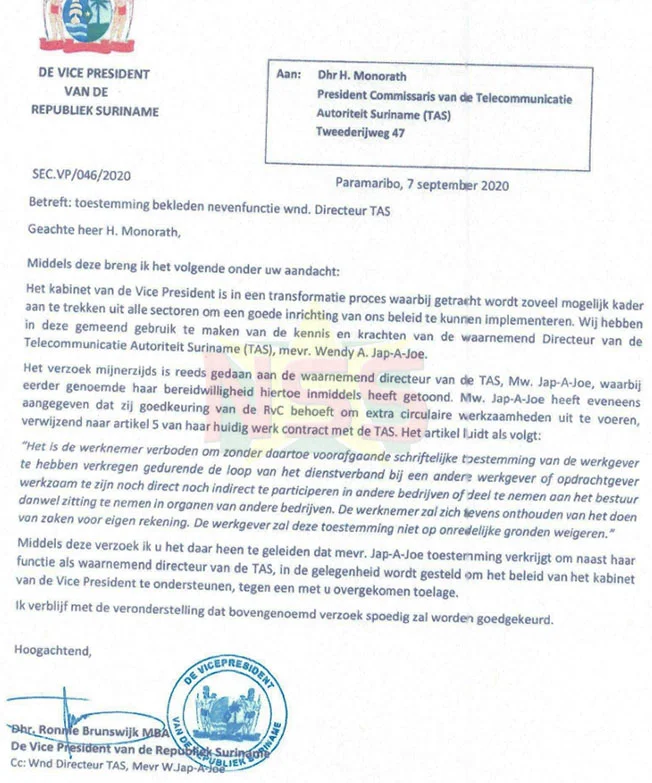
During recent closed-door coalition leadership meetings held across Tuesday and Wednesday, ABOP party chair and former Vice President Ronnie Brunswijk submitted a trove of previously undisclosed documents not used in prior TAS-related court proceedings, which he claims prove Monorath did not act independently when making high-stakes decisions during his time as TAS supervisory board president, while Wendy Jap-A-Joe served as the authority’s director. Brunswijk has publicly and privately rejected any potential dismissal of Monorath, framing such a move as a “declaration of political war,” and has stated he holds additional unpublicized dossiers detailing misconduct by senior members of the ruling NDP party that he is prepared to release if the minister is forced out.
The submitted records include both signed and unsigned government-level correspondence outlining side arrangements for secondary employment roles and cross-agency work assignments, but legal and regulatory experts emphasize that informal political approval does not equate to formal legal authorization for the actions in question. Core procedural violations have been confirmed by Transport, Communication and Tourism Minister Raymond Landveld, who testified to the National Assembly (DNA) that no official legal mandate exists to validate the 2021 employment contract Monorath signed on TAS’s behalf with Jap-A-Joe. Under Article 4, Section 4 of the Telecommunications Facilities Act, TAS director employment terms must be formally approved by the responsible minister after consultation with the supervisory board and full sign-off from the Council of Ministers — a process that was never completed, as even unsigned Council of Ministers documents do not constitute legally binding proof of required authorization.
The scandal also exposes massive unvetted public spending: TAS allocated tens of millions in public funds to compensate seven of its staff members for work performed for the then-Vice President Brunswijk’s cabinet, paying them 60% of their gross salaries under the label of “government sponsorship,” in addition to separate unreported payouts to Monorath and Jap-A-Joe documented by Suriname’s financial registry CEBUMA. Monorath, a licensed attorney, also held a separate formal employment contract with the former vice president’s cabinet while serving as TAS’s supervisory board head, creating a clear conflict of interest that violates the authority’s own governance rules, which prohibit the supervisory board president from being beholden to the director they are tasked with overseeing.
On November 5, TAS’s current supervisory board filed a formal criminal complaint with the Prosecutor General against both Jap-A-Joe and Monorath, alleging circumvention of mandatory legal procedures and unlawful financial enrichment that caused measurable harm to the state-run independent regulator. Three parallel official investigations are now underway: the Central National Audit Service (CLAD) is conducting a full administrative review, the TAS board has launched an organizational quick-scan, and a forensic accounting probe is underway to trace all misappropriated funds.
The crisis has placed President Jennifer Simons in an unprecedented high-stakes position, where her upcoming formal decision on Monorath’s tenure extends far beyond the fate of a single cabinet member. The timing of the scandal amplifies political pressure: the National Assembly is scheduled to hold an interpellation debate at 14:00 the same day to question the government’s public safety performance in response to a wave of armed robberies and violent murders, requiring Monorath, as the sitting security minister, to answer to lawmakers even as he faces active criminal investigation. Even if Brunswijk’s documents confirm Monorath followed informal political orders from the prior administration, legal analysts note that public officials cannot evade statutory accountability for violating clear governance rules — a standard that applies with extra rigor to a trained jurist in a senior oversight role. The standoff has laid bare the fundamental tension between ruling coalition political loyalty and the rule of law, with calls growing for a full, transparent audit of all TAS operations regardless of which senior political figures are implicated in the misconduct.
Documenten redden Monorath niet, positie onhoudbaar