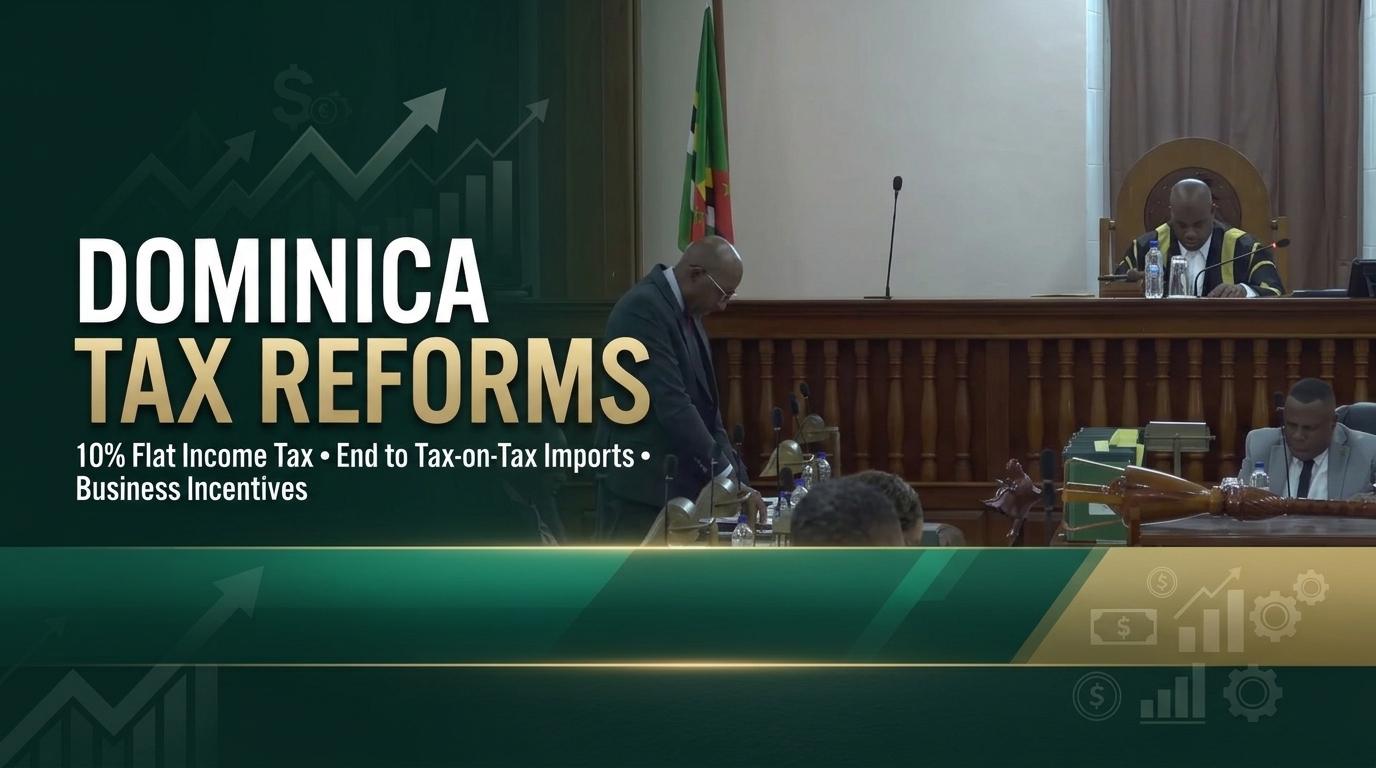
Following formal parliamentary approval of sweeping amendments to Dominica’s core tax legislative framework covering the Income Tax Act, Value Added Tax (VAT) Act, and Excise Tax Act, a comprehensive suite of pro-growth tax reforms tied to the 2026/2027 National Budget is set to roll out across the island nation, delivering tangible benefits to ordinary residents, consumers, and commercial operators alike. The overarching policy design targets four core public policy goals: lifting personal disposable incomes, streamlining convoluted import taxation protocols, spurring new formal job creation, and drawing expanded domestic and foreign private investment to the Eastern Caribbean jurisdiction.
The most transformative adjustment to personal income tax rules will take effect on 1 January 2027, replacing the previous tiered income tax structure with a single, uniform 10 per cent flat rate for all employed taxpayers. Finance Minister Dr. Irving McIntyre emphasized that this structural overhaul will put more after-tax cash directly into the pockets of working households, freeing up additional household spending power that is projected to ripple through local consumer markets and stimulate broader grassroots economic activity.
For the import and commercial sectors, a landmark set of VAT and excise tax revisions will go live three months earlier, on 1 October 2026, eliminating the longstanding cascading taxation practice where levies were repeatedly applied on top of previously assessed tax charges for imported goods. Under the new simplified regime, both VAT and excise duties will be calculated exclusively using the standard cost, insurance, and freight (CIF) value of all incoming shipments. Minister McIntyre noted that this change will cut red tape for customs clearance, reduce short-term cash flow strains for importers, and deliver particular cost relief for individuals and businesses importing high-value goods including motor vehicles, which previously faced layers of stacked taxation that inflated final purchase costs substantially.
The amended tax code also introduces a first-of-its-kind disaster preparedness incentive tailored to Dominica’s high exposure to regional hurricanes and extreme weather events. Eligible registered businesses will be permitted to divert up to 0.5 per cent of their annual gross revenue to dedicated, regulated Business Vulnerability Funds, with all such contributions fully deductible from their annual taxable income. Firms can accumulate reserves in these funds up to the total net book value of their insurable physical assets, though all withdrawals for emergency recovery or resilience upgrades must receive formal sign-off from the Comptroller of Inland Revenue; unauthorized withdrawals will be reclassified as taxable income and subject to standard levies.
To accelerate private sector job growth, policymakers have reinstated a popular two-year employment tax rebate scheme that launches on 1 October 2026. Eligible employers that create and fill new permanent positions will qualify for a 2 per cent tax rebate calculated against the total salaries paid for each new role, capped at EC$600 per individual job and a maximum annual rebate of EC$10,000 per registered business. Starting in the 2027 income assessment year, commercial real estate investors that construct or carry out major, full-scale reconstruction of rental commercial properties will also be able to claim a 3 per cent annual deduction on all qualifying project costs, up to a maximum of EC$30,000 per year, for a full 10-year period following the date the completed building is opened for rental operations.
Rounding out the reform package, all imported garbage collection trucks will now be fully exempt from excise tax, a targeted adjustment designed to lower financial barriers for private waste management operators looking to partner with the state-run Dominica Solid Waste Corporation to expand island-wide waste collection coverage. Government officials have confirmed that private service providers will be invited to submit formal partnership proposals in the coming months, running parallel to ongoing public sector purchases of new waste collection vehicles. Taken as a unified package, these coordinated tax adjustments form a central pillar of the Roosevelt Skerrit administration’s medium-term strategy to cut operational costs for local businesses, raise the quality of accessible public services, and build far greater long-term economic resilience for the small island nation against external economic and climate shocks.