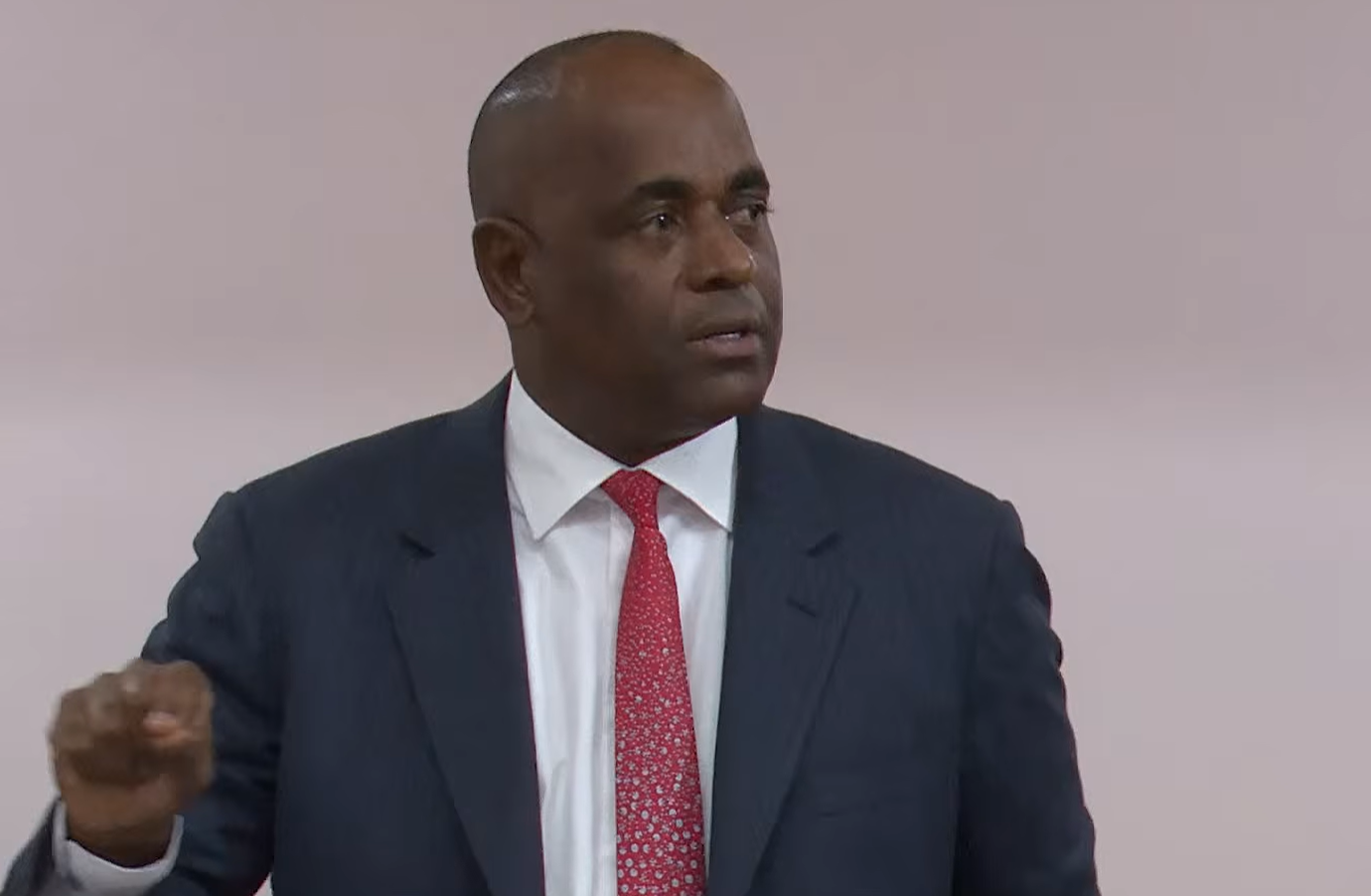
Roseau, Dominica – In a robust parliamentary address delivered Monday, Prime Minister Roosevelt Skerrit mounted a full-throated defense of Dominica’s long-running Citizenship by Investment (CBI) Programme, framing the policy as an irreplaceable pillar of domestic economic progress, employment generation, and grassroots entrepreneurial growth as the Caribbean nation faces a fast-approaching European Union regulatory deadline that threatens its citizens’ visa-free access to the Schengen Area.
Skerrit laid out a detailed case for the programme’s tangible on-the-ground impacts, noting that CBI-derived revenue has bankrolled critical public infrastructure, world-class tourism assets, and small business support schemes that would have been entirely unfeasible under the country’s regular national budget. The prime minister’s intervention comes as Dominica joins four fellow Organisation of Eastern Caribbean States (OECS) members – Antigua and Barbuda, Grenada, Saint Kitts and Nevis, and Saint Lucia – navigating dual layers of escalating diplomatic and regulatory scrutiny from both Brussels and Washington over perceived gaps in vetting for citizenship granted to foreign investors.
The five OECS nations face a November 12, 2026 formal response deadline set by the European Commission, following a June 2026 ultimatum from EU Internal Affairs and Migration Commissioner Magnus Brunner. The bloc has demanded that all five jurisdictions fully phase out their CBI schemes by June 1, 2028, or face immediate revocation of their nationals’ visa-free entry privileges across the 29-country Schengen Area. The EU’s position is legally underpinned by Regulation (EU) 2025/2441, a revised visa suspension mechanism ratified in late 2025 that explicitly classifies investor citizenship programmes that do not require a genuine residential or social tie to the host nation as valid grounds for revoking preferential travel access.
Compounding that transatlantic pressure, Dominica has already been subject to punitive travel restrictions from the United States since the start of 2026, under Presidential Proclamation 10998. The order, issued January 1, 2026, suspended new issuances of immigrant visas, B-1/B-2 visitor visas, F and M student visas, and J exchange visas for Dominican nationals, while shortening validity windows for other non-immigrant visa categories, over longstanding U.S. concerns that the CBI scheme previously granted citizenship with no mandatory residency requirement. Even after Dominica passed sweeping legislative overhauls of the programme in October 2025 – including binding minimum residency rules, enhanced multi-layered due diligence checks, and the creation of an independent regulatory oversight body – bilateral negotiations with the U.S. State Department to roll back the restrictions remain ongoing.
Against this backdrop of unprecedented external pushback, Skerrit emphasized that CBI capital has been deliberately directed toward productive, revenue-generating national assets, pointing to flagship internationally branded tourism developments including Secret Bay, Intercontinental Dominica, and the Ocean Oasis project linked to Ocean’s Edge developments. “Every job at the fully operational Ocean Oasis, every role at the InterContinental, every livelihood supported at Secret Bay exists directly because of investments this government made using CBI funds,” Skerrit told assembled members of parliament. “We must set the record straight for every Dominican citizen on this point.”
He further outlined that the administration has structured CBI financing to provide concessional, low-interest loans to existing hospitality operators to fund property expansions, facility modernization, and service upgrades to keep Dominica’s tourism sector globally competitive. A World Bank-commissioned independent impact assessment, Skerrit disclosed, projects that once all CBI-funded hotel projects reach full operating capacity, they will contribute an estimated US$40 million in annual recurring government revenue for public services.
Beyond large-scale tourism, Skerrit highlighted grassroots economic empowerment as one of the programme’s most underrecognized transformative legacies. Between the launch of the targeted small business grant scheme in 2009 and the close of the 2025–2026 fiscal year, the government has disbursed roughly EC$111 million in no-strings direct grants to Dominican small business owners, a separate support stream from low-interest loans offered via the Agricultural Industrial and Development (AID) Bank. A dedicated small business support unit established with CBI funding has catalyzed a “revolution in small business development,” Skerrit argued, pointing to upgrades for traditional cottage industries such as coconut processing, where government-funded industrial equipment has allowed local small-scale producers to move past labor-intensive manual production to higher-output, more profitable operations. For thousands of ordinary Dominicans, he noted, CBI-backed support has opened pathways to launch viable independent enterprises, earn stable long-term incomes, and build genuine economic autonomy – even as the programme’s long-term future hangs in the balance amid growing international regulatory pushback.