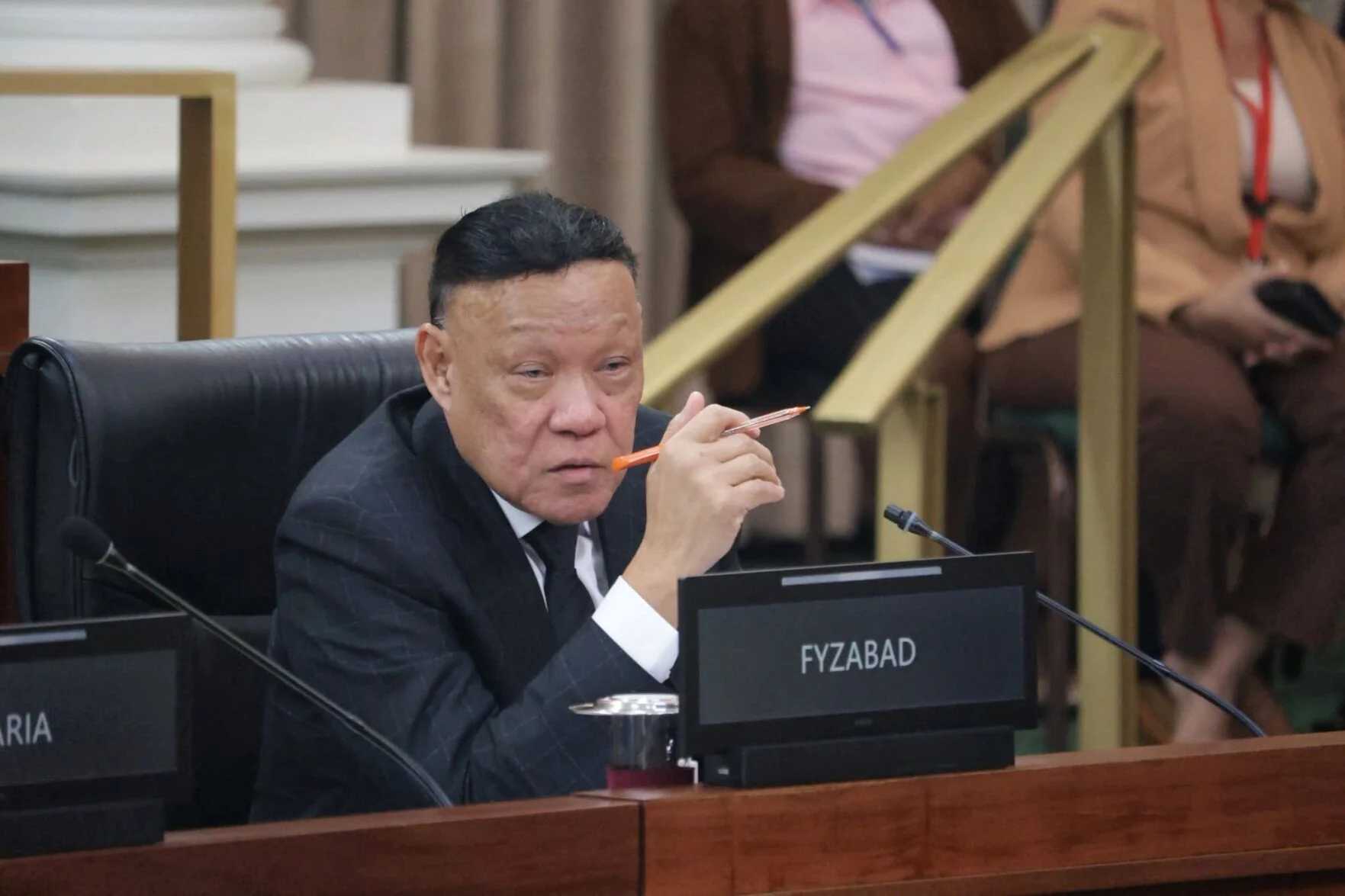
Trinidad and Tobago’s sitting Housing Minister David Lee has formally announced his intention to file an appeal against a recent High Court ruling that cleared the legal path for him to stand trial on charges of conspiring to defraud the state of approximately $1.4 million in tax revenue. The landmark ruling, delivered last Wednesday by Justice Westmin James, dismissed Lee’s long-running legal challenge to the Director of Public Prosecutions (DPP)’s move to revive dormant criminal proceedings against him, following his earlier discharge by acting Chief Magistrate Christine Charles in April 2025. In an official public statement released yesterday, Lee emphasized that the High Court’s procedural decision in no way constituted a finding of criminal guilt against him, noting that no judicial body has formally validated the allegations levelled against him. He confirmed that his legal counsel has advised him there are substantial, legally sound grounds for an appeal with strong prospects of success, and he will be pursuing all available appellate remedies. The local legal publication The Express notes that Lee’s legal team has 42 days from the date of Justice James’ ruling to submit a formal appeal filing to the court. Lee outlined that the initial discharge from the lower magistrate’s court came after a rigorous four-day preliminary enquiry, where the court reviewed testimony from 19 live witnesses and 29 sworn written statements. Magistrate Charles ruled at the time that the prosecution’s evidence was inherently so weak that even when interpreted in the most favourable light for the prosecution, no properly instructed jury could reasonably return a guilty verdict on the charges. Lee has repeatedly raised serious procedural concerns about the DPP’s subsequent actions, alleging that the prosecution filed its High Court application to reinstate the case on the very final day permitted by procedural rules, without providing him any advance notification or opportunity to present a defence. A warrant for his arrest was subsequently issued with no accompanying public explanation to justify overriding the magistrate’s original discharge ruling. The housing minister further contends that the entire process the DPP used to revive the case relies on the repealed Indictable Offences (Preliminary Enquiry) Act, which was formally superseded by the Administration of Justice (Indictable Proceedings) Act 2011. His legal team argues that using this defunct legislation violates core tenets of natural justice, procedural fairness, and his fundamental right to be heard before adverse legal action is taken against him. While Lee stated he fully respects the independence and institutional authority of the national judiciary, he noted he respectfully disagrees with the recent High Court’s judgment, and believes critical unresolved legal questions remain about the validity of the proceedings against him. In his original ruling, Justice James explicitly rejected all of Lee’s core legal challenges, upholding the DPP’s full legal authority to apply for the reinstatement of the criminal case. The central point of legal contention before the court was whether the 2011 repeal of the old preliminary enquiry legislation stripped the DPP of the power to seek a judicial review of the magistrate’s discharge decision. Lee’s legal team had argued the repeal eliminated that power entirely, while the DPP’s office maintained that the older legislation remained in full force for all cases that were formally instituted before the 2011 new law came into effect. Justice James sided with the DPP’s interpretation, ruling that Lee’s discharge by the magistrate did not automatically terminate the underlying criminal proceedings, and that parliamentary intent never defined a magistrate’s preliminary enquiry discharge as a full end to a case under either the old or new legislative framework. The judge further noted that Lee’s voluntary choice to proceed via a preliminary enquiry process, made on the advice of his experienced legal counsel, did not waive his subsequent legal rights, and demonstrated that the two legislative regimes could operate in tandem during the transition to the updated 2011 legal system. Justice James also rejected Lee’s claims of procedural unfairness related to lack of prior notification, pointing out that Lee had actively participated in the full preliminary enquiry process, benefited from the opportunity to cross-examine all prosecution witnesses, and successfully filed a no-case submission that led to his initial discharge. The judge additionally dismissed Lee’s allegation that the subsequent arrest warrant issued by Justice Hayden St Clair-Douglas amounted to an abuse of process, or that the judge had simply rubber-stamped the DPP’s application without proper review. Justice James noted that the DPP’s office had submitted the full, complete transcript of the four-day preliminary enquiry for the reviewing judge’s full consideration, and that the longstanding legal presumption of regularity applies with special force to decisions made by sitting judges. He characterized Lee’s claims of rubber-stamping as unsubstantiated speculation, not supported by any admissible evidence. The High Court ruling explicitly confirmed that Lee had no legal statutory right to be consulted or notified before the arrest warrant was issued, and that his arrest was carried out under a fully lawful warrant consistent with national due process requirements. Even as he rejected Lee’s immediate legal challenge, Justice James clarified that his ruling did not eliminate all of Lee’s legal options moving forward, noting that the housing minister retains the full right to apply to the eventual trial judge to have the proceedings permanently stayed as an abuse of process, or to raise any relevant procedural or evidentiary submissions during the upcoming trial. The underlying criminal allegations stem from a 2019 import transaction, where prosecutors claim Lee and local businessman Hugh Leong Poi conspired to defraud the state of approximately $1.4 million in unpaid taxes related to the import of a high-end Mercedes-Benz G63 AMG vehicle. In his public statement, Lee pushed back against what he described as misleading political commentary and public speculation that has incorrectly framed the High Court’s procedural ruling as a de facto finding of guilt. “While public officials must always be subject to rigorous scrutiny and accountability, that scrutiny must be rooted in verifiable facts, not unfounded assumptions,” Lee stated, emphasizing that procedural court decisions should never be misrepresented as findings of criminal wrongdoing. He affirmed that the presumption of innocence, due process, and procedural fairness are universal rights guaranteed to every citizen of Trinidad and Tobago, not special privileges reserved for a select few, and he intends to exercise those rights to their full extent. Lee also confirmed that despite the ongoing high-profile legal proceedings, he remains fully focused on his official duties as both Housing Minister and the elected Member of Parliament for the Caroni Central constituency. He noted he will continue advancing his policy priorities to address critical national housing shortages, expand accessible homeownership opportunities for low and middle-income citizens, and deliver tangible quality of life improvements for his constituents. “I will not allow partisan political speculation to replace established due process, nor will I allow these legal proceedings to distract me from the public responsibilities entrusted to me by the people of Trinidad and Tobago,” Lee said, adding that he maintains full confidence in the national judicial system and will pursue every lawful avenue available to clear his name. He concluded by stating that his decades-long record of public service, his commitment to national development, and his ongoing dedication to advancing the welfare of Trinidad and Tobago’s people will not be defined by unproven allegations or partisan political commentary.