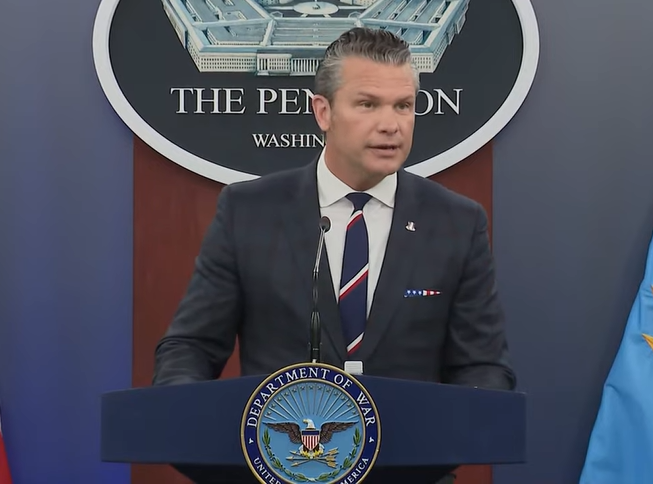
On Tuesday, November 10, 2026, at a Pentagon press briefing, U.S. Secretary of Defense Pete Hegseth forcefully rejected newly reintroduced articles of impeachment filed against him by Kentucky Republican Representative Thomas Massie, framing the congressional measure as a partisan stunt rooted in policy disagreements rather than any legitimate breach of public duty. The impeachment push marks the latest high-profile scrutiny facing a senior official in Donald Trump’s second presidential administration, as widespread public and legislative criticism mounts over the ongoing U.S. military conflict with Iran that has fueled domestic economic volatility and elevated cost-of-living pressures for ordinary American households. During his public remarks, Hegseth argued that no defense secretary should face removal proceedings for executing lawful, congressionally authorized military operations, emphasizing that the allegations against him fail to meet the constitutional standard for impeachment laid out by the nation’s founding framers. “It’s a farce, and it’s a stunt, and everybody knows it,” Hegseth told assembled reporters. “One disgruntled congressman wants to shred the impeachment clause over routine policy disagreements, not high crimes, not misdemeanours, not treason, not bribery — none of the offences the founders ever intended to justify removing a sitting cabinet secretary.” Hegseth went on to note that such policy disputes should be resolved through legislative debate and regular congressional oversight, not through impeachment proceedings that would effectively hand partisan opponents an opportunity to stage a public show trial even as Republicans hold majority control of both chambers of Congress. In a sharp contrast to the current scrutiny he faces, Hegseth pointed to the 2021 chaotic U.S. withdrawal from Afghanistan and the unaddressed Chinese surveillance balloon incursion over U.S. airspace during the Joe Biden administration, noting that former Defense Secretary Lloyd Austin faced zero impeachment votes even after those widely criticized national security missteps, including a multi-day unannounced absence from public duty that left the Pentagon without clear leadership. Beyond the ongoing Iran campaign, Hegseth defended a broader portfolio of aggressive U.S. military actions launched under the Trump administration over the past year, including maritime interdiction operations in the Caribbean targeting alleged drug trafficking vessels, and the special military operation that resulted in the capture and extradition of Venezuelan leader Nicolás Maduro to the United States to face criminal drug trafficking charges. He cited data showing more than 70 suspected narco vessels sunk, 218 alleged narco operatives killed, and a 65 percent drop in regional maritime drug smuggling rates as proof the Caribbean operations were saving thousands of American lives by cutting off illicit fentanyl and other dangerous drug supplies. Hegseth acknowledged the tangible human cost of these global deployments, confirming that no U.S. service members lost their lives during the Venezuela mission, but 18 troops have been killed in action during Operation Epic Fury, the U.S. military campaign against Iran. He noted he had personally traveled to Dover Air Force Base to receive the remains of those fallen service members, to honor their sacrifice. Under U.S. congressional rules, the impeachment articles against Hegseth would first need to pass by a simple majority vote in the House of Representatives before moving to a full trial in the Senate, where a two-thirds supermajority vote would be required to convict him and remove him from office. Given the current partisan makeup of the Senate, legal and political analysts widely agree that a conviction and removal is extremely unlikely to succeed.
Hegseth dismisses impeachment push as ‘farce’ amid mounting criticism over Iran war