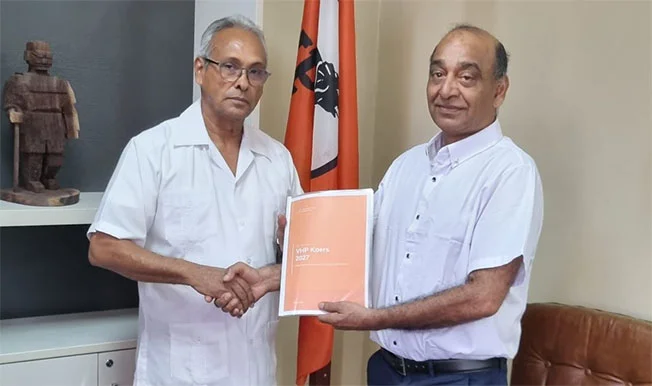
On November 11, local Suriname time, the Surinamese political party VHP’s Netherlands affiliate, led by chair Lachman Soedamah, formally presented its landmark policy document “VHP Koers 2027” to sitting VHP party leader Glenn Oehlers, launching a public debate over the party’s future direction ahead of its May 2027 leadership elections. The first candidate to respond publicly and in writing to a set of 20 probing questions distributed by VHP-Nederland is Armand Achaibersing, a former Finance Minister and leading contender for the party’s top post.
Achaibersing opened his response with an unprecedented admission of systemic failures during the VHP’s 2020-2025 term in national office. He noted the party’s devastating 2025 general election loss, where it dropped three parliamentary seats and lost more than 20,000 votes, as a clear rebuke from voters: longstanding core supporters stayed home, while first-time 2020 VHP voters abandoned the party over unmet expectations. The former minister acknowledged that the party’s top leadership became so consumed with national governance duties during its incumbency that internal party operations were largely neglected, creating a top-heavy structure disconnected from rank-and-file members. He further conceded that unresolved integrity scandals, which the party failed to address transparently and resolve publicly, had eroded public trust, and accepted partial co-responsibility for the heavy burden working-class households bore under the party’s necessary economic reform programs, noting that protections for vulnerable populations were insufficiently prioritized.
At the core of Achaibersing’s reform platform is a strict institutional separation between the roles of VHP party chair and the national presidency, arguing that both positions demand full, undivided commitment and carry distinct, non-overlapping responsibilities. He is pushing to amend party statutes to require the party chair to step aside from day-to-day party leadership immediately upon accepting a senior government post, and to cap the number of VHP central board members serving simultaneously in national government roles. Achaibersing also pledged to limit his own tenure as party leader to a maximum of two five-year terms if elected, and to expand rank-and-file influence over party decisions through regular digital consultations, local chapter assemblies, and an open party-wide debate on adopting a full “one member, one vote” democratic framework.
To root out patronage culture, the candidate called for an immediate end to the longstanding practice of rewarding political loyalty with public sector appointments, state contracts, or other material benefits. Instead, all candidate and public leadership selections will be based on verifiable expertise, personal integrity, and proven public service track records, vetted in advance by an independent party integrity commission. He also mandated annual public financial disclosures for the VHP, independent external auditing of all party accounts, and full public reporting of all donations exceeding a set threshold. For the broader public sector, Achaibersing pledged that the VHP parliamentary caucus would introduce legislation within 12 months of his election to establish an independent civil service recruitment and promotion commission, eliminating political favoritism in state hiring.
Achaibersing also laid out bold plans to make the party far more representative of Suriname’s diverse population: he reserved 5 of 25 seats on the next VHP central board for youth members, guaranteed winnable ballot positions for young candidates in the 2030 general elections, and committed to full gender parity in party leadership and equal male-female representation on all future election candidate lists. The new central board will also be structured to reflect Suriname’s full ethnic, religious, and geographic diversity, with no single demographic group allowed to hold a majority of seats.
On national economic policy, the former finance minister outlined a strict framework for managing Suriname’s future oil revenues, barring the government from pre-spending unearned oil income to avoid the “resource curse” pitfalls of unsustainable debt, runaway inflation, and systemic corruption. All oil earnings will be channeled into a dedicated national Savings and Stabilization Fund, overseen by independent third-party monitors, with public, regular reporting on all disbursements. The funds will be prioritized for long-term investments in education, public health, and economic diversification, to ensure benefits are shared across both current and future generations of Surinamese citizens.
Achaibersing committed to releasing a full, detailed public policy manifesto outlining both VHP internal renewal plans and national socioeconomic development strategies no later than March 1, 2027. VHP-Nederland, which emphasized its 20-question initiative is not intended to endorse any single candidate but to push the leadership contest to focus on policy rather than personal rivalries, welcomed Achaibersing’s detailed response and called on all other party chair candidates to publish their own visions for the VHP’s future. The full text of Achaibersing’s 20-question response has been published as an official annex to the VHP-Nederland policy announcement.
Achaibersing: VHP heeft integriteitskwesties onvoldoende aangepakt