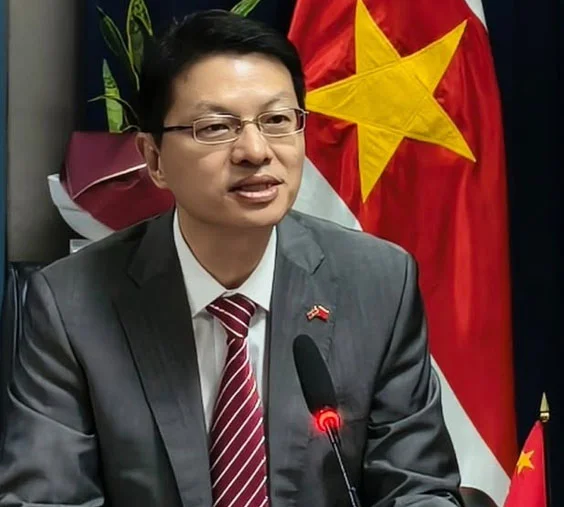
On November 10, Chinese Ambassador to Suriname Lin Ji released a formal written contribution drawing on outcomes from the 5th Plenary Session of the 20th Central Committee of the Communist Party of China (CPC), held in Beijing from October 26 to 29, 2026, to share evidence-based governance frameworks applicable to political parties and governments across all political systems.
Lin emphasized that meaningful anti-corruption efforts can never be contingent on the personal goodwill of individual political leaders, nor can they remain limited to rhetorical slogans and short-lived, ad-hoc campaigns. Sustained, robust oversight mechanisms, fully transparent governance structures, and unwavering long-term enforcement protocols are non-negotiable prerequisites to curb systemic corruption and rebuild eroded public trust in state institutions. He framed corruption as an existential threat to governmental credibility, social equity, and inclusive economic progress, noting that China’s decades-long anti-graft campaign has proven that durable institutional guardrails against power abuse are far more effective than over-reliance on individual leaders’ resolve. Key priority areas for targeted transparency include public finance management, government procurement processes, public resource allocation, and independent oversight of state-owned enterprise operations, with all state power required to operate within clearly defined institutional boundaries.
The ambassador’s second core principle holds that the success of governing parties and administrations must never be measured solely by top-line economic growth metrics or foreign investment inflow figures. Tangible, measurable improvements in ordinary citizens’ daily lives must serve as the primary benchmark for governance performance, with particular attention paid to advancing accessible education, affordable healthcare, stable employment, adequate housing, universal social security coverage, and streamlined public service delivery. Policy design must center the needs of marginalized groups including youth, low-income households, and other vulnerable communities, with civil servant performance evaluations tied directly to the number of real, solved public problems rather than the volume of unfulfilled campaign promises.
Third, Lin argued that national development planning cannot be constrained to the narrow timeline of a single election cycle or administration term. Long-term, consistent policy continuity is critical for progress on complex, cross-cutting priorities ranging from structural economic reform, energy transition, and technological innovation to education system upgrades, large-scale infrastructure rollout, and ecological conservation. For resource-rich nations such as Suriname that hold significant oil, gas, and mineral reserves, he stressed that natural resource revenue must be strategically reinvested in public goods, economic diversification, and sustainable development pathways to avoid the economic volatility associated with over-reliance on a single extractive sector.
Fourth, Lin highlighted that the capacity of state administrative apparatus is the backbone of successful policy implementation. Civil servant selection frameworks must prioritize professional expertise, personal integrity, and proven track records of delivery over other considerations, supported by clear role delineation across government agencies, improved inter-departmental coordination, and targeted deployment of digital tools to streamline public service delivery. National development, he noted, depends far more on institutional capacity to translate written policy into tangible public outcomes than on natural resource wealth or the sheer volume of published policy plans.
Finally, Lin explicitly clarified that no country is expected to fully replicate China’s governance model, given vast differences across nations in political systems, historical trajectories, cultural contexts, and developmental starting points. The CPC’s governance experiences are presented as a set of actionable reference points for global peer learning, for cross-national knowledge exchange on party building, anti-corruption system design, public administration optimization, inclusive economic growth, and living standard improvement, with every nation retaining full autonomy to adapt insights to its unique domestic circumstances.