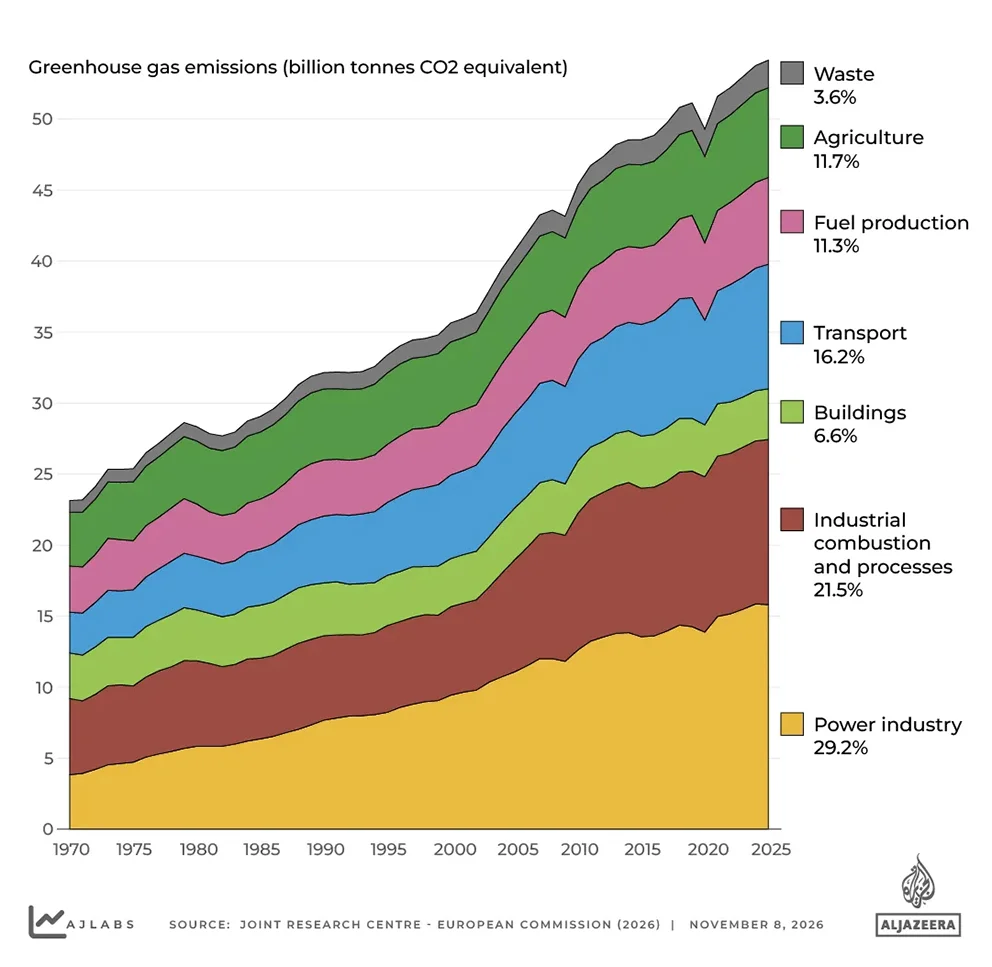
As global climate delegates convene for COP31 in Türkiye to negotiate the next phase of international climate policy, newly released 2025 emissions data from the European Commission’s Joint Research Centre (JRC) Emissions Database for Global Atmospheric Research (EDGAR) paints a stark picture of rising planetary pollution and deep inequity in both historic responsibility and climate risk exposure.
Total anthropogenic greenhouse gas emissions for 2025 reached 54.1 billion tonnes of CO₂ equivalent, marking a 0.7% year-over-year increase from 2024 and a 68.5% surge above 1990 levels, excluding emissions and sequestration linked to land use and forestry. Carbon dioxide accounts for 73.8% of total emissions, followed by methane at 17.6%, nitrous oxide at 5.3%, and fluorinated gases at 3.3%, with the vast majority of CO₂ output stemming from the combustion of coal, oil, and natural gas, compounded by deforestation that removes critical carbon sinks.
The global energy sector has emerged as the single largest emissions source, responsible for nearly 30% of 2025 total output, driven by soaring electricity demand in fast-expanding emerging economies. Industrial activity follows at 21%, while transport – including road, shipping, and aviation – contributes 16%, meaning the three sectors combined generate roughly two-thirds of all global greenhouse gas pollution.
Current annual emissions data reveals a small cluster of economies accounts for the overwhelming share of 2025 output: China tops the list at 29.5% (nearly 16 billion tonnes), the United States follows at 11.1% (6.02 billion tonnes), and India at 8.3% (4.51 billion tonnes), with the three nations combined responsible for almost half of global annual emissions. The 27 EU member states collectively contribute 5.8%, Russia 4.8%, Indonesia 2.5%, Brazil 2.4%, and Iran 2.1%. However, when measuring cumulative historic emissions since the start of the Industrial Revolution, the distribution shifts dramatically: the United States accounts for 23.5% of all historic CO₂ output, compared to 15.4% for China, reflecting over a century of unregulated fossil fuel use across North American and European industrialized economies. This distinction between current and historic emissions remains a core sticking point in UN climate negotiations, as developing nations argue wealthy industrialized states bear disproportionate responsibility for funding global decarbonization and adaptation efforts.
The report also spotlights the unique, precarious position of low-emission, forest-rich nations such as Suriname, which boasts 94.5% forest cover and is one of the world’s rare carbon-negative countries, sequestering more greenhouse gases than it emits. Suriname has pledged in its updated 2025 third National Determined Contribution (NDC 3.0) to retain its carbon-negative status through 2035 via forest conservation, renewable energy expansion, waste management upgrades, and coastal protection measures. Yet more than 80% of its population and most of its economic activity are concentrated in low-lying coastal zones, leaving the nation highly exposed to sea level rise, coastal erosion, saltwater intrusion, shifting rainfall patterns, and prolonged drought. The recent planned expansion of Suriname’s offshore oil and gas sector adds further complexity: while fossil fuel exports could deliver transformative revenues for national development, the industry raises critical questions about reconciling economic growth with global climate goals, even as emissions from exported fuels are counted in the consuming nation’s national inventories rather than Suriname’s.
This pattern of disproportionate risk for low-emission states is even more pronounced across the Caribbean, where small island nations collectively contribute a negligible share of global emissions but face catastrophic climate impacts. OECD data records 357 climate-linked extreme weather events across the region between 1980 and 2024, affecting 24 million people and inflicting average annual economic losses equivalent to 2.13% of regional GDP. In 2025 alone, Hurricane Melissa caused an estimated $12.2 billion in damages in Jamaica, equal to 56.7% of the nation’s total GDP. Tourism, agriculture, and fisheries – the backbone of most Caribbean island economies – are under growing threat from ocean warming, intensifying hurricanes, and freshwater source salinization.
For both Suriname and its Caribbean neighbors, the biggest barrier to building climate resilience remains inadequate, inaccessible international climate finance. While global funding mechanisms exist to support developing nation adaptation, complex application procedures, limited local implementation capacity, and crippling national debt burdens prevent most vulnerable states from accessing the resources they need. Many nations warn that poorly structured climate financing forces them to take on unsustainable new debt that crowds out critical social and development investments. Against this backdrop, COP31 negotiations for the region are not merely about broad global emissions reduction pledges, but about securing fair, accessible funding, recognizing differentiated historic responsibilities, and protecting vulnerable populations that have contributed almost nothing to the climate crisis.
Klimaatcrisis legt ongelijke verantwoordelijkheid bloot: grote uitstoters tegenover kwetsbare landen