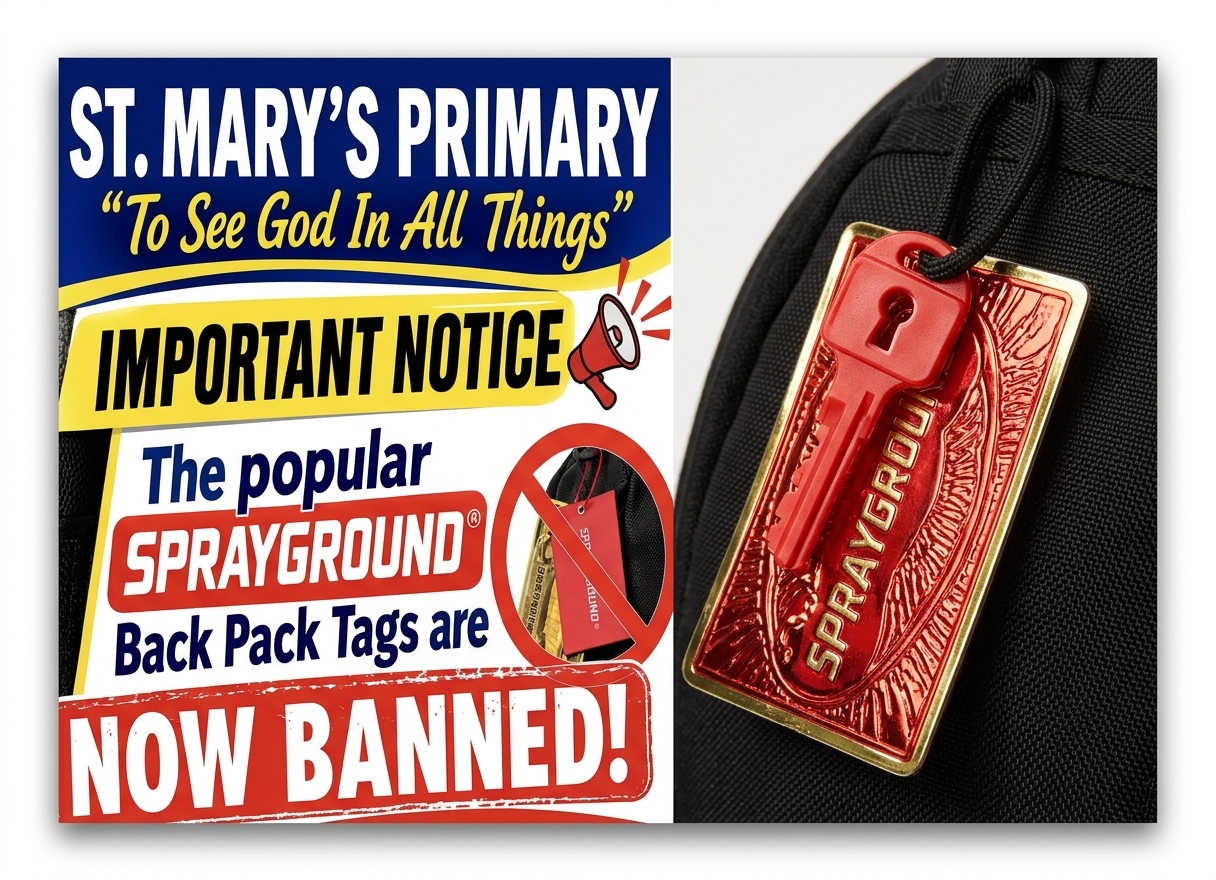
A long-established all-boys educational institution in Roseau, St. Mary’s Primary (SMP), has formally implemented a campus-wide prohibition on the branded hang tags attached to Sprayground backpacks, a popular luxury youth streetwear line. The official notice, shared as a public flyer on the school’s verified Facebook page, has sparked heated cross-community discourse spanning local parents, teaching staff, and education stakeholders across the wider Caribbean, centering on longstanding debates over student conduct, unregulated youth consumerism, and on-campus safety protocols.
The thick, glossy red and gold plastic tags that come affixed to Sprayground bags have far outgrown their original function as product identifiers, emerging as a coveted cultural status marker among young people across the region. Keeping the tag permanently attached to a backpack is widely seen as a tangible display of “street credibility” and proof that the bag is an authentic, high-value purchase. This widespread cultural fixation has spawned a viral social media-driven trend dubbed “tag snatching,” where students deliberately target peers to steal their coveted tags. The items have become so in-demand that thriving secondary resale markets now list the tags as standalone collectible goods, with many students taking extreme steps such as supergluing their tags directly to their backpack fabric to avoid having them stolen.
For SMP’s administrative team and teaching staff, the once niche youth trend rapidly escalated into a major disruptive disciplinary crisis. Multiple educators and parent supporters who commented on the school’s public announcement confirmed that the tags have directly fueled a surge in targeted bullying, petty theft, and even physical scuffles between students on school grounds.
One veteran regional educator publicly voiced full support for the new policy, emphasizing the massive operational burden the trend places on already overstretched school faculty: “When these tags go missing, the school is forced to divert critical instructional time to resolve the issue. Imagine having to sacrifice an entire first period after lunch to search for a tiny plastic tag, when I could be delivering a planned lesson to 35 other students who showed up ready to learn.” A second supportive community member noted that the authentic tags have warped into an unhealthy public display of household affluence, and that removing the tags from campus eliminates a core trigger for bullying, freeing both teachers and students to redirect their full attention to academic activities.
Reactions to the new policy on social media have been sharply polarized, laying bare deep generational and philosophical divides over school governance priorities. A large cohort of parents expressed profound relief over the ban, noting that the tags had spawned unnecessary, constant playground conflict and even unexpected financial friction, as some families had begun filing formal requests for the school to reimburse them for stolen tags. Many other parents added that they had already been proactively cutting the tags off their children’s Sprayground bags immediately after purchase to avoid running into campus trouble. A smaller group of commenters expressed open confusion over the new rule, questioning why a small plastic accessory could generate such widespread institutional attention, or mocking the school for issuing a formal official flyer for what they dismissed as a trivial concern. One skeptical local commenter wrote, “Next they’ll be trying to ban the tags sewn onto underwear and undershirts too.”
A vocal bloc of critics of the ban argued that prohibiting the physical tags entirely misdiagnoses the root of the problem. They asserted that school administrations should instead focus their enforcement resources on penalizing specific acts of theft and bullying, rather than banning the inanimate item that has become a target. One critic noted, “We cannot afford to pour disproportionate amounts of limited time and staffing into policing the contents of students’ backpacks while far more fundamental, unresolved barriers to our children’s educational progress go unaddressed.” One frustrated parent asked, “If next week students start stealing entire backpacks, will the school ban backpacks entirely?” Other critics added that many regional schools have a documented track record of ignoring far more severe instances of harmful bullying, while choosing to direct enforcement resources at minor, aesthetic youth trends.
As the new SMP policy goes into full effect, the Roseau school joins a rapidly expanding roster of Caribbean regional educational institutions working to decouple the pressures of aggressive, status-driven consumer culture from the safe, learning-focused environment of the K-12 classroom.
St. Mary’s Primary bans Sprayground backpack tags amid stealing and bullying concerns