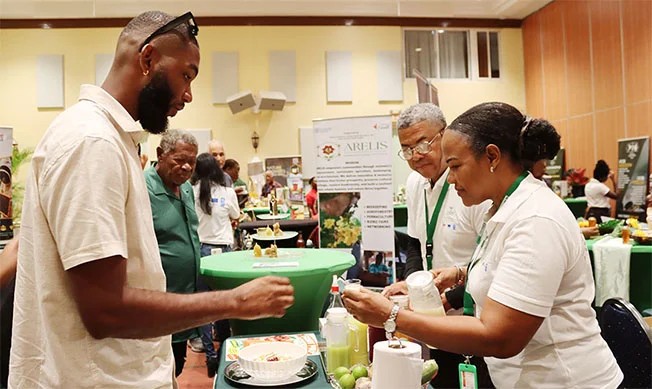
On November 7, 2024, Suriname’s Minister of Agriculture, Animal Husbandry and Fisheries Mike Noersalim delivered a landmark address at the opening ceremony of the three-day regional ‘Swit Okasi’ (Sweet Opportunities) conference, hosted at Torarica as part of the 13th Caribbean Beekeepers Congress and CARICOM Regional Honey Show. Noersalim framed youth and women as the core innovators that will drive the Caribbean beekeeping sector to evolve into a resilient, ecologically sustainable, and economically robust industry, calling for targeted investments in generational renewal, grassroots entrepreneurship, and forward-looking technological innovation across the region. The conference’s core agenda is focused on merging generations of traditional Caribbean beekeeping knowledge with modern sustainability frameworks and climate adaptation strategies, to safeguard pollinator populations amid rising climate volatility. Noersalim emphasized the non-negotiable role bees play in underpinning regional food security: while staple crops such as rice and corn do not rely on insect pollination, hundreds of nutrient-dense fruits, vegetables, and legumes critical to Caribbean dietary diversity depend entirely on bee activity. He warned that declining pollinator populations would erode the nutritional value of regional food supplies, reduce agricultural system resilience to extreme weather events, and threaten long-term livelihoods for smallholder farming communities. Beyond ecological and food security benefits, the minister outlined the vast untapped economic potential of the beekeeping value chain: raw honey, beeswax, propolis, and other hive-derived products are in high demand across food processing, natural cosmetics, therapeutic wellness, and even pharmaceutical sectors, creating scalable, low-barrier entrepreneurial opportunities for marginalized communities. Noersalim urged the 200+ regional beekeepers, policymakers, and development partners in attendance to move beyond theoretical knowledge sharing, and forge tangible cross-border collaborative partnerships to expand market access for Caribbean hive products. He extended formal recognition to key supporting partners, including the European Union, United Nations Development Programme via the Mangrove+ conservation initiative, the Inter-American Institute for Cooperation on Agriculture, and the Caribbean Beekeepers Association, for their ongoing technical and financial backing of regional pollinator protection work. The minister also paid special tribute to veteran local beekeepers, many of whom have sustained the sector for decades with limited resources, noting that their accumulated hands-on expertise forms the irreplaceable foundation for the sector’s future expansion. Over the three-day event, attendees will participate in hands-on technical workshops, peer-reviewed academic research presentations, and targeted policy roundtables, alongside the third annual CARICOM Regional Honey Show, which will showcase award-winning regional hive products, facilitate cross-border trade matchmaking, and raise public awareness of the economic and ecological value of local Caribbean beekeeping.