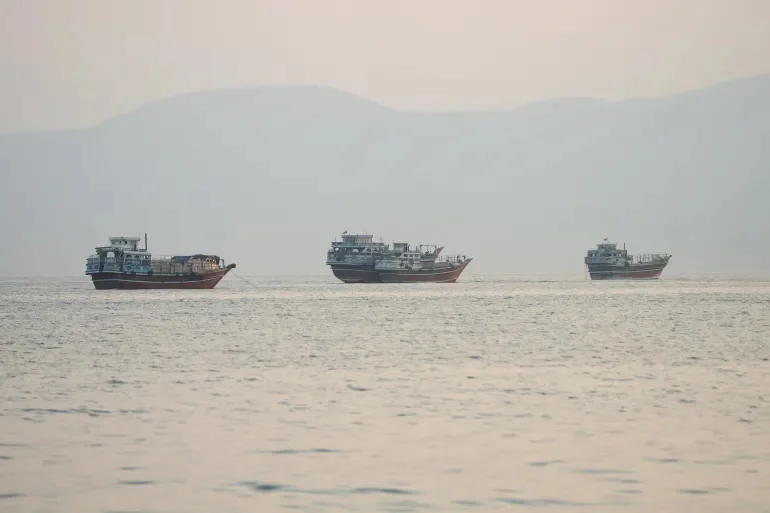
On November 3, senior Iranian parliamentary official Amir Hayat Moqaddam, deputy head of the Iranian Parliament’s National Security and Foreign Policy Commission, announced formal transit exemptions for vessels registered in India, China, Qatar, and Iraq from Iran’s previously imposed navigation restrictions across the strategic Strait of Hormuz, a 39-kilometer narrow waterway situated between Iran and the Omani Musandam Peninsula. The announcement, released via Iran’s state-run ISNA news agency, specified that Indian and Chinese flagged vessels will be required to pay official transit fees for unimpeded passage, Qatari ships will be granted full free access, and no formal fee structure has been finalized for Iraqi vessels. Moqaddam further noted that Tehran has secured explicit assurances that even U.S. naval forces will not intercept vessels from these four exempted nations during their voyage through the strait.
This targeted exemption framework was rolled out against a backdrop of sustained, months-long confrontation between Iran and the United States, which escalated after the outbreak of open hostilities between the U.S., Israel, and Iran on February 28. Iran first implemented broad navigation restrictions on the Strait of Hormuz immediately after that conflict erupted, and the U.S. responded by imposing a full maritime blockade on all vessels traveling to and from Iranian ports on July 13 of this year.
Tehran has framed the exemption policy as a mutually beneficial arrangement designed to advance its core economic and political priorities amid sweeping international sanctions that have crippled its domestic access to critical supplies. For India, the bilateral deal guarantees unobstructed Hormuz passage for its commercial fleet in exchange for steady shipments of life-saving pharmaceuticals and medical supplies that Iran cannot produce at sufficient volumes domestically. For China, which purchases nearly 90% of Iran’s total crude oil exports according to independent market data, the exemption is a deliberate move by Tehran to lock in Beijing’s long-term diplomatic and economic support, while generating much-needed new revenue from transit fees. Qatar, which shares a massive shared natural gas field with Iran and has served as the primary neutral diplomatic mediator between Tehran and Washington for months, receives full fee-free navigation privileges as a gesture of strategic goodwill. The exemption for Iraq, which maintains deep cross-border political and economic ties with Iran, is intended to support Baghdad’s post-conflict economic recovery by securing unimpeded access for its oil export shipments through the Gulf.
The Strait of Hormuz remains the single most critical chokepoint for global energy trade: data from leading maritime analytics firm Kpler shows that an average of 10.23 million barrels of Gulf crude oil passed through the strait daily in October 2024, with 42% of that volume bound for China and 13% bound for India, underscoring the outsized stakes for the global economy of keeping the waterway operational. Even with the new exemptions, significant ambiguity and risk remain. The U.S. has clarified that its existing maritime blockade only applies to vessels directly traveling to or from Iranian ports, while transiting ships heading to non-Iranian ports are not subject to interception – but Washington has not yet issued formal guidance on how it will treat exempted vessels from the four nations that are sailing directly to or from Iranian territorial ports. Iran has also not published clear regulatory language defining whether the exemptions apply based on vessel flag, ownership, operating company, or cargo origin, creating lingering legal uncertainty for shipping operators.
Safety risks for all commercial traffic in the region remain extremely high. Since the outbreak of hostilities in late February, more than 120 commercial vessels have been hit by attacks or suffered navigational incidents across the Gulf, with October 2024 recording the highest number of incidents of any month so far this year, according to data from the International Maritime Organization and UK Maritime Trade Operations. On October 30, Qatari LNG carrier *Al Mayeda* was struck by unidentified projectiles in Gulf waters, and between November 2 and 5, at least five additional commercial vessels – including two tankers that struck sea mines and one that caught fire – were involved in separate incidents near the Strait of Hormuz, with full details of the attacks still under investigation.
These cascading geopolitical and security developments have created highly volatile conditions on global oil markets. On November 6, international crude prices posted a modest uptick as fears of imminent new U.S. military strikes on Iranian infrastructure intensified, after U.S. President Donald Trump stated he would imminently decide between pursuing a formal peace deal with Iran and dismantling the remainder of Iran’s active military capabilities. Brent crude closed at $98.32 per barrel, while U.S. WTI crude settled at $90.83 per barrel, though both benchmarks posted sharp weekly declines as markets priced in growing optimism over potential diplomatic de-escalation. Qatari mediators continue to lead ongoing closed-door talks between U.S. and Iranian representatives, with negotiations covering the full reopening of the Strait of Hormuz, the lifting of the U.S. maritime blockade, the rollback of international sanctions on Iran, and restrictions on Iran’s nuclear program. Tehran has stated it will only enter broader formal peace negotiations after the U.S. removes the blockade and suspends punitive sanctions, and is deliberately decoupling immediate maritime navigation security issues from long-running nuclear negotiation tracks. For the foreseeable future, the Strait of Hormuz will remain both the linchpin of global energy security and a high-stakes geopolitical bargaining chip, with ripple effects of any further escalation set to impact economies thousands of miles beyond the Middle East.