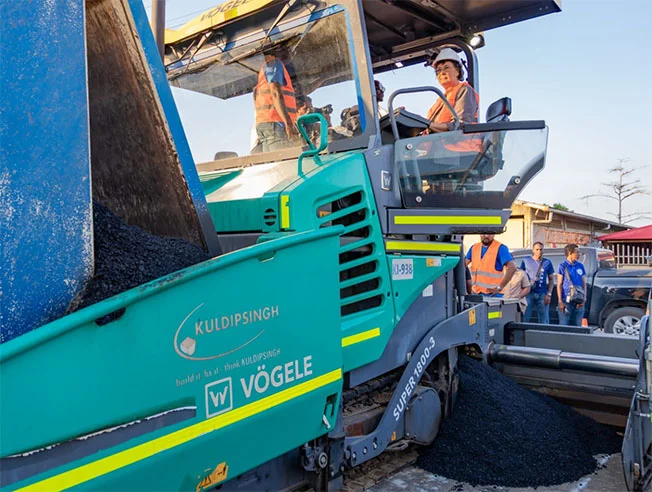
On November 6, Surinamese President Jennifer Simons officiated the launch of a long-awaited national road improvement program at Latour’s Franklynweg in the Paramaribo district, taking part in a symbolic asphalt-laying ceremony to mark the official kickoff. The first phase of the nationwide initiative will upgrade 160 kilometers of unpaved roads across three key coastal districts: Paramaribo, Wanica, and Commewijne, marking the government’s coordinated push to resolve decades of underinvestment in the country’s road network. Of Suriname’s total 5,000 kilometers of national roads, roughly half remain unpaved, translating to an estimated 2,500 kilometers of unimproved routes that would require a total investment of US$2.5 billion to fully pave, according to Public Works and Spatial Planning Minister Stephen Tsang. Given the scale of the required funding, the administration has structured the rollout as a staggered multi-year program scheduled to run through 2031, prioritizing high-impact routes including residential neighborhood streets, public bus corridors, and key logistics thoroughfares to maximize community benefit with available public resources. The inaugural site, Franklynweg, will receive far more than a new asphalt surface: construction plans include a dedicated sidewalk on one side of the route, speed bumps near adjacent school zones to boost pedestrian safety, and targeted upgrades to local drainage systems to reduce flood risk during heavy rain events. Private contractor Kuldipsingh Infra N.V. has been tapped to deliver the construction work, with independent oversight firm Buro CITE N.V. tasked with quality assurance to ensure compliance with engineering standards. During her address at the launch event, President Simons emphasized that the government cannot resolve the entire infrastructure backlog in a single fiscal year, noting the administration will prioritize expanding access to as many underserved communities as possible with allocated budgets, with annual works continuing uninterrupted until the 2031 target timeline. Minister Tsang noted that the road upgrades are designed to deliver far broader public benefits beyond improved travel access: smoother, more reliable routes will unlock new economic activity for local small businesses, cut transportation costs for commuters and freight operators, and support the planned expansion of new residential neighborhoods across the three target districts. Alongside the construction rollout, government officials outlined a set of shared stewardship guidelines for local residents and road users to protect the new infrastructure long-term. Minister Tsang issued a public warning against illegal waste dumping that clogs roadside drains and causes severe urban flooding during heavy downpours, and called on motorists to refrain from reckless speeding on the newly paved surfaces that could cause premature wear. Vikash Moenna, Deputy Director of Dry Civil Engineering Works, added that the new road is engineered for a maximum axle load of 8 tons, requiring freight transporters to adhere to the weight limit to avoid damaging the fresh asphalt, while also urging local families to keep children clear of active construction zones for safety. Paramaribo South District Commissioner Wennys Vijfhoven confirmed that unpaved, potholed roads and failing drainage systems have long ranked as the top public complaints from local residents, framing reliable paved road access as a fundamental public right rather than a discretionary luxury, and calling on communities to partner with local authorities to keep roadside drains clear of debris to preserve the new infrastructure for decades of use.
Regering begint met asfaltering van 160 kilometer weg; achterstand kost US$ 2,5 miljard