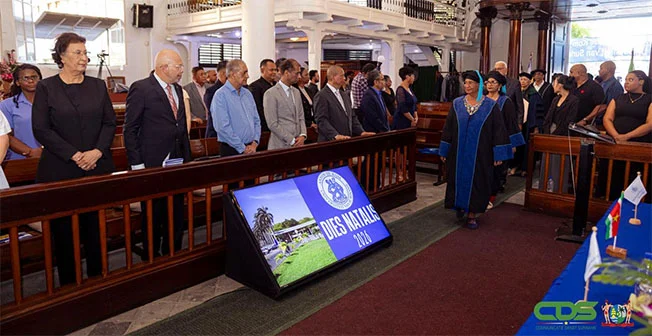
On November 6, 2024, officials gathered at the Centrumkerk in Suriname to mark the 58th Dies Natalis (founding anniversary) of the Anton de Kom Universiteit van Suriname (AdeKUS), with national leadership outlining a shared path to elevate the institution as a cornerstone of the country’s long-term development, while stopping short of announcing concrete, earmarked financial allocations. Presiding over the ceremony, Suriname’s President Jennifer Simons emphasized that the national government is formally committing to prioritize strengthening AdeKUS, noting that the university is currently navigating a critical transitional phase that requires aligned, collective action between state authorities, academic staff, students, and broader university stakeholders to upgrade conditions for teaching, research, and public community outreach services. The 58th anniversary celebrations were centered on the official theme “The role of AdeKUS as a leader in shaping the future of Suriname”, with keynote addresses delivered by prominent figures Silvano Tjong-Ahin and Maureen Lichtveld. Simons acknowledged that the government has full visibility into both the high-impact societal role AdeKUS is positioned to play in Suriname’s national development trajectory, and the full scope of operational and structural challenges the institution currently faces. She noted that the core priority moving forward is for all relevant parties to co-design targeted solutions and put in place the necessary foundational operational frameworks to enable the university to deliver on its mandate. Simons also announced that her administration will launch a new round of structured, multi-stakeholder consultations with the university’s executive board, alongside representatives from faculty, student bodies, and other internal university subgroups to co-develop support strategies, as confirmed by Suriname’s national Communications Department. While framing the government as the lead stakeholder driving institutional support, Simons stressed that meaningful progress requires equal buy-in and active contribution from lecturers, students, and all affiliated members of the AdeKUS community. “I will not make a promise to deliver any specific, pre-defined funding or resource allocation today. What I do commit to is my full personal and administrative dedication to advancing this institution, and in turn, I ask for your full dedication to the same shared goal,” Simons told attendees, adding that she is confident that coordinated, collective effort will enable AdeKUS to fulfill the critical national role that Suriname requires. Separately, Suriname’s Education Minister Currie laid out a detailed vision for an inclusive, future-focused AdeKUS that aligns its academic offerings and research agenda with the country’s evolving economic and social needs. He emphasized that expanded accessibility and elevated academic quality must progress in tandem, ensuring that young people from Suriname’s remote inland regions have identical higher education opportunities as their peers based in the capital Paramaribo, and that students living with disabilities have full, unobstructed access to all university programs and campus facilities. While referencing the rapid expansion of Suriname’s booming oil and gas sector, Currie stressed that AdeKUS must not narrow its research and training focus exclusively to that industry, noting that critical national priority areas including sustainable agriculture, ecotourism, public health, emerging technology, and climate change adaptation all demand targeted academic research and a pipeline of highly trained, specialized local professionals. Currie also advocated for reinforced academic autonomy, expanded innovation programming, and formalized cross-sector partnerships between the university, government bodies, private industry actors, and civil society organizations. He added that higher education curricula must also integrate targeted focus on student mental health support, character development, and the growing societal and operational implications of artificial intelligence. “Suriname does not merely need highly educated professionals. Above all else, Suriname needs citizens who are willing to step up and take active responsibility for the collective future of our nation,” Currie stated, concluding that AdeKUS must not only adapt to emerging future national developments, but proactively lead the process of shaping that future for the benefit of all Surinamese people.