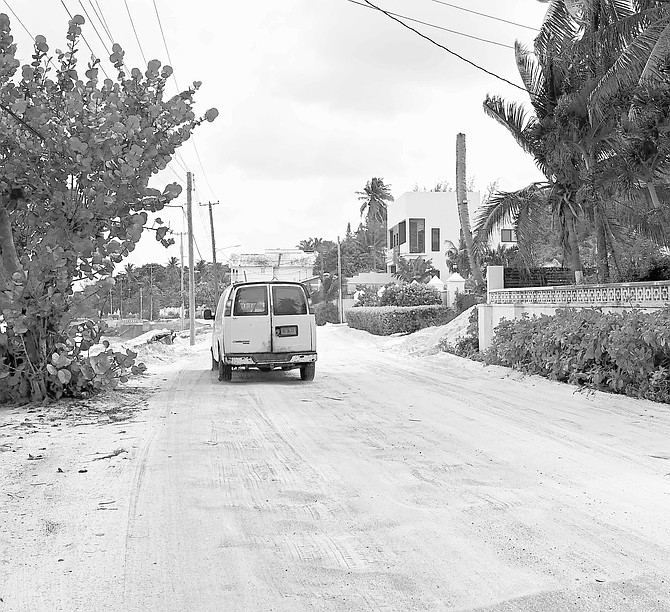
Residents, commuters, and local business operators across western New Providence are voicing mounting frustration over persistent, recurring sand buildup along the high-traffic West Bay Street corridor, which has created widespread traffic disruptions and growing road safety risks for all road users. The wave of public outcry emerged after on-site field surveys conducted by The Tribune last week captured extensive stretches of compacted sand lining the roadway near Gambier Village, with some piled sand mounds reaching as high as four feet along the roadside.
Affected commuters shared accounts that the sand deposits have lingered on the asphalt for weeks even after multiple partial cleanup attempts, rather than being fully removed. 60-year-old local driver Leon noted that formal sand removal operations only launched two to three days prior to the Tribune’s interview, despite the deposits being visible and creating hazards for far longer. Local small business owner Ricky emphasized that the issue has grown progressively worse amid recent bouts of severe weather, recalling that past hurricane events deposited far larger volumes of sand and even heavy rocks directly onto the paved road. He explained that the current ad-hoc cleanup approach, which relies on tractors to push loose sand to road shoulders, leaves a thin layer of compacted sand on the driving surface that vehicles grind into uneven, bumpy patches that can damage tires, wheel alignments, and undercarriages of passenger cars, while also forcing widespread speed reductions that snarl local traffic.
55-year-old restaurant operator Giorgio, a 20-year resident of The Bahamas, noted that while his large personal vehicle can easily traverse the sand-covered stretches, drivers of smaller compact cars are forced to creep across the uneven patches to avoid costly vehicle damage, creating further bottlenecks. He argued that the core root of the recurring problem is the roadway’s extremely close proximity to the shoreline, rather than broader climate trends, and warned that temporary cleanup operations will never deliver permanent relief. “When you build a road that close to the ocean, the sea will always remind you who is in charge,” he said, noting that sand will inevitably wash back onto the driving surface no matter how many times crews clear the pavement.
Killarney Member of Parliament Michela Barnett-Ellis confirmed that her constituency outreach team formally reached out to the Ministry of Works last week to request full removal of sand, rock, and coastal debris dumped across West Bay Street following recent king tide events. She noted that ministry crews dispatched to the site only completed partial clearance work near the Delaporte neighborhood before stopping operations, and that their approach of pushing sand to road shoulders is inherently ineffective as loose coastal sand will simply blow or wash back onto the driving lanes during the next high tide event. Barnett-Ellis framed the worsening hazard as a direct consequence of climate change driving higher, more frequent high tides, and warned that the risk extends far beyond minor traffic delays: unmitigated coastal erosion and wave action could eventually render the entire West Bay Street corridor completely impassable. She has formally called for targeted, long-term coastal defense infrastructure investments, including the potential construction of segmented seawalls along high-risk stretches of the shoreline adjacent to the road, to stabilize the coast and prevent future sand and debris incursions.
Works Minister Clay Sweeting addressed the growing public concerns during a press briefing on Tuesday, confirming that the ministry’s specialized technical assessment team is currently conducting full on-site evaluations to identify viable, sustainable engineering solutions that can stop recurring sand from washing onto the West Bay Street roadway permanently. Sweeting noted that the administration will review the technical team’s full findings before rolling out targeted mitigation measures to resolve the long-running hazard.
Frustrated residents complain about the repeated West Bay Street sand build-up