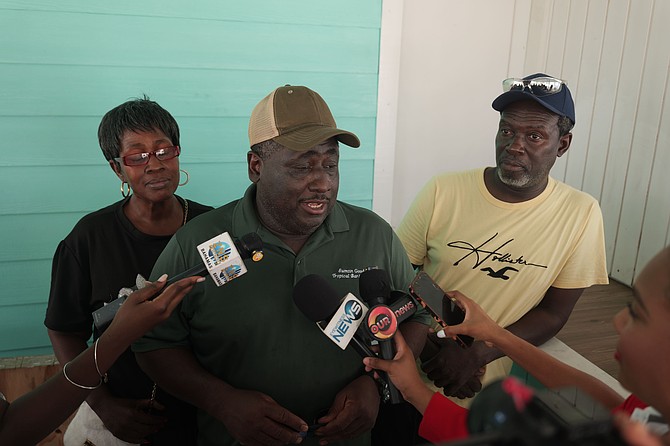
Nearly 12 months after a devastating blaze tore through Nassau’s iconic Arawak Cay Fish Fry, destroying six food stalls and inflicting severe structural damage on two additional units, the majority of impacted local vendors have yet to resume full reconstruction, as municipal officials finalize updated, more rigorous construction safety protocols designed to eliminate the risk of a similar catastrophic incident. Tribune Media staff reporter Earyel Bowleg joined members of the local press on an official guided tour of the fire-ravaged site yesterday, where affected food stall operators shared real-time updates on their ongoing recovery efforts ahead of the one-year anniversary of the November 16, 2025, fire. Lillian Laramore-Smith, president of the Arawak Cay Conch, Fish, Vegetable and Food Vendors Association, emphasized that affected operators have not abandoned their ambitions to return to the popular tourist and community dining hub, with collective plans to reopen upgraded, more resilient operations that outperform their pre-fire predecessors. She noted that vendors are awaiting an imminent formal government announcement that will deliver targeted support for fire survivors and all other operators at the beloved Fish Fry destination. “This fire, as devastating as it was, has unlocked so many collaborative opportunities for us. We are now seated at formal negotiation tables to secure targeted investments that will overhaul the entire site to ensure this kind of tragedy never repeats,” Laramore-Smith told reporters. She also revealed that the association is actively designing a group insurance scheme for all vendors, a solution crafted to address the major gap that left most operators without individual coverage at the time of the blaze. Only two of the eight vendors impacted by the 2025 fire have managed to rebuild their operations completely without any government financial support: Eddie Dormeus, owner of Brother Eddie’s Kitchen, and fellow operator Rodney Russell. Dormeus shared that he poured more than $100,000 of his own personal savings into rebuilding his business, navigating a grueling, makeshift restart process in the immediate aftermath of the fire. He recalled launching temporary operations on nothing more than a pair of wooden pallets while heavy construction equipment cleared smoldering debris from his plot, before shifting his entire kitchen into two repurposed vans to keep serving his loyal customer base while he broke ground on a small, permanent new building at the back of his property. “I knew I had to start somewhere, no matter how humble the setup, so I did whatever it took to keep my business running,” Dormeus explained. He noted that bureaucratic holdups around property documentation slowed down his full reconstruction timeline, and described the emotional weight of losing his entire decades-old business in the fire as an experience he would not wish even on his worst enemy. “When you are in that kind of crisis, the chaos and grief are completely indescribable. I lost every single thing I owned in that fire, so I had to build my entire operation back completely from the ground up,” he said. Despite the overwhelming financial losses, Dormeus said he prioritized retaining his longstanding customer community over rushing to rebuild a new physical structure, a strategic choice he credits as the sole reason his business survived the crisis. “My customer base was the one thing I never lost. I refused to fixate on replacing the building first, because the people who supported me for years are the real backbone of this business. That’s why I started on pallets, then moved to the vans, and now I have this new permanent space,” he added. Laramore-Smith praised Dormeus’ resilient, low-budget temporary setup, noting that his open-air dining model echoed the original, community-focused spirit of the early Arawak Cay Fish Fry, where visitors enjoyed fresh seafood meals outdoors. Association second vice-president Kevin Russell emphasized that the fire exposed longstanding gaps in the site’s aging infrastructure, fire safety protocols, and public investment, all of which local stakeholders are now working to resolve. He explained that the original Fish Fry was designed as a compact local fish market, with stalls built directly adjacent to one another with no fire separation, a layout that allowed the 2025 blaze to spread at catastrophic speed. New official rebuilding rules will now enforce strict minimum spacing requirements between individual stalls, eliminating the close-proximity layout that accelerated the 2025 disaster. Russell also noted that the local fire department has worked closely with vendors to roll out upgraded safety mandates, including requirements for all operators to install modern, high-capacity fire extinguishers, with all of these new safety rules set to become formal conditions for annual operating license renewals for all Arawak Cay vendors. The 25-member vendors association is currently in talks to welcome new local operator Ron Butterfield, who took over Big Boys Cafe after his brother passed away nearly two years ago. Butterfield, who currently runs a location on Robinson Road, is renovating a new Arawak Cay outlet to meet all the new upcoming safety standards, and has already partnered with Carnival Cruise Line to launch a popular visitor-focused boat tour experience tied to the Fish Fry destination. He expressed hope that local government will accelerate its ongoing support for vendors, who are already pouring significant personal capital into upgrading their operations to meet modern standards. “Arawak Cay needs to keep pace with global modernization, because tourists and local visitors expect our public dining hub to evolve with the times. We do not want any visitor to walk away saying the site needs upgrades. We want to lead the way, and we are counting on the government to walk alongside us as we make these major investments to build a safer, better Arawak Cay for everyone,” Butterfield said.