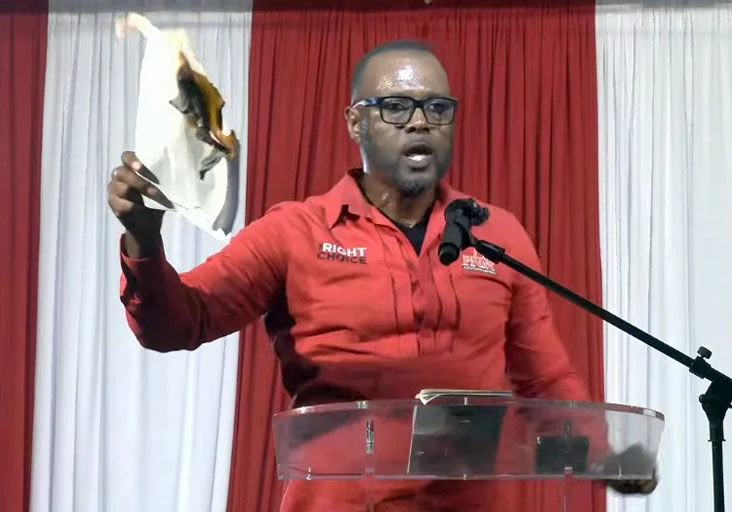
The Law Association of Trinidad and Tobago (LATT) has formally denounced the high-profile public burning of a court order by Marvin Gonzales, chairman of the ruling People’s National Movement (PNM) and a licensed attorney-at-law, describing the act as distasteful, unbecoming of a legal professional, and an unnecessary performative stunt, while announcing that the incident does not meet the threshold to trigger formal disciplinary proceedings against him. The ruling concludes a formal complaint filed by prominent attorney Aaron Mahabir, a former LATT Council member, who had raised alarms that Gonzales’ public act of defiance directly eroded public respect for the country’s independent judiciary. The controversy traces back to July 23, 2026, when Gonzales stood before party supporters and rolling television cameras at the PNM’s Balisier House headquarters and set fire to a court order linked to a judicially sanctioned inquiry into the construction and financing of the party’s headquarters, a probe that followed a prior investigation by the Trinidad and Tobago Police Service. During the public display, Gonzales declared the party would not be intimidated by the court document, and insisted the order would not be permitted to “desecrate the grounds” of Balisier House. The viral incident immediately sparked widespread debate over the ethical obligations of legal professionals, who are legally classified as officers of the court bound to uphold the authority of the judicial system. In a 6-page formal complaint submitted to LATT on July 31, 2026, Mahabir argued that the act was far more than a routine political protest, and represented a direct threat to public confidence in the administration of justice. “A court order is not a trophy, and it is certainly not kindling,” Mahabir wrote. “It is one of the clearest tangible expressions of the State’s judicial authority, and whatever grievance a litigant may hold against it must be pursued through formal court channels, not on a public political stage.” He emphasized that the harm was amplified because Gonzales was a licensed attorney, who was bound by the profession’s code of ethics to defend, not publicly undermine, judicial institutions. Mahabir also raised concerns that LATT’s initial silence on the incident could be misinterpreted as selective enforcement of professional standards, noting that the association had previously taken public action against other legal professionals, including former government minister Fitzgerald Hinds, over public statements that brought the administration of justice into disrepute. To support his case, he cited established disciplinary precedents from other common law jurisdictions, including the 2-year suspension of English solicitor Raymond McKeeve for destroying material covered by a court search order, and a Florida attorney suspension for public conduct deemed disrespectful to judicial authority, noting that professional bodies were empowered to take action in such cases independent of formal court contempt proceedings. Mahabir explicitly stated he was not requesting LATT to bypass established procedural safeguards or prejudge disciplinary findings, but was asking the association to issue clear public guidance on whether the public destruction of a court order aligned with expected professional standards for attorneys, to clarify the profession’s core obligations to uphold judicial authority, and to conduct a formal review of the Gonzales incident under its established disciplinary rules. In an official formal response dated October 20, 2026, LATT president Lynette Seebaran-Suite, SC, notified Mahabir that the association’s governing Council had completed a full, careful review of his submission, all relevant provisions of the Legal Profession Act Chapter 90:03, the profession’s Code of Ethics, and common law precedents related to the offence of scandalizing the court. The Council ultimately determined there was no sufficient legal basis to refer the matter to LATT’s independent Disciplinary Committee, and Seebaran-Suite confirmed she would not exercise her statutory powers under Section 37 of the Legal Profession Act to initiate such a referral. Even so, the association went to significant lengths to make clear it did not endorse Gonzales’ conduct, formally placing on public record its view that the public burning of a court order by a licensed attorney fell well below the standards expected of members of the legal profession. Seebaran-Suite also extended official thanks to Mahabir for bringing the critical issue to the association’s attention, acknowledging his longstanding contribution to upholding the reputation and public standing of Trinidad and Tobago’s legal profession.