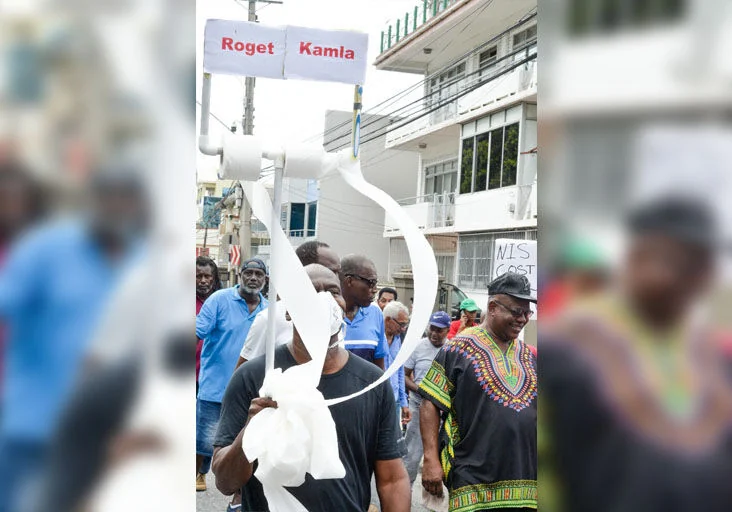
Trinidad and Tobago Prime Minister Kamla Persad-Bissessar has reaffirmed her administration’s commitment to fulfilling campaign pledges extended to trade unions that backed the United National Congress (UNC) during the most recent general election, while pushing back against criticism that her government has sidelined labour groups that did not support the party. The prime minister’s remarks came exactly one day after thousands of union members and private sector workers staged a nationwide street demonstration, demanding the administration follow through on longstanding promises to the labour movement and airing widespread grievances over the government’s contentious handling of industrial relations frameworks. When pressed by reporters to confirm whether formal negotiation channels would remain open with unions that took part in the recent march, and to clarify if her administration categorized labour groups into pro-government allies and hostile opposing stakeholders, Persad-Bissessar emphasized that her tenure has delivered tangible, material benefits to all registered unions, irrespective of their past political alignment. “We are absolutely dedicated to honoring every commitment we made to the unions that stood with us through the last election campaign,” she told the Sunday Express in an exclusive interview. She cited the Trinidad and Tobago Unified Teachers’ Association (TTUTA) as a concrete example of a non-UNC-supporting union that had received major wins under her leadership, noting that the group had successfully secured long-delayed salary increments and retroactive backpay for its educator members, a milestone many previous administrations had failed to deliver for years. Despite that acknowledgment, the prime minister went on to accuse a subset of union leaders of letting partisan political grudges and racial animus toward the UNC dictate their recent organizing and public advocacy. “That is the core reality here: many of these actors’ actions are rooted in deep-seated political and racial hatred for our party,” she stated. She went on to urge the faction of union leaders she labeled as “hostile” to abandon what she framed as self-serving, personal publicity-seeking tactics, and instead collaborate constructively with her administration to deliver tangible gains for the rank-and-file workers they represent. “These hostile union leaders need to stop chasing personal clout and work alongside the government to deliver real, measurable benefits for the members who elected them to represent their interests,” she added. In a separate line of commentary, Persad-Bissessar forcefully rejected widespread claims that a photograph she shared on social media showing a sparsely attended version of the recent union protest had been digitally altered to downplay turnout. She insisted that the demonstration never drew more than 450 attendees at its absolute peak, a figure far lower than the thousands of participants claimed by protest organizers. When responding to critics who publicly disputed the veracity of her shared photo, the prime minister launched a scathing rebuke of the protest’s organizers and their supporters, again framing their actions as driven by anti-UNC political and racial hostility. “Move on, haters and racists. Your protest was a total flop, and the vast majority of the national population wants absolutely nothing to do with your divisive racial and political hate campaigns,” Persad-Bissessar declared, adding sarcastically that “at its absolute highest point, there were only 400 to 450 real people there, and the rest were a hundred thousand ghosts that organizers claimed showed up.” She also issued a direct message to the small group of actual protesters who attended the march, urging them to return to their regular work duties the following day, leaning into the “ghost attendees” jab to mock organizers’ inflated turnout claims. The protest and the subsequent war of words over turnout have since emerged as a major flashpoint in ongoing tensions between the government and the national labour movement, with widespread public debate over both the actual size of the demonstration and the administration’s increasingly combative framing of labour advocacy. Turning to an unrelated public administration issue, Persad-Bissessar confirmed that she would launch a formal review of the recent water restrictions implemented by the Water and Sewerage Authority (WASA) across Tobago, after reports emerged that event organizers of the popular local “Stink and Dutty” fete had ignored the curbs and sprayed large volumes of water on partygoers throughout the event. When asked to comment on why the restrictions appeared to have been completely unenforced at the large public gathering, the prime minister noted that she did not yet have full clarity on the source of the water used at the event, and would need to verify details before taking further action. “I need to confirm all the facts first, because right now we cannot confirm if the water used to spray attendees was drawn from WASA’s regulated municipal supply, or if it was siphoned unfiltered from a local dirty river,” she explained. She also went on to question the widespread, unregulated practice of spraying large volumes of unidentified water on revellers at public fetes, noting, “I am always astonished that people willingly let themselves be hosed down with unknown water at these events, because in the vast majority of cases, no one has any way of verifying where that water actually came from, or what contaminants it might contain.”