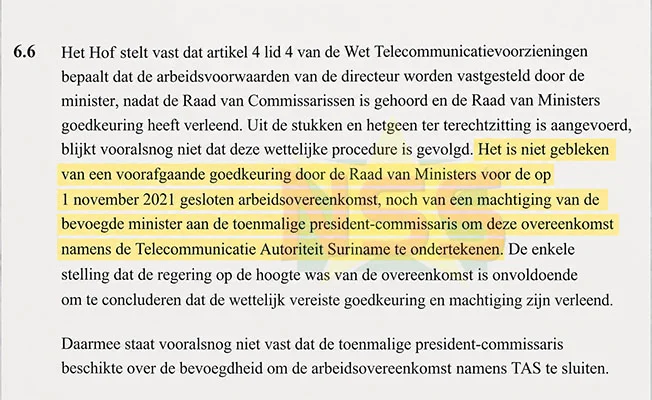
A recent landmark ruling from Suriname’s Court of Justice, issued on October 30, has concluded a string of consecutive legal defeats for Wendy Jap-A-Joe, former acting director of the Telecommunications Authority Suriname (TAS), by dismissing all her remaining appeals over her disputed leadership position at the public regulatory body. Beneath Jap-A-Joe’s well-documented legal losses, however, lies a far more consequential governance gap tied to the conduct of a sitting cabinet minister. The indefinite-term employment contract Jap-A-Joe relied on to claim continued tenure at TAS was signed in November 2021 by Harish Monorath, then TAS’s supervisory board chair and currently Suriname’s Minister of Justice and Security. No formal legal authorization for Monorath to execute that agreement on TAS’s behalf has been produced to date, a particularly notable oversight given Monorath’s professional background as a licensed attorney and former dean of the Surinamese Bar Association, who would have been uniquely positioned to understand public sector legal requirements. The court’s verdict confirms that Jap-A-Joe’s original five-year presidential appointment as TAS director, set to expire in October 2026, was legally terminated at the end of that fixed term, with no separate dismissal resolution required. Per Suriname’s telecommunications regulations, TAS’s supervisory board was legally empowered to take over day-to-day administration of the agency starting October 20, 2026, once her formal tenure lapsed. The disputed 2021 employment agreement has been provisionally suspended via summary judgment, with a full pending civil procedure required to issue a final ruling on its full invalidity. The core controversy now centers on unaccountable decision-making that bypassed explicit legal protocols governing TAS operations. Article 4 paragraph 4 of Suriname’s Telecommunications Facilities Act explicitly stipulates that the terms and conditions of TAS’s director employment contract must be set by the relevant sector minister, only after formal consultation with the TAS supervisory board and full approval from the Council of Ministers. The law grants no independent authority for the supervisory board chair to unilaterally sign such a binding agreement. Court document reviews confirmed no prior Council of Ministers approval, no ministerial delegation of authority to Monorath to sign the 2021 contract, no evidence that the full TAS supervisory board was notified of the agreement’s execution at the time, and no official records of the required approval steps on file at the Ministry of Transport, Communications and Tourism, the sector oversight body. This is not a minor administrative clerical error that can be retroactively corrected, the court emphasized: it strikes at the foundational rule of law principle that only legally authorized representatives can enter binding commitments on behalf of public institutions. As a veteran jurist and former bar association leader, Monorath was expected to clearly distinguish between informal administrative involvement and formal statutory decision-making authority, rather than unilaterally usurping powers the law explicitly assigns to the minister and cabinet. His prior defense that government officials were “generally aware” of the agreement cannot substitute for the formal documented approvals mandated by law, the court noted. The problematic contract went far beyond standard salary and benefit clauses: it included a provision claiming Jap-A-Joe could retain all director powers indefinitely after her original five-year presidential appointment expired, until a formal contrary legal ruling was issued, even though existing law already specified the supervisory board would take over interim administration to avoid any leadership vacuum. The agreement also included extremely high-risk financial clauses, requiring TAS to provide a minimum 24-month severance notice period and 36 full months of full salary plus all associated benefits if Jap-A-Joe’s employment was terminated for any reason not tied to proven professional misconduct, exposing the public agency to potentially millions in unbudgeted public expenditures. For Jap-A-Joe, the legal fallout is already fully enforced: she is barred from acting in any official capacity on TAS’s behalf, has been ordered to return all agency property and confidential data, and was ordered to pay SRD 18,000 in total legal costs after losing her appeal. But legal experts and opposition figures have pointed out that full accountability cannot end with Jap-A-Joe, as the other signatory to the unauthorized agreement is a senior cabinet official tasked with overseeing Suriname’s entire justice system and rule of law enforcement. The court did not issue a formal ruling on Monorath’s personal civil or criminal liability, but its documented finding that no legal authorization for his signature exists has triggered widespread calls for public explanation. The Surinamese presidency, cabinet, and National Assembly all have a formal obligation to launch a full independent investigation to verify if any financial or operational harm was caused to TAS by the unauthorized agreement, to demand full public transparency from Minister Monorath on his decision-making process in 2021, and to assess appropriate administrative or civil consequences if he is confirmed to have acted outside his legal authority in his former TAS role.