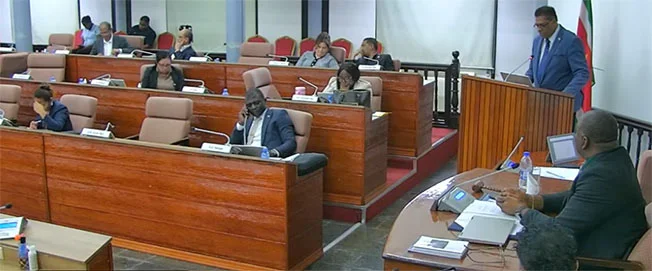
Paramaribo, Suriname – October 31: Ongoing revisions to Suriname’s Code of Criminal Procedure, a legislative package tied to the nation’s international anti-money laundering and counter-terrorism financing obligations, have been postponed for the fourth consecutive time following a rigorous second round of parliamentary review. During a Thursday plenary session, members of the National Assembly raised a cascade of substantive concerns, ranging from ambiguous statutory clauses and insufficient safeguards for expanded special investigative powers to unaddressed operational and privacy risks, prompting a full pause in the legislative process. The revised draft will first be circulated for expert review, with technical teams from Suriname’s forensic DNA agency and the Ministry of Justice and Police mandated to finalize their assessments no later than Monday, before the document is submitted to the National Legal Advisory Body (NAMLAC) for formal vetting. National Assembly Chair Ashwin Adhin noted that legislative leaders aim to resume committee deliberations within a 10-day window, though no definitive restart date has been formally scheduled. Lawmakers across party lines flagged a series of high-priority gaps in the current draft. NDP legislator Rossellie Cotino emphasized the life-threatening risks facing undercover operatives deployed against organized criminal networks, noting the bill lacks mandatory specialized training protocols, formal identity protection measures, and safety guarantees for operatives’ family members. She also raised questions about the proposed removal of existing Article 89, which governs court-authorized telephone wiretaps. Fellow NDP representative Ebu Jones highlighted unregulated provisions for deploying foreign undercover agents and civilian informants, warning that unclear eligibility rules for foreign operatives could undermine domestic legal jurisdiction, while unvetted civilian infiltrators pose risks of tampering with evidence or misusing criminal network contacts for personal illegal gain after their assignments end. Privacy advocates in the chamber, including VHP assembly member Kishan Ramsukul, pointed to a critical legal loophole in the draft’s provisions for recording devices: the bill outlines rules for installing surveillance equipment on private property but contains no framework for legally re-entering premises to retrieve the devices once a formal search warrant expires, creating both operational and privacy risks for innocent residents. His colleague Krishna Mathoera echoed the demand for explicit re-entry authorization clauses, alongside strengthened protections for attorney-client privileged communications and the private data of third parties unrelated to active investigations. NDP committee member Raymond Sapoen proposed a mandatory automatic logging system for all access to personal data collected during investigations, requiring every query to document the accessing official’s name, timestamp, case number, and legal justification, with regular independent audits to detect unauthorized access. He also pushed for tighter limits on searching personal mobile phones and computers, noting these devices often contain sensitive medical records, private family communications, and data belonging to parties with no connection to alleged crimes. Lawmakers also raised systemic concerns over independent oversight of the broad new investigative powers, which include long-term covert surveillance, digital forensics sweeps, and bulk communications data collection. The draft currently lacks clear thresholds for when a judge’s pre-approval is required for investigative actions, defined maximum durations for covert probes, and explicit penalties for law enforcement personnel who misuse their authority. No provisions currently outline protocols for notifying individuals who are wrongfully targeted for investigation, or formal processes to delete their collected data and award compensation for privacy harms. The session also addressed recent comments from Rapporteur Committee Chair Edgar Sampie, who stated that law enforcement agencies are already deploying certain unregulated investigative methods, including crowdsourced intelligence gathering via social media, that lack formal legal authorization, prompting demands for full transparency over existing unvetted practices. While NDP faction leader Rabin Parmessar acknowledged the significant time pressure Suriname faces to meet its international anti-financial crime obligations, he stressed that rushing the bill through without robust safeguards would create irreversible risks to civil liberties. VHP faction leader Asis Gajadien added that the sweeping new digital investigative powers could intrude deeply on ordinary citizens’ private lives and disrupt legitimate commercial operations, requiring additional layers of judicial oversight and clear lines of accountability for law enforcement overreach. Finally, multiple legislators flagged critical implementation gaps: current ministerial briefings confirm that police and justice agencies lack the full technical infrastructure, trained personnel, and operational guidelines required to execute the new powers responsibly. Lawmakers have proposed a phased rollout of the final law, restricting the most intrusive investigative tools from use until all supporting safeguards and operational capacity are fully established, alongside a formal public disclosure of the total projected cost of implementation and a clear timeline for capacity building.