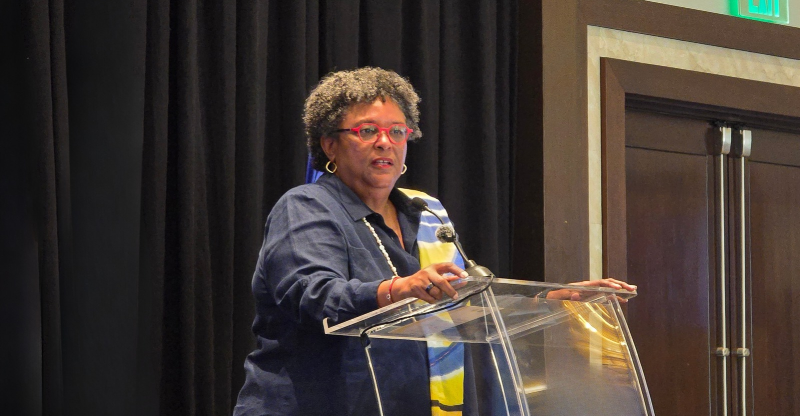
Barbadian Prime Minister Mia Mottley has formally signaled her administration’s readiness to launch structured, multilateral talks with the United Kingdom under the Caribbean Community (CARICOM) banner, even as a core rift over direct financial compensation for centuries of transatlantic chattel slavery remains unresolved between the two nations. Her Friday public statement came as a direct response to recent remarks from British Prime Minister Andy Burnham, who has broken with decades of prior UK government policy by voicing explicit openness to issuing a formal, state-backed apology for Britain’s central role in the transatlantic slave trade, while firmly rejecting the premise that contemporary British taxpayers should bear financial liability for historical atrocities in which they played no personal part.
Ahead of the upcoming Commonwealth Heads of Government Meeting (CHOGM) scheduled to take place in Antigua and Barbuda from November 1 to 4, Burnham laid out his administration’s proposed framework in a recent op-ed for *The Guardian*, expressing profound sorrow and regret for the intergenerational suffering inflicted by the British Empire’s slave trading operations. Instead of direct cash reparations, the UK premier has put forward a debt restructuring initiative for low-income Commonwealth nations, to be spearheaded by former British Prime Minister Gordon Brown, which would extend sovereign debt repayment timelines and negotiate drastically reduced, more favourable interest rates for vulnerable economies.
Mottley emphasized that lingering disagreements over financial compensation must not derail collective progress on the wide array of overlapping reparatory justice priorities where both sides can find common ground. “Dialogue matters because we are not yet on the same page on every element. On reparations in particular, our views differ, and we will say so plainly and respectfully. Honest disagreement on some questions should not hold back progress on the many others where we can readily agree,” she noted in her official statement.
For Barbados, these discussions carry uniquely heavy historical weight: in 1661, under early English colonial administration, the island enacted the world’s first formal slave code, a landmark piece of legislation that legally classified enslaved African people as disposable property and became the blueprint for discriminatory, exploitative slave laws implemented across nearly every other British colonial territory in the Americas. “That system was built by law and enforced by the State,” Mottley stressed, grounding the current calls for accountability in verifiable, state-sanctioned historical record.
The Barbadian prime minister outlined a clear roadmap for actionable, mutually beneficial progress across multiple priority areas that do not require immediate resolution of the financial reparations impasse: a formal official apology from the UK, targeted joint investment in regional public health and education infrastructure, cross-national development partnerships designed to dismantle systemic poverty and long-standing institutionalized anti-Black inequality, and fairer global sovereign debt arrangements aligned with the core goals of Mottley’s landmark Bridgetown Initiative. She also reiterated that all formal negotiations should be guided by CARICOM’s established Ten Point Plan for Reparatory Justice, and called for explicit, coordinated commitments from all participating governments to actively confront and eradicate persistent anti-Black prejudice across Commonwealth institutions and societies.
This upcoming round of engagement builds directly on the consensus reached at the 2024 Commonwealth Heads of Government summit in Samoa, where all attending national leaders formally agreed that the time had arrived for meaningful, good-faith dialogue on reparatory justice, even though no binding collective agreement on financial compensation was finalized at that gathering. Mottley specifically credited former British Prime Minister Sir Keir Starmer for helping to shepherd that historic 2024 consensus, noting that “That decision opened the door to the process now before us.”
Mottley also proposed expanding the negotiating table to include formal tripartite collaboration between CARICOM, the African Union, and the United Kingdom, arguing that the shared historical and contemporary stakes of addressing the legacy of the transatlantic slave trade extend far beyond Caribbean national borders. She went on to personally thank Burnham and UK Foreign Secretary Ed Miliband for their willingness to engage in these long-overdue discussions, framing their openness as a critical moral recognition that confronting unaddressed colonial harms is a necessary and long-overdue step for both nations and the broader Commonwealth community. Even as she acknowledged that full, unanimous agreement on every demand of the reparatory justice movement may not be achievable in the immediate term, Mottley reaffirmed her unwavering long-term commitment to advancing the cause. “I say simply, as I have said before: we are not necessarily expected to complete the task, but neither are we at liberty to resile from it.”