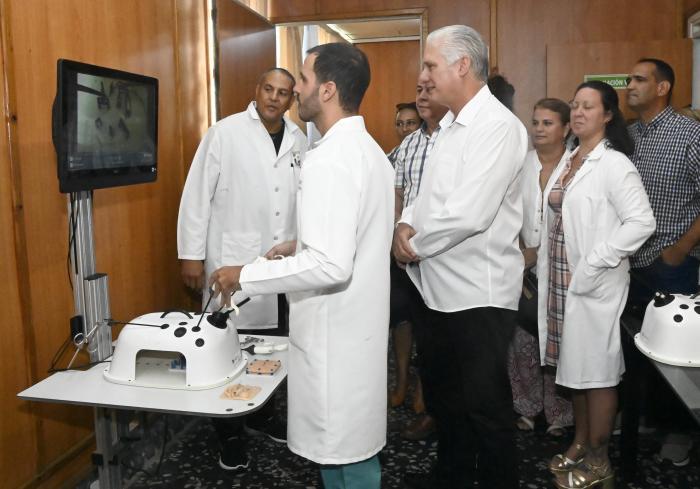
On October 30, 2026, Cuban First Secretary of the Communist Party Central Committee and national President Miguel Díaz-Canel Bermúdez conducted a two-part official work tour across Havana, first stopping at the renowned William Soler University Pediatric Hospital before moving to the Benigno water source facility in Cotorro municipality to assess progress on the capital’s city-wide Comprehensive Water Supply Program.
Accompanied by Public Health Minister José Angel Portal Miranda and top Havana provincial party and government officials, Díaz-Canel met directly with the hospital’s leadership, medical specialists and frontline care teams to recognize their unwavering commitment to delivering uninterrupted pediatric care amid severe operational constraints imposed by long-standing U.S. economic sanctions. The president emphasized that Cuban health workers have maintained full operation of all clinical services even amid crippling shortages of fuel, transportation, essential medications and reliable power, a feat he described as a testament to the collective heroism of the Cuban people. He further noted that the global recognition Cuba earned through its recent UN diplomatic victory was directly tied to the selfless dedication of medical staff serving both domestic communities and international humanitarian medical missions.
Hospital director Dr. Alena Fontane Valdés briefed the president on the institution’s suite of nationally leading specialized care programs, which include the Regional Neonatal Surgery Center, National Reference Center for Pediatric Liver Transplantation, National Reference Center for Airway Surgery and Autologous Esophageal Transplantation, and specialized units for stem cell implantation for Duchenne muscular dystrophy and obstetric brachial palsy surgery. Medical leadership shared that even under harsh blockade-related pressures, key clinical outcomes have continued to improve, including rising survival rates for critically ill ventilated neonatal patients and intensive care unit patients across the facility. Díaz-Canel toured key hospital spaces including the surgeon training virtual simulation classroom, telemedicine department and active surgical wards, where he spoke directly with young patients and their family members, and reaffirmed his administration’s support for ongoing digital transformation efforts to modernize pediatric care delivery across the country.
Following his visit to the pediatric hospital, the presidential delegation traveled south to the Benigno well field in Cotorro municipality, a critical supplementary facility for Havana’s eastern water distribution network that currently provides potable water to roughly 58,000 residents of San Miguel del Padrón municipality. During the assessment, Aguas de La Habana General Director Yosvany Rubí Bazail outlined ongoing infrastructure upgrade work, noting that all civil engineering projects for the Benigno well field have been completed, while parallel initiatives to reduce system-wide water leaks and install additional pumping equipment are progressing on schedule. Officials detailed a cross-agency strategy integrating distributed power generation and renewable energy solutions to address the persistent energy deficit that has long hindered consistent water pumping operations across the capital. In coordination with the National Electric Union, the first phase of the program is deploying large backup generator sets at key water supply pumping stations, with initial tests returning fully satisfactory results, though intermittent service disruptions continue due to the broader national energy crisis and unplanned recent breakdowns on major transmission mains such as the Cuenca Sur system, alongside delayed spare part imports for critical pumping equipment and temporary adjustments to power lines connected to new generator installations.
Díaz-Canel called for enhanced inter-agency coordination across participating bodies including the Ministry of the Revolutionary Armed Forces, deputy prime minister’s office, Ministry of Energy and Mines, and the National Institute of Hydraulic Resources to accelerate implementation of all planned upgrades, minimize service disruptions for Havana residents, and steadily expand reliable potable water access across the capital.