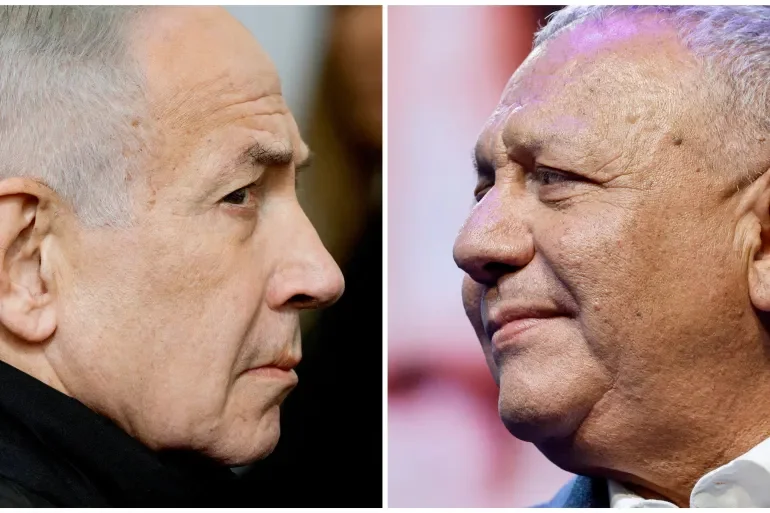
The full tabulation of votes for Israel’s latest Knesset parliamentary elections concluded on October 30, revealing a deeply fragmented political landscape where neither of the two dominant national political blocs secured the 61-seat threshold required for a governing majority in the 120-seat legislature. Incumbent Prime Minister Benjamin Netanyahu’s right-leaning faction claimed 53 seats, while the centrist opposition coalition led by former military chief Gadi Eisenkot secured 48 seats, leaving neither side able to form a stable government on its own. The two Arab-majority political lists, by contrast, secured a historic combined total of 19 seats, nearly doubling their representation from the 10 seats they held in the outgoing Knesset, catapulting them to a uniquely decisive position in upcoming coalition negotiations. Netanyahu’s Likud party remains the single largest individual faction in parliament with 27 seats, while Eisenkot’s Yashar party follows in second place with 21 seats. The Joint List, a coalition of Arab nationalist and left-aligned political movements led by Yousef Jabareen, won 11 seats, and the independent, community-focused Ra’am party headed by Mansour Abbas claimed 8 seats, marking the highest level of Arab legislative representation in Israel’s history. On paper, a partnership between Eisenkot’s 48-seat opposition bloc and the two Arab parties would yield a 67-seat commanding majority, but that mathematical feasibility is undermined by deep, longstanding divisions within the opposition over collaboration with Arab political factions. While left-leaning opposition figure Yair Golan of the Democrats has openly advocated for partnering with Arab parties to oust Netanyahu from office, and has already held preliminary talks with Ra’am’s Abbas, Eisenkot himself has previously ruled out any formal political alliance with Arab factions. Former prime minister Naftali Bennett, leader of the Beyachad party, and Yisrael Beytenu head Avigdor Liberman have also both publicly rejected any governing coalition that relies on Arab party support, with Liberman additionally stating he will not join a Netanyahu-led government either. One proposed workaround for the opposition would be to form a narrow minority government supported by external parliamentary backing rather than formal coalition membership, but that option also faces widespread political pushback from hardline factions on both sides. Meanwhile, Netanyahu’s Likud party has made unsubstantiated public claims of widespread electoral irregularities and potential foreign interference in the vote, with no concrete evidence of large-scale fraud released to date. Central Elections Committee chair Judge Noam Sohlberg has acknowledged receiving serious reports of suspected foreign meddling and has referred the allegations to Israel’s Shin Bet security agency for formal investigation, though officials have stressed no findings of systemic fraud have been confirmed. Eisenkot has publicly condemned Netanyahu’s efforts to discredit the finalized vote count, arguing that democratic election results must be respected and that state institutions should not be weaponized for partisan political gain. The competing allegations and deep partisan tensions have amplified existing national divisions that already ran high during the election campaign, which was dominated by fierce debates over Netanyahu’s controversial domestic policies, the ongoing military conflict in Gaza, and the long-term trajectory of the country. Official final election results are scheduled to be formally certified and published on November 4, after which Israeli President Isaac Herzog will convene consultations with all elected party representatives to select a designated lawmaker to lead coalition formation negotiations. The first assigned candidate will be granted a standard 28-day window to assemble a viable 61-seat majority, with a possible 14-day extension permitted under Israeli electoral rules. If that initial formation attempt fails, other parliamentary candidates will be given subsequent opportunities to build a governing coalition. Over the coming weeks, Netanyahu will retain significant political clout even without a pre-negotiated majority, while the Eisenkot-led opposition will face the steep challenge of reconciling its internal ideological rifts to court enough support to unseat the long-serving prime minister. For the Arab parties, their unprecedented 19-seat haul grants them unprecedented leverage to advance policy priorities for Israel’s Arab citizen population, but they face the dual challenge of navigating their own divergent political priorities and overcoming widespread opposition from Zionist factions to formal or informal partnerships. The final vote count makes clear that no single major political camp holds enough power to govern unilaterally, leaving the next phase of coalition negotiations to determine Israel’s governing path for the next legislative term.