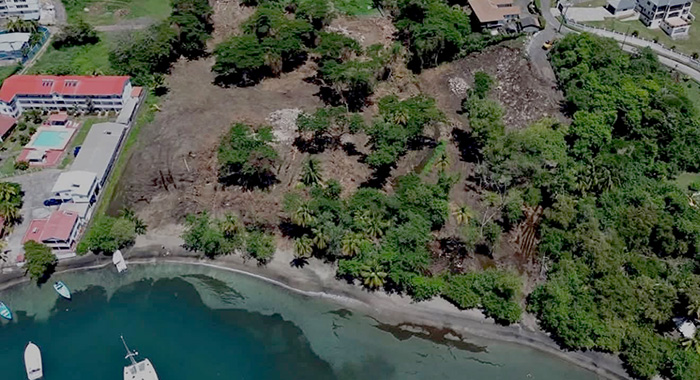
During a parliamentary sitting held on Thursday, October 22, 2026, St. Vincent and the Grenadines’ Minister of Physical Planning Nigel “Nature” Stephenson formally acknowledged that no existing national statute prohibits private landowners from felling trees — including ecologically critical mangrove stands — on their privately held parcels. The minister’s remarks came in response to a line of questioning from opposition senator Carlos James, who sought clarity surrounding the unauthorised removal of mangroves in the Canash coastal zone. James first asked whether the Physical Planning and Development Board had submitted any official briefings on the Canash mangrove clearance and associated adjacent development to the minister, before pressing Stephenson on whether he had considered invoking Section 30 of the Town and Country Planning Act to issue a formal directive ordering the board to take immediate action to mitigate or prevent site conditions that pose imminent or potential environmental harm. In his formal response, Stephenson outlined that local developer Rybeck Properties Ltd., owned by Ryan Gonsalves, had submitted a preliminary in-principle application for a new commercial apartment complex on December 16, 2025. The planning board formally rejected this application on March 26 of this year, with the board secretary signing the official refusal notice on April 27; a core set of reasons for the rejection centred on documented environmental risks to the local mangrove ecosystem. Crucially, Stephenson confirmed that no formal planning application was ever filed to authorise the mangrove felling that took place in recent months. He explained that the Physical Planning Board first learned of the full scale of the mangrove clearance only after the act had been completed, leaving the body with no legal pathway to invoke Section 30 powers to halt the destruction mid-operation, as existing statutory provisions grant no authority to restrict tree felling on private land without a prior approved planning submission. Opposition Leader Ralph Gonsalves had previously called public attention to the Canash mangrove destruction in a statement dated August 31, labelling the incident an “environmental massacre and marauding” occurring within the designated South Coast Marine Conservation Area. Stephenson further detailed the systemic gaps in existing environmental legislation that left the Canash mangroves unprotected. The 1992 Forest Reserve and Conservation Act only extends formal legal protection to forested areas explicitly named on its official schedule, which lists the Kings Hill Forest Reserve, Cumberland Forest Reserve, and Tobago Cays Marine Park — with no inclusion of the Canash mangrove stands. While the 1992 law establishes a legal framework to designate additional forests or mangroves as protected, the supporting operational regulations required to enforce these designations were never formally passed by successive administrations. Compounding these gaps, the Fisheries Act only offers protection to marine waters within the South Coast Conservation Area, with no provisions extending safeguards to adjacent coastal vegetation such as mangroves or beaches. Stephenson noted that years of cross-stakeholder work led by the National Parks, Rivers and Beaches Authority to formalise the South Coast as an official marine park never culminated in a legal designation, a decision he attributed to the former Unity Labour Party administration. A 2014 ecological assessment conducted by researcher Dr. Kimberly Barlwyn, prepared as part of the proposed South Coast Marine Park planning process, had explicitly flagged emerging threats to the Canash mangroves and recommended formal protective status, but no action was taken to implement those recommendations. Stephenson clarified that the cleared mangrove areas sit across two privately owned parcels, while a third adjacent parcel owned by the local Sailing Association retains its full mangrove cover intact. He added that the Canash site hosts only buttonwood mangrove species, with no red, black, or white mangroves present, and noted that a KFW (German Development Bank) funded sign installed at the site by the national parks authority falsely claims red mangroves are present and implies the area receives formal protected status, a claim he deemed entirely unsubstantiated. As a positive precedent for voluntary mangrove stewardship, Stephenson cited a Brighton site owned by Jerrol Thompson, where the landowner signed a voluntary perpetual protection agreement with the national Forestry Department to preserve local mangrove stands. He emphasised that under the current fragmented legal framework, the country’s mangrove ecosystems on private land remain “at the mercy of the individual property owner” with no statutory guardrails to prevent destructive clearing. The minister also clarified that a separate ongoing jetty development at Canash, approved on October 7, 2025, is being carried out by a distinct, unrelated landowner, with the planning board actively monitoring construction to ensure full compliance with approved plans. Stephenson closed his parliamentary address by framing the Canash incident as a urgent wake-up call for sweeping regulatory reform, and pledged that the ruling New Democratic Party administration will move rapidly to enact long-overdue regulations under the Forest Reserve and Conservation Act, extend formal protection to the Ashton Lagoon mangroves on Union Island, and finally formalise the long-delayed South Coast Marine Park to prevent future unregulated mangrove destruction across the nation.