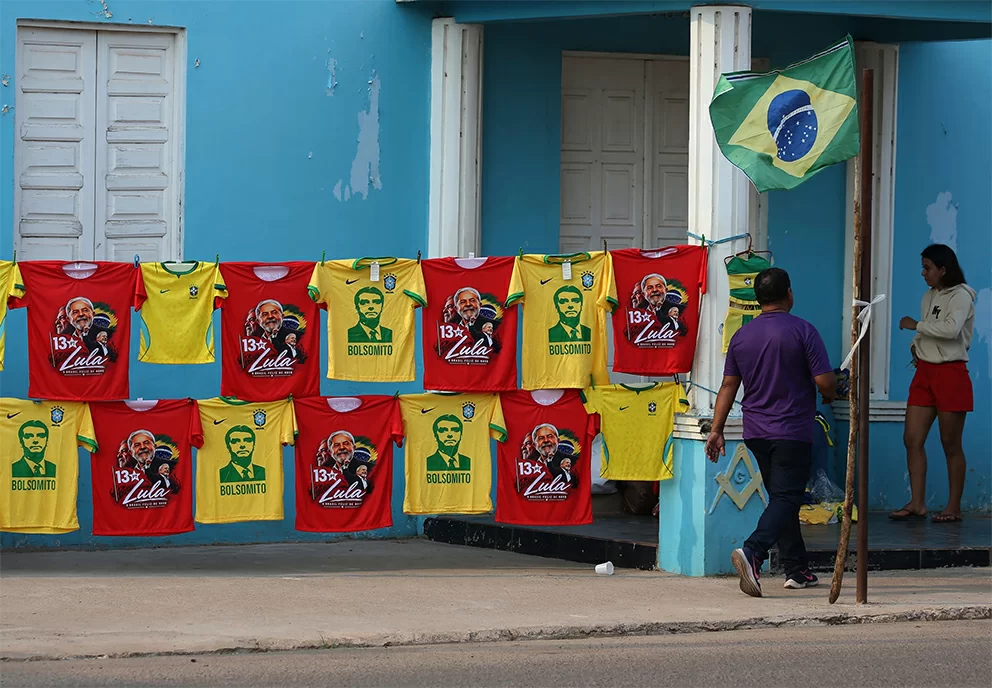
On October 25, millions of Brazilian voters headed to the polls for a decisive second-round presidential runoff that will chart the South American nation’s political, economic, and social trajectory for the next four years. The tightly contested race pits incumbent left-wing leader Luiz Inácio Lula da Silva, seeking re-election, against right-wing opposition senator Flávio Bolsonaro, eldest son of former far-right president Jair Bolsonaro. Weeks before polling day, campaign merchandise lined shopfronts across Amazonas state’s Autazes municipality: bright red t-shirts emblazoned with Lula’s portrait sat side-by-side with yellow shirts featuring Flávio Bolsonaro’s face, vividly illustrating the deep partisan rift gripping the country. The runoff was triggered after no candidate secured a 50%+1 majority in the October 4 first round, where Flávio Bolsonaro garnered 47.03% of valid votes, edging out Lula’s 45.16% by roughly 2.2 million ballots. In the final days of campaigning, opinion polls showed a dead heat, with margins falling within standard statistical error, leaving the final outcome entirely uncertain. Nearly 159 million Brazilians are registered to vote, following a first-round turnout of 125 million that saw 33.5 million eligible citizens stay home; voter mobilization of these non-participating groups is widely seen as the deciding factor in the race. Polling stations opened at 8 a.m. local time and closed at 5 p.m., with Brazil’s widely used electronic voting system set to deliver preliminary official results just hours after polls shut. For most voters, two core issues top their priority lists: sky-high cost of living surges and rampant public safety concerns. Lula, who previously governed Brazil from 2003 to 2010 and returned to the presidency in 2023, has centered his re-election campaign on expanding his signature social safety net policies, pushing for small business debt relief, free weekend public transit, and debates over a reduced 4-day work week to ease household financial strain. Flávio Bolsonaro, by contrast, has run on a platform of harsh anti-crime enforcement and targeted policies to drive down food prices, positioning himself as a champion for citizens frustrated with rising insecurity and eroding purchasing power. Both candidates carry significant legal baggage: Lula’s prior corruption convictions, which once led to a brief prison stint, were later annulled by Brazil’s higher courts, while Flávio Bolsonaro is currently under active investigation for alleged corruption, money laundering, and tax evasion, claims he has repeatedly denied and dismissed as politically motivated. Beyond domestic policy, the runoff carries massive stakes for Brazil’s global and regional influence. A key point of divergence between the two candidates is their approach to relations with the U.S. under the Donald Trump administration: Lula has openly criticized steep U.S. import tariffs on Brazilian goods and recent U.S. sanctions targeting a Brazilian judge involved in legal proceedings against former president Jair Bolsonaro, advocating for a more independent foreign policy path. Flávio Bolsonaro, meanwhile, has close political ties to Trump and has pledged to deepen bilateral economic cooperation, particularly around the extraction and trade of Brazil’s vast reserves of rare earth minerals and other strategically critical raw materials. As Latin America’s largest economy and most populous nation, Brazil’s election outcome will ripple across the entire region: a Flávio Bolsonaro victory would embolden far-right political movements across South America, while a Lula win would preserve the left-leaning governing bloc aligned with nations including Mexico. Environmental policy, long a global priority tied to Brazil’s Amazon rainforest, hangs in the balance as well: Lula’s administration has prioritized aggressive anti-deforestation enforcement and Amazon conservation, while Flávio Bolsonaro has signaled he would pursue looser regulations to expand agricultural and natural resource extraction. The race also carries a deeply personal political legacy dimension: Flávio Bolsonaro has centered large swathes of his campaign on securing amnesty for his father Jair, who is currently serving a 27-year prison sentence for crimes related to his 2022 attempt to subvert democratic election results after losing that year’s presidential contest. Lula, in turn, has repeatedly warned voters that a Flávio Bolsonaro victory would roll back years of democratic progress and unravel hard-won social gains for low-income Brazilians. As electoral officials begin tallying votes, every ballot carries unprecedented weight in a contest that will not only select Brazil’s next president, but define the country’s stance on social equity, climate action, global alliances, and the future of its democratic institutions.