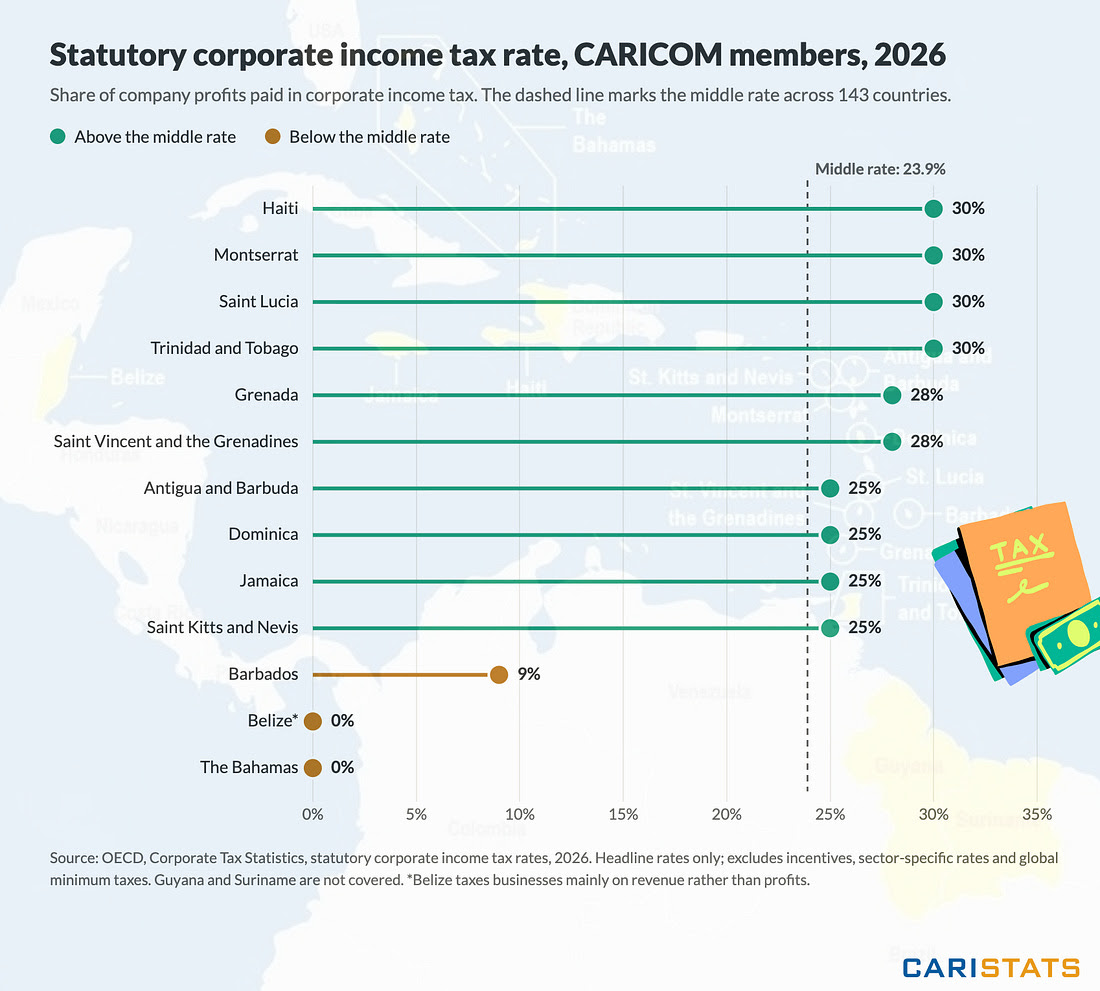
Statutory corporate income tax, defined as the percentage of a firm’s total taxable profits remitted to national governing bodies, stands as one of the most critical comparative metrics for cross-border investors evaluating potential jurisdictions to establish operations and scale commercial activities. Freshly released 2026 corporate tax statistics from the Organisation for Economic Co-operation and Development (OECD) paint a fragmented picture of corporate taxation across the Caribbean Community (CARICOM), a 15-member regional economic bloc focused on coordinated economic integration. The dataset, which tracks headline statutory profit tax rates across 143 global jurisdictions and covers 13 CARICOM members (excluding Guyana and Suriname), reveals that 10 of the surveyed CARICOM nations impose corporate income tax rates ranging from 25% to 30% on business profits. This range sits notably above the global median statutory corporate tax rate of 23.9% calculated across all 143 tracked countries, meaning the vast majority of the bloc’s members apply a heavier profit tax burden than the typical worldwide jurisdiction. A distinct subset of three CARICOM members, however, operates on a drastically different corporate taxation framework that deviates from the regional norm. The Bahamas levies no standard corporate income tax on business profits at all, while Belize has structured its primary business tax regime around gross revenue rather than net profit, effectively eliminating a formal corporate income tax charge for most firms. Barbados, meanwhile, has implemented a steady downward adjustment of its headline corporate rate, slashing it from 25% in 2019 to a 9% baseline for most domestic and smaller international enterprises. The rollout of the internationally agreed 15% global minimum corporate tax, a policy framework designed to prevent large multinational corporations from shifting profits to low-tax jurisdictions to reduce their overall tax bills, has introduced targeted adjustments to these low-tax CARICOM regimes in recent years. In 2024, Barbados formalized a dual-rate structure that retains the 9% baseline rate for the vast majority of small and medium-sized local businesses, while imposing a mandatory 15% minimum tax on all large multinational entities operating within its borders. The Bahamas followed suit the following year, rolling out its own 15% minimum tax for qualifying multinational firms in 2025, while preserving its zero corporate profit tax rule for all other non-qualifying businesses. It is important to note that the OECD’s 2026 headline rate figures referenced exclude targeted tax incentives, sector-specific preferential rates, and the newly implemented global minimum tax surcharges, meaning the effective tax rate for many firms may vary from the published headline statutory numbers.