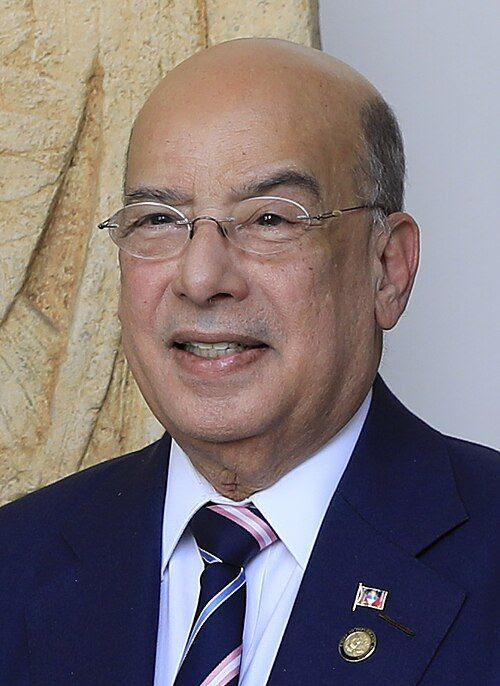
By Sir Ronald Sanders, Ambassador of Antigua and Barbuda to the United States and Organization of American States
When I accepted Ukraine’s Order of Merit on October 19, I centered my remarks on a non-negotiable principle that underpins the security of every small nation across the globe: full sovereignty means the inalienable right to govern our own societies, protect our collective cultural identities, and shape our independent national futures. Today, that foundational principle is facing its most severe modern test in Russia’s full-scale war against Ukraine, and the ripple effects of this conflict extend far beyond the boundaries of Eastern Europe. The global community cannot afford to grow numb to the ongoing violence, nor can it allow other emerging crises to push Ukraine’s struggle out of the international spotlight.
The human toll of the conflict has escalated sharply in recent months. The United Nations Human Rights Monitoring Mission in Ukraine has confirmed that at least 328 unarmed civilians lost their lives and another 2,105 sustained injuries in September 2026 alone. This figure marks an 85% jump in civilian casualties compared to the same period in 2025. The mission has further documented that the first two weeks of October ranked among the deadliest stretches for civilian populations in years of conflict. Most recently, on October 21, Russian strikes targeting residential and infrastructure areas in Kyiv and near Kharkiv killed five people and wounded at least 23 more, according to Ukrainian official statements cited by the Associated Press.
As the harsh European winter approaches, a new wave of coordinated Russian attacks on critical energy infrastructure — including electricity generation and heating facilities — threatens to plunge millions into life-threatening conditions. Between October 13 and 14, successive strikes cut power to 600,000 Kyiv residents for several hours, Ukrainian authorities confirmed to the UN monitoring mission.
At its core, this conflict is a clear test of global values: Russia is employing unprovoked military force to seize another UN-recognized state’s territory and dictate the course of its people’s future. For every other nation on Earth, the choice is stark: speak out against this violation of international law, remain passive in silence, or actively enable Russia’s aggression. The United Nations Charter leaves no room for ambiguity on this point: all member states are bound to refrain from the threat or use of force against the territorial integrity or political independence of any other state.
Six decades ago, President John F. Kennedy stood in divided Cold War-era Berlin, a city split by the Soviet-built Berlin Wall, and declared “Ich bin ein Berliner” — “I am a Berliner.” In that simple phrase, he articulated global solidarity with a people whose freedom was directly threatened by coercive force. Today, the question facing every person who believes in the rule of law is: can we, in the same moral spirit, declare “We are Ukrainians”?
This declaration does not demand that we claim Ukraine’s history or lived experience as our own — that would be impossible. But any people who have ever faced the threat of losing their homeland, their cultural identity, or their right to self-determination can recognize what Ukrainians are fighting to defend. Standing in solidarity with their struggle is a way to affirm that their fundamental rights matter to every one of us, regardless of where we live.
A look at the international response to the 2022 Russian invasion makes clear why this principle needs constant, active defense. On February 25, 2022, 11 members of the UN Security Council co-sponsored and supported a draft resolution that formally condemned Russia’s aggression and demanded an immediate end to its military offensive. Russia, as a permanent Security Council member, exercised its veto to block the measure. The Security Council subsequently triggered an emergency special session of the UN General Assembly, where on March 2, 141 member states voted in favor of a resolution reaffirming Ukraine’s sovereignty and territorial integrity and calling for Russia’s full withdrawal. An overwhelming global majority backed the rule of international law, but the General Assembly lacks the power to force compliance from aggressor states, while Russia’s veto has blocked any binding action from the Security Council.
This institutional gridlock is not a reason for small and mid-sized states to step back from defending the international order. Instead, it is a call to demand more forcefully that international law be universally respected. The ban on unprovoked use of force is not a special privilege reserved only for major military powers, nor a concession that large nations can revoke at will. When powerful states openly disregard this core rule, it falls to small and vulnerable nations to name the violation openly, and to highlight the gap between many governments’ rhetorical commitment to upholding international law and their quiet inaction.
I have long argued that Caribbean nations cannot afford to dismiss or ignore the crisis sparked by Russia’s war against Ukraine. The economic shocks of the conflict — from skyrocketing food and fuel prices to disrupted global transport chains — have already hit small, import-dependent Caribbean economies hard. More fundamentally, eroding the global norm against unprovoked aggression directly undermines the security of every small state, whose own sovereignty depends entirely on these rules being universally enforced.
Small states have critical tools at their disposal: they can use their voting power in the UN General Assembly and regional bodies to repeatedly affirm Ukraine’s sovereignty and territorial integrity. They can coordinate unified diplomatic statements, contribute to humanitarian relief efforts, insist on full compliance with international humanitarian law, and reject any proposed peace settlement that is imposed on Ukraine without the explicit, free consent of its government and people. They must push for a just and lasting peace that fully respects Ukraine’s rights and the sovereign choices of the Ukrainian people. Most importantly, they must push back against the growing “war fatigue” that allows aggression to seem acceptable simply because it has dragged on for years.
Most recently, on October 21, Russian President Vladimir Putin held a meeting with U.S. envoy Steve Witkoff in St. Petersburg. After the talks, the Kremlin announced that Putin had agreed in principle to resume trilateral peace negotiations with Ukraine and the United States after November 10. Diplomacy is always a necessary path to end conflict, but any successful negotiation must deliver a durable settlement that upholds Ukraine’s sovereignty and the free choices of its people. A just peace cannot turn illegal military occupation into a legitimate claim to territory, nor can it accept coercion as the cost of ending the war.
In 2022, I worked alongside my colleague, Ambassador Rita Claverie de Sciolli of Guatemala, to draft an Organization of American States resolution that ultimately suspended Russia’s status as a Permanent Observer to the bloc. I have continued to advocate publicly for Ukraine’s sovereignty and territorial integrity at OAS meetings and in my published commentaries, because silence would amount to conceding that power can simply override law. I am proud that the government of my own country, Antigua and Barbuda — a small, vulnerable island state — has consistently stood for the rule of law, even in the face of great power pressure.
It is the people of Ukraine who bear the brunt of this war’s suffering every day. But the core principle they are defending belongs to every nation, large and small. If one sovereign nation can be dismembered by force while the world looks away, no small state can ever feel confident that its own independence is secure.
We cannot allow Ukraine’s struggle to become a forgotten war. Defending another people’s right to freedom is inseparable from defending our own. In that profound moral sense, every one of us who believes that a nation’s future must be shaped by its own people can say: We are Ukrainians.