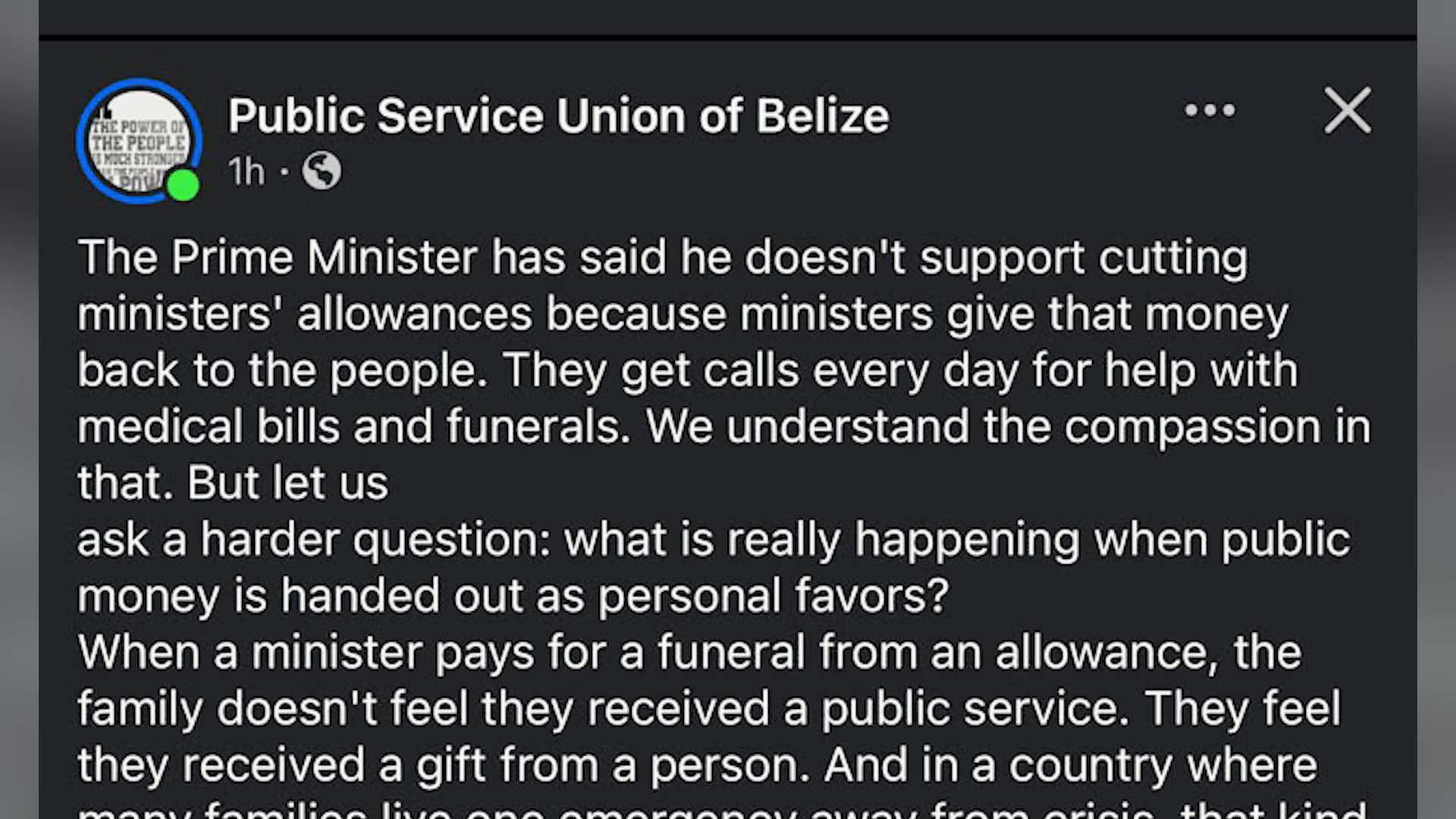
A growing political controversy has erupted in Belize over the structure of government constituency assistance, with the country’s Public Service Union (PSU) launching a formal challenge to the current system that lets cabinet ministers directly distribute public funds to struggling constituents facing emergency costs like unexpected medical bills or end-of-life funeral expenses.
At the heart of the dispute is a core question of governance: should emergency public aid be distributed at the personal discretion of elected politicians, or through standardized, transparent public programs that are equally accessible to all eligible residents? The PSU argues the current unregulated framework erodes democratic norms by blurring the critical line between needs-based public assistance and politically motivated patronage designed to win voter loyalty.
Critics point out that the system currently operates with no published eligibility criteria, no publicly accessible records of how funds are allocated, and no formal appeals process for applicants who are denied support. These gaps, the union contends, create fertile ground for political clientelism, where aid is handed out not based on need, but on a recipient’s political alignment or willingness to support the ruling party at the polls. Instead of the current discretionary handout model, the PSU is calling for the government to scrap the existing arrangement and replace it with structured, transparent public assistance programs that operate under clear, consistent rules.
Prime Minister John Briceño, however, has vigorously pushed back against these claims, defending the current system—including the national Constituency Development Fund—as a pragmatic, efficient way to deliver urgent help to local communities. In a response to questions about whether the fund fuels political patronage, Briceño argued that the decentralized structure was designed to cut through bureaucratic red tape that previously delayed small, critical projects across the country.
Under the old system, Briceño explained, even minor local improvements—from fixing a broken community drain to repairing a damaged door at a neighborhood school—required lengthy approval from multiple central government ministries, including the Ministry of Rural Development, Ministry of Local Government and Infrastructure, and Ministry of Housing. To speed up delivery of these small but impactful projects, the current administration allocated constituency funding based on each district’s voter population, making money available to every elected Area Representative regardless of party affiliation—both for ruling People’s United Party (PUP) and opposition United Democratic Party (UDP) representatives.
Briceño emphasized that the arrangement has been broadly successful, delivering fast, localized support that directly serves community needs. He rejected accusations that the fund is used to cultivate political clientelism, framing the model as a deliberate reform to improve public service delivery for all Belizeans. “It has nothing to do with clientelism or whatever you want to call it,” Briceño said. “It is simply that we are finding ways how we can get help and how we can serve our people most effectively and most efficiently.”
This report is adapted from a verbatim transcript of an evening television news broadcast, with all comments from speakers reproduced accurately for the public record.