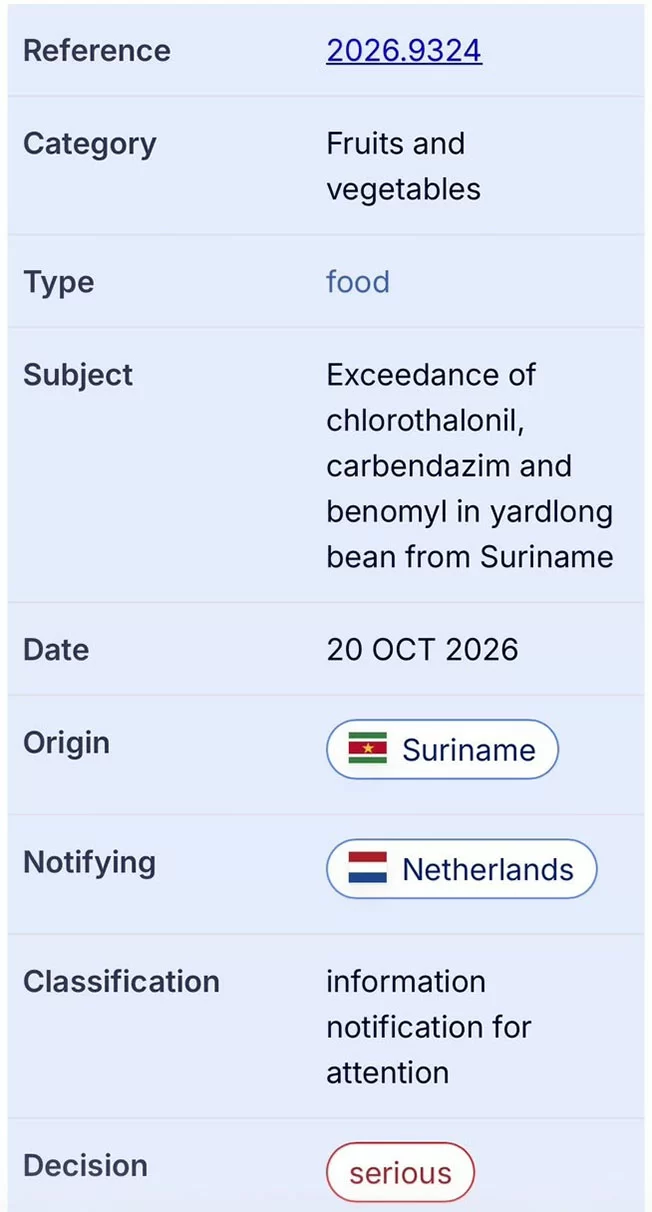
A fresh contamination incident has put Suriname’s agricultural export sector and national food safety framework under renewed scrutiny, after the Netherlands notified the European Union of excessive pesticide residues found in yardlong beans imported from the South American nation. The alert, logged October 20 in the EU’s Rapid Alert System for Food and Feed under reference number 2026.9324, has been classified as a serious risk, marking the second such EU notification for Surinamese agricultural products within just one week.
Lab tests detected three prohibited pesticides—chlorothalonil, carbendazim and benomyl—in the consignment at levels exceeding EU regulatory safety limits. The notification is categorized as an “information notification for attention”, though no details have been released on the specific exporter or the exact concentration of the detected residues. This latest transgression has reignited long-running debates over the adequacy of domestic food safety controls in Suriname, coming as the country’s 2026 new Food Act is scheduled for full plenary debate in the National Assembly (DNA).
The EU’s consistent detection of unsafe residue levels in exported produce has raised urgent questions about the safety of vegetables sold to local consumers. EU border controls regularly screen imports for compliance, but public health advocates have long questioned how rigorously domestic produce is tested, and what enforcement measures are in place when illegal residue levels are uncovered. Surinamese National Assembly member Ann Sadi from the ruling National Democratic Party (NDP) has previously drawn attention to the public health risks posed by unregulated pesticide use in local agriculture, and consumer protection for domestic residents has been a core priority in negotiations over the new food safety legislation.
The 2026 Food Act, which completed its committee review phase in early July, is designed to strengthen food safety oversight across the entire supply chain, covering domestic production, imports, exports and retail sales. The legislation aims to create a unified regulatory framework to guarantee food quality and safety for both export markets and local consumers. During months of pre-legislative consultations, the parliamentary review committee held discussions with multiple government ministries, the Public Health Bureau, the National Institute for Food Safety (NIVS), the Suriname Standards Bureau and industry representatives.
These talks revealed several unresolved key issues, including disagreements over authority distribution between regulatory bodies, questions about the law’s on-the-ground enforceability, and concerns over insufficient operational capacity at relevant government agencies. The repeated EU alerts over pesticide contamination have added new urgency to the upcoming plenary debate, as policymakers face two overlapping challenges: preventing future rejected export consignments that damage Suriname’s agricultural reputation, and ensuring the domestic population has consistent access to safe, residue-free food. While the new Food Act is intended to provide a clear legal foundation to address both goals, public health analysts note that meaningful consumer protection will ultimately depend on robust implementation, sustained investment in inspection capacity and consistent end-to-end oversight of the entire food production chain.