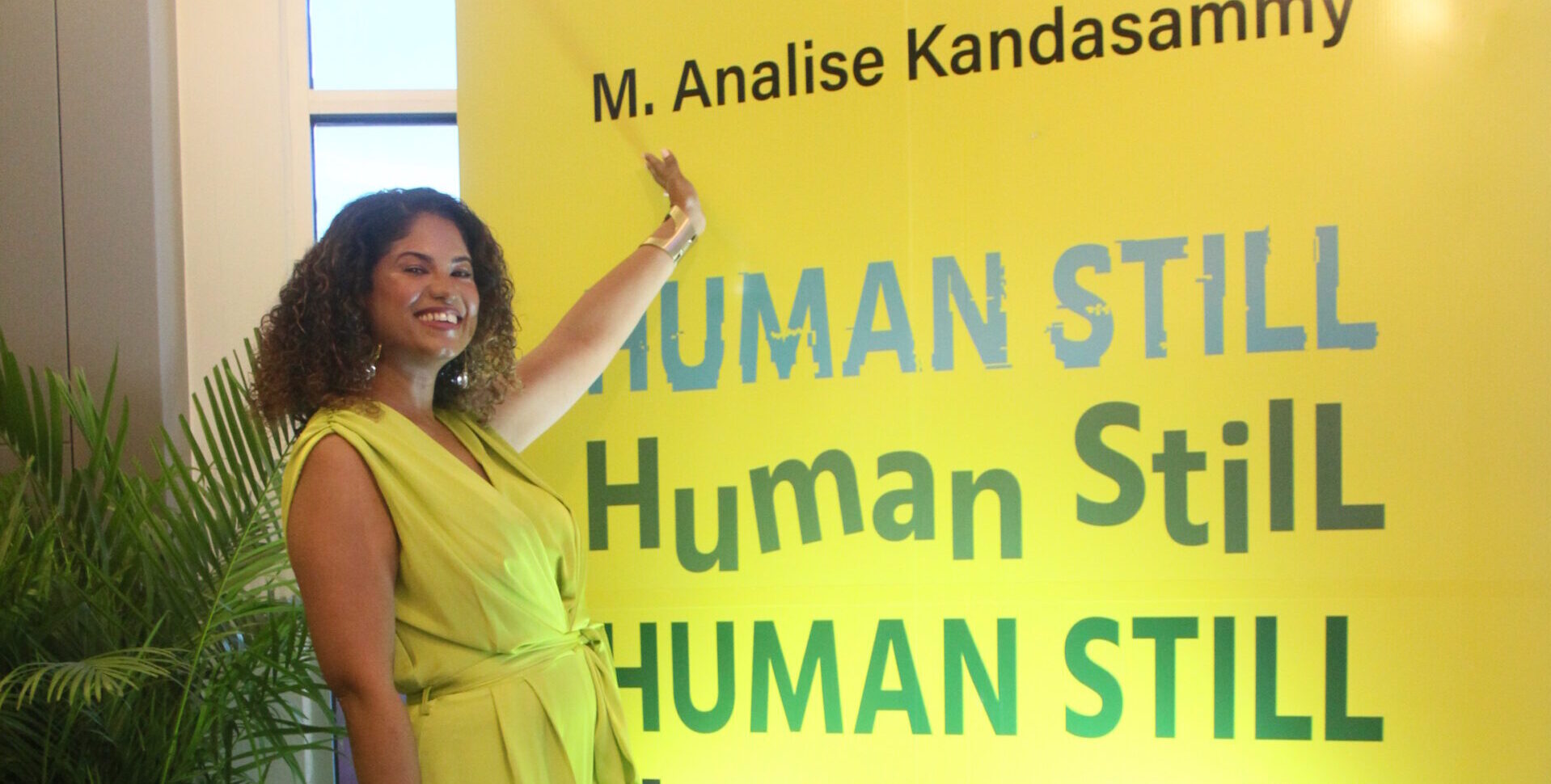
Across the Caribbean basin—from Dominica to Guyana, Trinidad and Tobago and beyond—artificial intelligence is already reshaping daily life, transforming how local populations work, learn, and grow small and medium businesses. But as regional economies and communities rush to embrace the productivity and access benefits of new digital tools, one pressing question has largely gone unaddressed: Are we safeguarding the irreplaceable strengths that make human beings uniquely valuable amid rapid AI advancement?
That is the core question driving M. Analise Kandasammy, a Guyanese-born author and human-centred futurist, who argues this conversation deserves equal standing alongside popular discussions of digital transformation, economic productivity, and the future of work in the region. With the recent launch of her debut book, *Human, Still: Strengthening Your Mind for an AI-Shaped Future*, Kandasammy is bringing a long-overlooked Caribbean perspective to a global AI debate that has for too long been dominated by Silicon Valley technologists and Western industry experts.
Kandasammy does not advocate for Caribbean professionals to fear AI or block its adoption across regional industries. Instead, she calls for intentional, deliberate investment in protecting and nurturing the human capabilities that no algorithm can replicate. Her core thesis is simple yet striking: “You don’t need to out-process the machines. You need to out-human them.”
This message carries particular weight for Caribbean economies, where sustained growth depends heavily on supporting homegrown entrepreneurship, driving local innovation, and developing domestic human talent. AI has already unlocked tangible opportunities across the region: it has helped small businesses compete on a global stage, allowed working professionals to streamline their workflows, and given students access to educational resources that previous generations could only dream of. But these dramatic advancements also raise urgent, underdiscussed questions about the future of critical thinking, independent judgment, and how workers define their professional value. If AI can draft reports, parse complex datasets, and generate creative concepts in seconds, what becomes of the workers who spent decades honing those skills? As algorithms take on an increasing role in everyday decision-making, are populations growing more capable, or just more dependent on technology to think for them?
For Kandasammy, these questions are far from abstract—they are deeply personal. Her professional focus on AI began in 2022, when she first encountered the technology during her master’s degree studies. It was not until 2025, however, as she watched AI development accelerate at an exponential rate, that she began to question what these changes would mean for her own career. She found herself asking a question that many working professionals across the Caribbean recognize but rarely voice aloud: “Will I still be needed?”
That personal question, paired with four years of dedicated research into agentic AI, formed the foundation of *Human, Still*. Unlike most popular AI books that focus on how people can adapt their skills to “compete” with increasingly sophisticated machines, Kandasammy’s work guides readers to strengthen the innate qualities that set human cognition apart from artificial intelligence.
Through her original Uncrackable Clarity framework, Kandasammy explores how people can protect their cognitive wellness: managing mental fatigue, guarding scattered attention in an always-connected digital world, and cultivating sound, independent judgment even when information overload and technological demands feel unmanageable. Her guiding philosophy, “Know Yourself, Navigate Everything,” is rooted in the belief that self-awareness and mental clarity will only grow more valuable as AI reshapes the global economy and daily life.
For small island nations across the Caribbean, this conversation extends far beyond individual career trajectories. It touches every major sector, from primary and higher education to small business development, public leadership, and how the region prepares the next generation for a future where AI will play an ever-larger role. Kandasammy argues that Caribbean communities should not be passive consumers of AI technologies developed outside the region; instead, they should bring their own unique lived perspectives to the global discussion about how AI shapes people and societies.
Currently based in Trinidad and Tobago, Kandasammy is building a regional and global platform centered on the human side of AI development. She plans to expand this conversation through keynote speaking engagements, hands-on workshops, and educational initiatives across the Caribbean and beyond. The recent launch of her debut book marks a key milestone in this work, but her larger ambition is to push Caribbean professionals, institutional leaders, and policymakers to think more deeply about the balance between technological progress and human capability.
As the global race to expand AI’s capabilities continues to accelerate, Kandasammy offers a critical reminder to her home region: progress should not come at the cost of the very human qualities that give work, innovation, and community meaning. While the global future will undoubtedly be shaped by artificial intelligence, how humans think, make choices, and retain what makes us human remains entirely in our own hands.