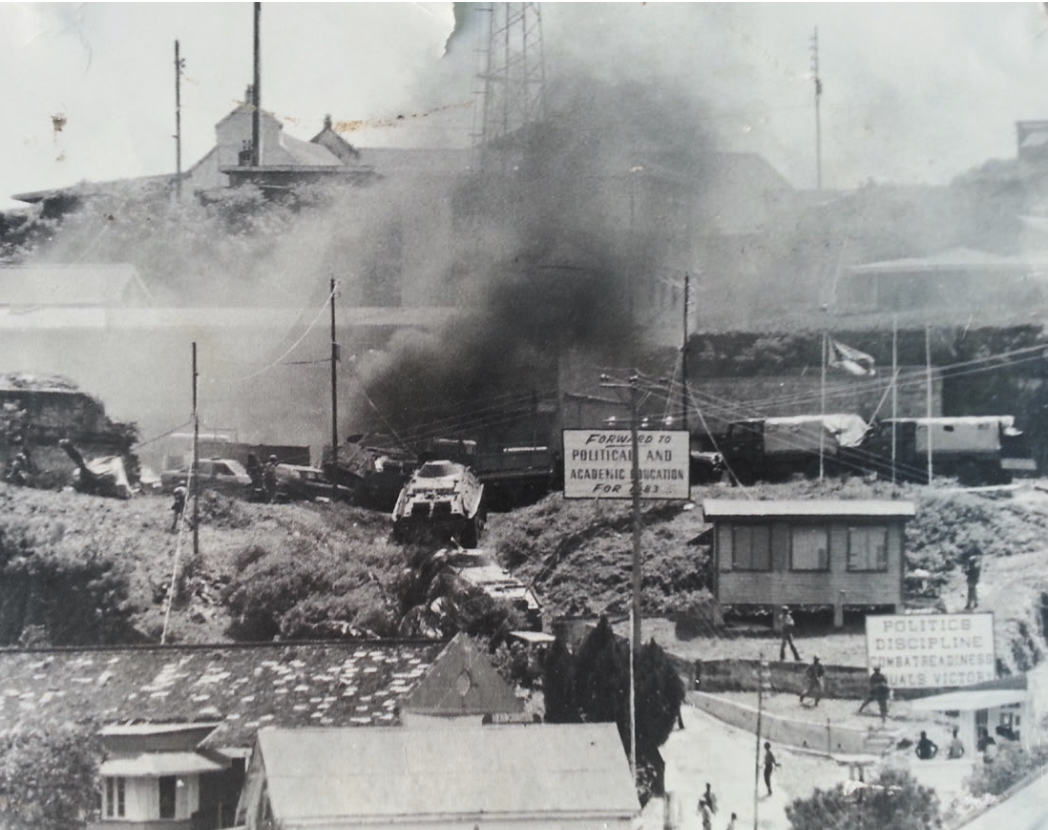
Forty years ago, on the crisp morning of October 19, 1983, Grenada already simmered with political unrest. Yet even the most seasoned political observers could not predict the catastrophic bloodshed that would unfold that day, forever reshaping the small Caribbean nation’s trajectory.
The crisis grew out of an internal power struggle within Grenada’s ruling government. The country’s Central Committee had ordered Prime Minister Maurice Bishop placed under house arrest after he rejected a forced power-sharing agreement with his deputy, Bernard Coard. For days, domestic negotiators and international actors scrambled to find a peaceful path forward, ultimately crafting a tentative plan that would have restored Bishop to the premiership pending his formal approval. But the violence of what would become known as Bloody Wednesday would erase all hope of a diplomatic resolution.
Thousands of Bishop’s supporters, led by prominent allies Unison Whiteman and Norris Bain, organized a mass demonstration to demand the prime minister’s release. The crowd marched peacefully to Bishop’s residence at Mt Wheldale, where they freed him from confinement without facing resistance from the armed guards stationed at the property. Energized by their success, the demonstrators moved to Fort Rupert—also known as Fort George, the location of the country’s army headquarters—and the large crowd swiftly took control of the compound.
As thousands more gathered in downtown Grenada’s Market Square to celebrate Bishop’s release and wait for his public address, the nation’s remaining hardline political leadership moved to reclaim control. Desperate to retake the army headquarters and force Bishop’s surrender, ruling faction leaders ordered the People’s Revolutionary Army (PRA) to storm the fort with lethal force. A fierce shootout erupted inside the compound, leaving multiple people dead and dozens more wounded immediately. In the aftermath of the battle, Bishop—who had been recaptured—three of his cabinet ministers, and four key loyalists were executed by firing squad in the fort’s central courtyard. The PRA initially attempted to cover up the executions, falsely claiming the leaders had died in the crossfire of the battle.
Official casualty counts confirm that at least 16 people were killed during the attack and the subsequent wave of panic that swept across the capital, with more than 100 others injured. Unconfirmed rumors claiming that hundreds were killed or remain unaccounted for have never been substantiated by independent investigations.
In the immediate aftermath of the coup, the PRA declared martial law across the country, imposing a strict 24-hour shoot-on-sight curfew to suppress any further resistance. General Hudson Austin, the leader of the hardline faction, announced that a 16-member Revolutionary Military Council (RMC) would take over full control of Grenada’s government. The political collapse and bloodshed of Bloody Wednesday set the stage for a major international intervention just six days later: on October 25, 1983, a United States-led military force invaded Grenada to oust the RMC government.
Decades after the tragedy, efforts to honor the lives lost on October 19 began to take shape. In 1993, a memorial plaque was installed in the central courtyard of Fort George at the site where the executions took place, to permanently commemorate those killed. For years after the plaque was unveiled, supporters of Bishop and the victims lobbied the Grenadian government to declare October 19 a national public holiday. For decades, the country had recognized October 25—the date of the U.S.-led invasion—as a national holiday called Thanksgiving Day, but many Grenadians argued that the victims of Bloody Wednesday deserved official national recognition.
That demand was finally realized 40 years after the fateful day. In 2023, Grenada celebrated the first official National Heroes Day on October 19, marking a historic step toward official remembrance of the political upheaval and lives lost in 1983.