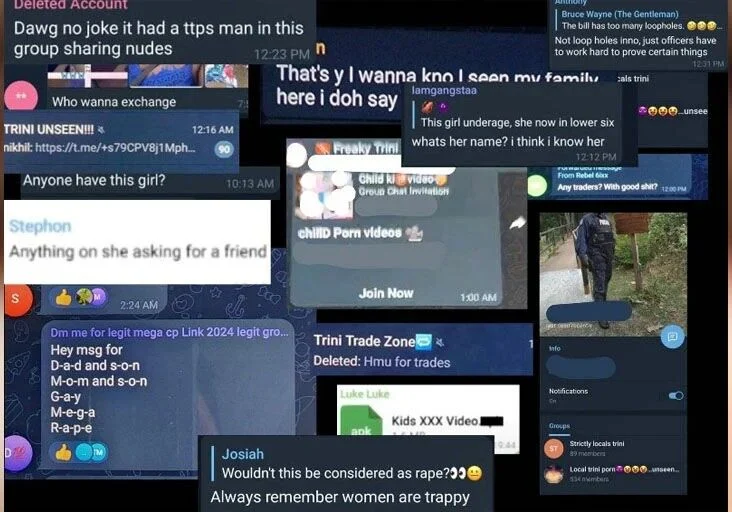
For years, underground online chat groups operating across platforms like Telegram and Discord have operated as open marketplaces for the sexual exploitation of children and non-consenting adults in Trinidad and Tobago. Within these networks, members trade and barter horrific collections of child sexual abuse material, rape imagery, and non-consensual explicit content, with entry to some groups selling for as little as a $250 phone card. Anonymous administrators enforce internal rules, and some members even joke that they will never face legal consequences for their actions.
This open criminal activity has been known to law enforcement for years: victims have come forward to file reports, local advocacy groups have infiltrated the rings and handed over comprehensive evidence to police, and senior Trinidad and Tobago Police Service (TTPS) officials have repeatedly pledged to launch and advance investigations into the networks dating back to 2022. But a months-long freedom of information investigation by the *Express* has revealed a staggering lack of progress, transparency, and accountability, leaving hundreds of victims without justice and the online exploitation industry largely unpunished.
Nearly six months ago, the *Express* submitted a formal Freedom of Information Act (FOIA) request to the TTPS seeking clarity on the status of investigations into these criminal rings. The outlet asked for confirmation of whether probes remained open, what division the investigation was assigned to, and how many suspects had been interviewed, arrested, or charged in connection with the networks. After a 160-day delay—130 days past the 30-day response window legally required for FOIA requests—the TTPS legal department issued a final response last week: the Special Victims Department (SVD), the unit tasked with overseeing these cases, holds no records matching the request. The denial does not explicitly confirm or deny that an investigation exists, and the TTPS declined to say whether other divisions were queried for the records.
The FOIA request also yielded alarming statistics about child pornography prosecutions across the country between 2020 and 2026. In total, TTPS received more than 142 child pornography reports across both islands over the seven-year period. Of those, more than 80%—114 reports—came from Trinidad, where the majority of the country’s population lives. Shockingly, the TTPS data confirms not a single charge has been filed in Trinidad over the entire seven-year period, and no cases have been referred to the Office of the Director of Public Prosecutions (DPP). By comparison, Tobago, which received just 28 total reports (less than 20% of the national total), secured 17 charges over the same period and referred an equal number of cases to the DPP. The TTPS has offered no explanation for the stark disparity.
Multiple attempts by the *Express* to contact SVD Superintendent Roger Reyes and the TTPS Corporate Communications Unit for comment on the missing records and the charge gap have gone unanswered. Minister of Homeland Security Roger Alexander, who pledged in August that the government would take a “strong-arm approach” to cracking down on child sexual exploitation online and announced new technology to identify offenders, also declined to provide an update when contacted by the outlet.
The lack of records and prosecutions comes after years of public pledges and court acknowledgements of ongoing investigations. In 2022, former SVD and Child Protection Unit head Claire Guy-Alleyne publicly confirmed that an investigation into the Telegram exploitation groups had been launched. In 2024, TTPS Corporate Communications Officer Joanne Archie told local media that two units would launch an immediate probe into the rings, later confirming to the *Express* that the investigation remained ongoing.
A 2025 Court of Appeal ruling in a constitutional case brought by victims and advocacy group the Humanitarian Foundation for Positive Social Change (HFPSC) also confirmed that police had acknowledged active investigative steps dating back to 2022. The case centered on an anonymous victim who discovered explicit images of herself as a child circulating on pornography sites and in the underground chat groups in 2020. She provided police with a comprehensive evidence package, including a flash drive with 42 group URLs and thousands of records of circulating abuse material—only for an officer to lose the flash drive. The court ruled that the victim’s report had “fallen into a black hole” between 2020 and 2022, finding that police had failed to uphold her constitutional right to protection and investigation. The ruling also noted that police had confirmed to the court that by 2022, they had verified the victim’s evidence, held internal meetings, sought legal advice, built perpetrator profiles, and assigned undercover officers to infiltrate the chat groups, who were awaiting covert communication tools to proceed.
For victims, the TTPS’s FOIA denial that no investigation records exist has amplified years of frustration and uncertainty. The anonymous claimant from the constitutional case, who was awarded damages for the police’s initial failure to investigate, told the *Express* she is still fighting for basic answers.
“Despite successfully pursuing constitutional proceedings against the Trinidad and Tobago Police Service for its failure to investigate my report expeditiously, and being awarded damages for the delay, I am now informed, through a Freedom of Information request, that records concerning the investigation do not exist within the Special Victims Department’s database,” she said. “How can the Police Service maintain in court proceedings on affidavit evidence that an investigation was ongoing at the time of the Court’s determination, yet subsequently state in writing that no records exist?”
HFPSC called the TTPS response a major failure of transparency and accountability that undermines public trust in the justice system. “Particularly where reports concern the online sexual exploitation of women and children. A successful constitutional claim should not leave a citizen still fighting for basic answers,” the group said in a statement. “If even a judgement of the High Court and Court of Appeal cannot secure accountability, what confidence can ordinary citizens have in the administration of justice?”