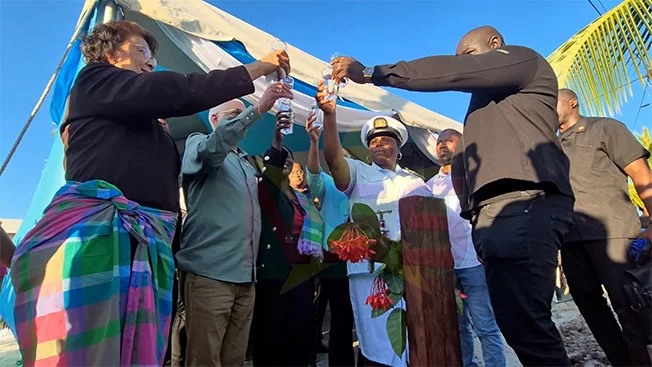
On Friday, during the inauguration of a new drinking water distribution network in Sunny Point Block 3, Wanica District, Suriname President Jennifer Simons outlined a bold national water policy agenda centered on prioritizing public access to safe drinking water over commercial exploitation, and called for urgent new investments in the Surinaamsche Waterleiding Maatschappij (SWM), the country’s national water utility.
Simons emphasized that water, as a fundamental resource for human life, should never be treated as a standard commercial commodity. Under her policy framework, meeting the domestic drinking water needs of the Surinamese population must take absolute precedence before any commercial water extraction concessions are approved for private businesses. “The SWM requires a dedicated investment program to address its existing operational challenges, and to keep pace with growing demand,” Simons noted during an on-site interview. She pointed to steady population growth and rising per capita water consumption as driving factors that require the government to create supportive conditions for the utility to expand its infrastructure and service capacity. Alongside calling for institutional investment, the president also urged all Surinamese residents to adopt more water-conscious habits and use drinking water resources responsibly.
A core priority of Simons’ water policy push is the enactment of a binding national water protection law by 2028, a measure she says is urgently needed to rein in unregulated groundwater extraction. The president has raised significant concerns about the current lack of oversight for commercial groundwater drilling and sales, noting that unregulated access puts long-term public water security at risk. Unlike existing draft frameworks that treat water as an extractive commodity similar to mining products, Simons’ proposed legislation would enshrine public water access as a fundamental right, lock in priority access for domestic use, and establish clear rules and regulatory oversight for all extraction activities. “Water regulation is at the top of this administration’s legislative agenda, and we target having this critical law in place by 2028,” she confirmed.
When addressing nationwide expansion of drinking water access, Simons rejected empty political promises, noting that universal access requires steady, incremental work rather than unrealistic pledges. “I will not stand here and tell you everyone will have running water tomorrow – that would not be the truth,” she said. “We will continue advancing step by step, connecting new communities one region at a time, until every corner of Suriname has access to high-quality safe drinking water.” She also highlighted that public access to water infrastructure requires shared responsibility from citizens, pointing to ongoing issues of stolen water pipes and vandalized infrastructure. “Government alone cannot develop a nation,” Simons said. “Every resident has a role to protect shared public infrastructure for the benefit of all.”
At the same event, SWM Director Clifton Lienga shared details of the new Sunny Point Block 3 network, which is on track to connect nearly 1,000 households serving more than 5,000 total residents by December this year. To date, more than 700 households have been registered for connection, with final infrastructure works including a new connecting line between Block 3 and the main Leiding 20 trunk line still underway. To speed up the connection process, Lienga announced that residents only need a national ID card to register – a land deed is not required, eliminating a common barrier that has caused lengthy delays in previous expansion projects. Connection fees range from 18,000 to 23,000 Surinamese dollars, with flexible installment payment plans available to low-income households. Each connected household will receive an individual lockable outdoor water tap, ending the common practice of multiple households sharing a single connection. Existing public standpipes will remain in place until all residents in the area have secured private connections, ensuring no resident loses access during the transition.
Lienga echoed the president’s concerns about unregulated groundwater extraction, warning that uncertified, careless drilling poses severe risks of long-term groundwater contamination. The SWM provides formal advisory input for all commercial groundwater extraction permit applications: if a proposed drilling site targets an aquifer that the SWM uses for public drinking water supply, the utility automatically issues a negative recommendation. For other aquifers, the SWM requires strict binding conditions for regular water quality inspections and monitoring.
Lienga cited the 2024 floods in Brokopondo as a stark example of how irreversible groundwater contamination can be: multiple community water sources were rendered permanently unusable after polluted floodwater infiltrated underground aquifers. He also added that growing unregulated mining activity across Suriname is an increasing threat to usable groundwater reserves, calling for strict environmental regulations and consistent enforcement to prevent the loss or contamination of vital aquifers. “Protecting our underground water resources is not just for today – it is a necessity to guarantee safe drinking water for future generations,” Lienga said.