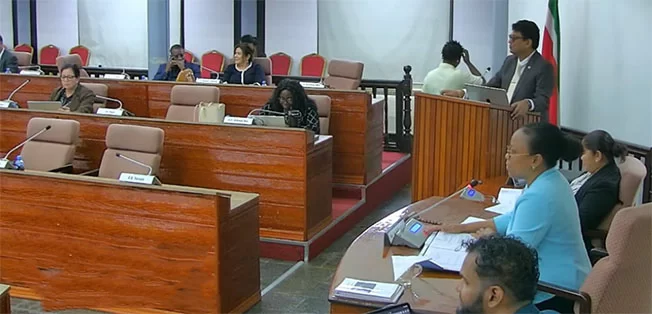
A broad consensus has emerged among members of Suriname’s National Assembly (DNA) that expanding the investigative powers of police and judicial authorities is a critical step in combating sophisticated transnational and organized crime. But during a plenary debate held Friday, lawmakers across party lines raised urgent, widespread concerns over the proposed legislation’s lack of clear guardrails, warning that unconstrained expansion of surveillance and investigatory authority could open the door to government abuse, unlawful privacy violations, and irreversible harm to innocent citizens.
As lawmakers continued deliberations over amendments to the country’s Code of Criminal Procedure, discussion centered not on whether new powers are needed, but on the strict conditions under which law enforcement agencies should be permitted to use them. The draft bill would grant authorities new tools including systematic long-term surveillance, undercover infiltration, warrant-based recording of confidential communications, and broad digital investigative access to personal and corporate devices. These measures are explicitly designed to help Suriname more effectively disrupt high-level criminal activity including drug trafficking, money laundering, and other interconnected organized criminal networks.
Even as lawmakers acknowledged the urgency of these tools, they questioned whether the draft bill’s existing provisions deliver sufficient protection for civilians when investigators overstep or misuse their new authority.
### Clear Legal Boundaries and Stronger Oversight Demanded
Asish Gajadien, leader of the ruling VHP party’s parliamentary caucus, emphasized that expanded investigatory powers must be paired with unambiguous legal limits and independent, effective oversight. He outlined common real-world scenarios where unfettered digital access can extend far beyond the scope of a specific criminal investigation: for example, a search of a single suspect’s seized laptop can grant investigators access to massive volumes of business records and personal data belonging to individuals with no connection to the alleged crime under investigation.
Gajadien called for tighter geographic and scope-based limits on digital investigations, additional mandatory judicial review before investigators can access broad datasets, and stronger protections for legally privileged confidential information. He also noted that Suriname currently lacks a robust cultural and institutional framework for holding public officials accountable for misconduct in office, arguing that harsher penalties must be put in place for officials who abuse their special law enforcement positions for unauthorized purposes.
Mahinder Jogi, another VHP member of the National Assembly, echoed these concerns, focusing on the reliability and integrity of the officers who will exercise these new powers. He called for increased investment in ongoing training, integrity screenings, and continuous performance monitoring for police and other investigatory staff, noting that expanding authority requires the government to first demonstrate that it can trust the personnel tasked with carrying out these sensitive duties.
### Innocent Civilians Face Irreversible Harm, Lawmakers Warn
A core recurring theme throughout the debate was the vulnerability of innocent civilians who are incorrectly swept up into criminal investigations. Stanley Betterson, a lawmaker from the ABOP party, warned that wrongful arrest or prolonged pre-trial detention can upend a person’s life permanently: even when a court ultimately clears a suspect of all wrongdoing, the resulting job loss, reputational damage, and long-term psychological trauma leave permanent consequences. To address this risk, Betterson called for expanded avenues for financial compensation for wrongfully targeted individuals and increased public investment in forensic expertise to reduce the rate of investigative error.
Ann Sadi, a lawmaker from the opposition NDP party, also drew attention to the need for strong legal protections for private citizens and business owners. She noted that wrongful suspicion and unauthorized searches of confidential corporate records can cause catastrophic harm, particularly for small businesses that rely on public trust to operate. Sadi added that civilians and business owners wrongfully harmed by investigatory misconduct should be guaranteed clear access to compensation and public correction of false accusations.
### Privacy and Data Protection Raise New Concerns
Multiple lawmakers also highlighted gaps in protections for personal data collected during criminal investigations, noting that risk extends not only to suspects but to family members, employees, customers, and other third parties who are incidentally caught up in surveillance or digital searches. Gajadien called for explicit, binding rules governing the storage, reuse, and permanent deletion of irrelevant incidental data, and also warned of the risk that legally privileged confidential communications between defense attorneys and their clients could be improperly accessed during digital searches.
Steven Reyme, leader of the A20 parliamentary caucus, raised similar questions, pressing the government to explain how it will guarantee that irrelevant data belonging to innocent civilians is permanently destroyed, and what legal remedies are available to civilians whose privacy is unlawfully violated. Reyme also questioned the lack of clear limits on the duration of surveillance operations, asking for clarification on what restrictions apply when a person is placed under prolonged monitoring and surveillance orders are repeatedly extended.
### Foreign Investigators Must Remain Under Surinamese Sovereignty
Another key topic raised by multiple speakers was the potential deployment of foreign investigatory personnel on Surinamese territory. While both Gajadien and Reyme acknowledged that cross-border international cooperation is often necessary to combat transnational organized crime, they insisted that foreign law enforcement officers cannot be permitted to operate without clear binding rules and robust oversight. Reyme emphasized that Suriname must retain full sovereign control over all investigatory activity carried out on its territory, and called for clear clarification on issues of responsibility, authority, and legal liability when foreign personnel violate the rights of Surinamese civilians.
### Broad Support for Anti-Crime Reform, But Insistence on Strengthening Safeguards
Despite the wide range of concerns raised during the debate, many lawmakers expressed their overall support for expanding investigatory powers to tackle evolving organized crime. Speakers uniformly acknowledged that modern criminal groups operate with increasingly sophisticated tactics, and that law enforcement cannot continue to rely on outdated, outdated tools to counter them.
Reyme also noted that Suriname holds binding international commitments related to countering money laundering and terrorist financing, and that an upcoming international evaluation of the country’s compliance framework in 2027 makes timely progress on the legislation necessary. Even so, he stressed that time pressure must not be allowed to compromise the quality and integrity of the final law.
Gajadien called on the government to reconvene the bill for review alongside independent legal experts, incorporating parliamentary feedback and proposed amendments into the final draft to address gaps in oversight and protection. The throughline of all parliamentary contributions was clear: the fight against organized crime must be strengthened, but not at the cost of eroding the legal certainty and fundamental rights of Suriname’s civilian population. For many DNA members, simply granting new powers to investigatory agencies without clearly defining who provides oversight, how abuse will be prevented, and what protections are available to civilians when the government makes mistakes is fundamentally unacceptable.