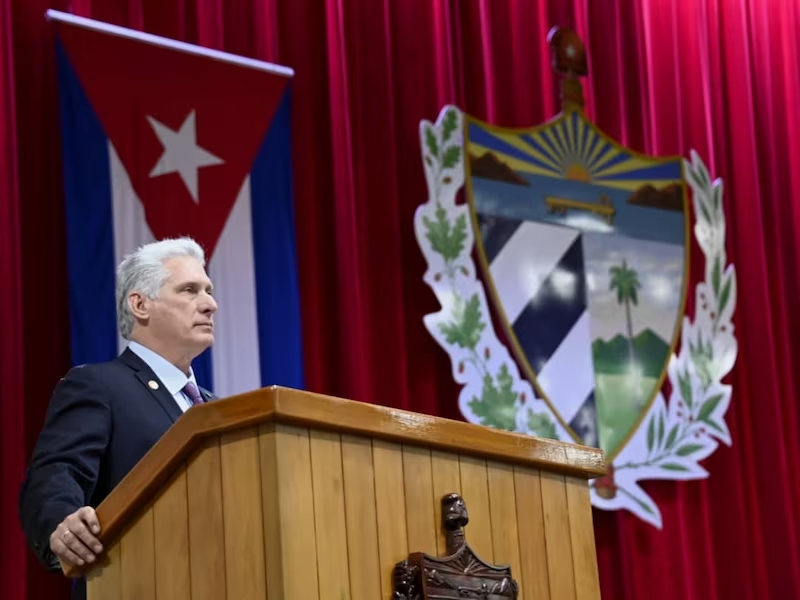
As the United Nations General Assembly prepares for its annual vote on a resolution calling for an end to the United States’ decades-long economic, commercial, and financial blockade against Cuba, top Cuban officials have publicly condemned a last-minute U.S. diplomatic campaign designed to break the overwhelming international consensus backing Cuba’s position.
On Thursday, Cuban President Miguel Díaz-Canel took to the social media platform X to accuse Washington of launching desperate pressure campaigns against sovereign nations to coerce them into supporting its blockade policy. Díaz-Canel emphasized that the collective punishment imposed by the U.S. on the Cuban people is so fundamentally unjustifiable that the U.S. has resorted to strong-arm tactics in the lead-up to the new vote, all to win backing for what he labeled a genocidal policy.
The president characterized the U.S. outreach targeting global leaders and foreign officials as a frantic push. Far from signaling American strength, he argued, this aggressive lobbying effort exposes just how isolated Washington is on its Cuba policy, how little genuine international support it holds, and how the weight of global opinion aligns firmly with Cuba.
Cuban Foreign Minister Bruno Rodríguez Parrilla echoed these condemnations in his own official post on X, going further to accuse U.S. Secretary of State Marco Rubio of engaging in open pressure and blackmail against foreign heads of state and government. Rodríguez Parrilla claimed the U.S. Secretary of State, growing nervous and anxious ahead of what is expected to be another overwhelming defeat at the UN, is actively pushing global leaders to reverse their longstanding opposition to the blockade and change their votes.
The foreign minister added that through repeated false claims and escalating hostile actions, Washington is seeking to cover up the reality of collective punishment against ordinary Cubans, and force the broader international community to become accomplices to this inhumane policy.
The timeline for this year’s vote is already set: Cuba will present its annual report, officially titled *The Need to End the Economic, Commercial, and Financial Embargo Imposed by the United States of America Against Cuba*, to the General Assembly on October 27, with the vote scheduled to take place the following day, October 28. For more than three decades, the Cuban resolution has garnered overwhelming support from UN member states, a consistent record that reflects widespread global rejection of the U.S. policy.
Since 1992, the General Assembly has adopted the Cuban resolution 33 separate times. Each annual vote has served as a clear, public demonstration of the international community’s widespread opposition to the sanctions Washington has maintained against the island nation for decades.
This year, 2026, has already seen a sharp escalation in U.S. sanctions policy against Cuba. Starting in January, Washington imposed a targeted energy blockade designed to disrupt fuel supplies to the island, a move that Cuban officials equate to a traditional naval blockade. This escalation has worsened the already severe harms of the broader multi-decade blockade, sending direct ripples through every corner of Cuban society: from electricity generation and public transportation to domestic food production, public health services, and overall economic activity. Ordinary Cuban citizens have faced severe disruptions to their daily lives as a result.
Cuban officials closed their remarks with a clear framing of the conflict: Cuba poses no threat to the global community — the U.S. blockade is the real humanitarian threat.