Against a backdrop of global food system instability driven by climate shifts and geopolitical upheaval, Suriname’s Ministry of Agriculture, Livestock and Fisheries (LVV) marked World Food Day on October 16 with a clear policy message and public outreach: prioritize local food production to build long-term food security, and foster the next generation of engaged food producers through hands-on education.
In his official address for the annual observance, LVV Minister Mike Noersalim issued a nationwide call for residents to intentionally choose locally grown food products more often, alongside a broader push for sustainable management of Suriname’s natural resources. The minister stressed that this dual approach is critical to building a resilient, self-sufficient Suriname where national food security is guaranteed for future generations.
“A future-proof food system does not emerge on its own,” Noersalim said, noting that meaningful progress requires bold policy choices, targeted investment, and a collective confidence in Suriname’s own agricultural capacity. He emphasized that food security is far more than a public welfare issue: it forms the foundational pillar of public health, national stability, and consistent economic growth for the country. The annual World Food Day observance also serves as an opportunity to honor the backbone of Suriname’s food supply chain, he added.
“On this day, we extend our sincere gratitude to our farmers, livestock raisers, fishers, and all supply chain partners who work tirelessly every day to keep our tables supplied,” Noersalim said.
Global disruptions have forced a defining policy choice for Suriname, the minister argued. Climate change, rising international geopolitical tensions, and widespread breakdowns in global supply chains have put unprecedented pressure on food systems worldwide, leaving countries that rely heavily on food imports vulnerable to price swings and supply shortages. Rather than continuing to depend on volatile global markets and large-volume food imports, Noersalim said Suriname has chosen a different path: one focused on boosting domestic production, prioritizing long-term resilience, and advancing sustainable agricultural practices.
This year’s global World Food Day theme, “Innovative Today, Nourish Tomorrow”, aligns perfectly with Suriname’s strategy, Noersalim noted. The theme underscores a core truth that guides the ministry’s work: every policy and public choice made today will directly shape the food security Suriname can deliver to its people tomorrow. Agricultural innovation, including climate-adaptive practices like greenhouse cultivation that help offset the impacts of extreme and shifting weather, is already being deployed to help Suriname meet its food production goals.
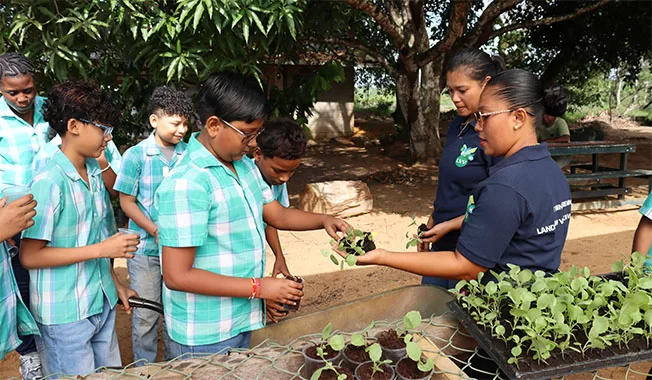
Beyond policy announcements, the LVV organized a series of community and educational events across the country to mark World Food Day, centered on engaging young people with agricultural production. At the Tamansari Citrus Plantation, the ministry hosted an educational day for students from Pandit Soerdjpal Ramjatanschool, where children got an up-close look at the diverse range of agricultural crops grown across Suriname. Students learned hands-on skills for planting and tending vegetable crops, and gained a clear understanding of how domestic agriculture supports the country’s overall food supply.
Amrish Bhaggan, Deputy Director of the Eastern Agricultural Division, highlighted the importance of teaching young people about healthy eating and organic cultivation during the event. He noted that introducing these concepts in childhood helps build lasting knowledge, and empowers young people to grow their own food responsibly from an early age. As part of this educational push, the ministry also donated hydroponic growing systems to two local schools, O.S. Baitul Rochman and O.S. 2 Tamanredjo, to help raise student awareness of food production and the value of nutritionally dense, fresh food.
Eline Troenosemito, an LVV policy officer who helped organize the educational events, explained that the programming is designed to go beyond basic awareness: students do not just learn about different crops, but gain the practical skills to grow food themselves. During the day, students also learned about agricultural operations in the Mon Tresor region and the history of the historic Mariënburg former sugar plantation, deepening their connection to Suriname’s agricultural heritage. The ministry’s ultimate goal for these outreach efforts is to encourage students to apply their new knowledge at home, growing small amounts of their own food and contributing personally to household and national food security.