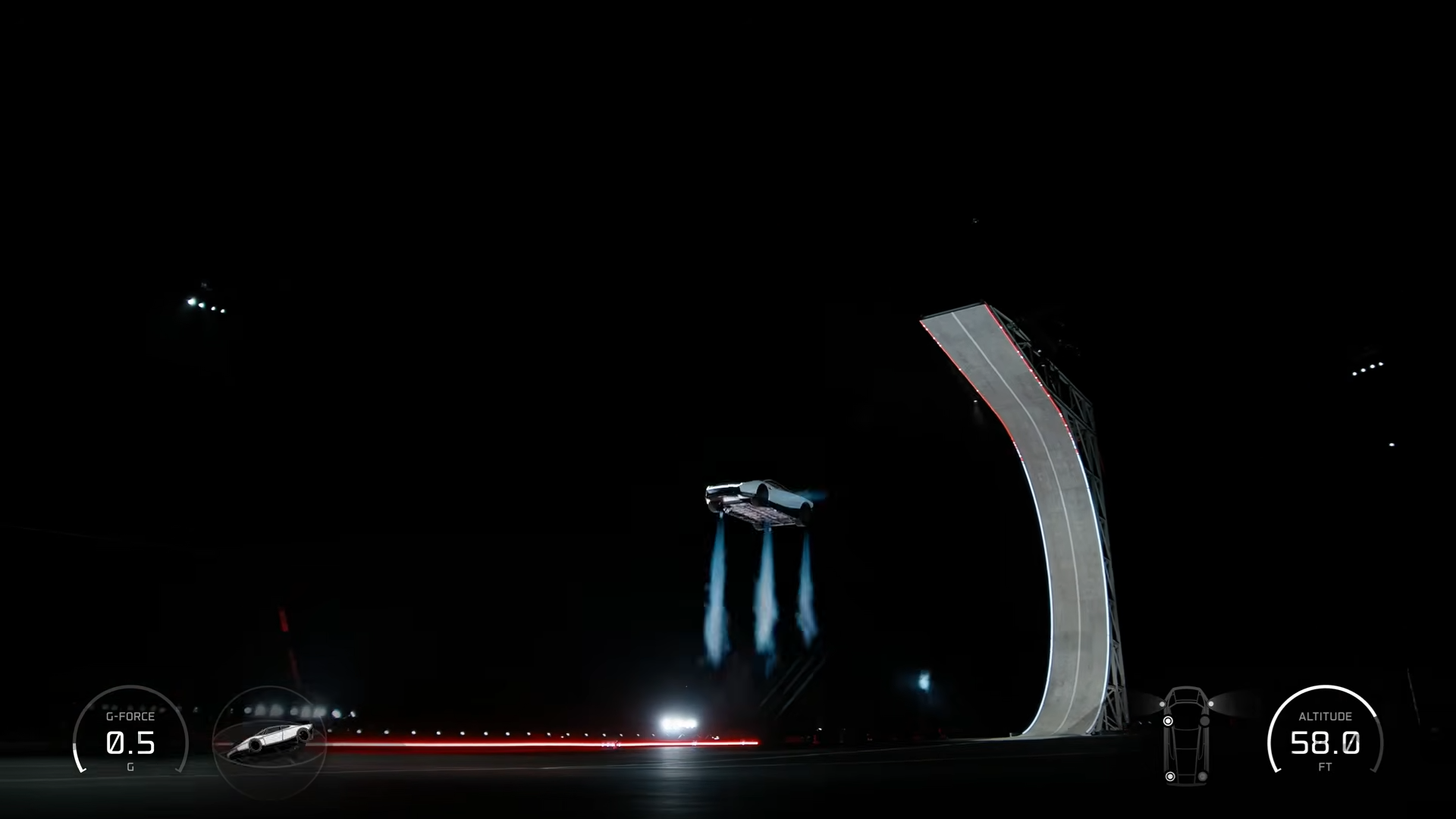
Elon Musk has officially pulled back the curtain on Tesla’s next-generation Roadster, a groundbreaking vehicle that blurs the long-standing line between traditional automotive manufacturing and aerospace innovation, with the entrepreneur confirming the model is engineered to achieve short-duration flight.
The public unveiling of the two-seat electric vehicle was hosted Thursday at SpaceX’s test and development facility located in Texas, bringing together decades of progress in both electric mobility and rocket propulsion technology.
What makes this new Roadster unlike any production passenger vehicle before it is its hybrid design: it combines Tesla’s industry-leading electric vehicle powertrain and full self-driving technology with an advanced aerospace-derived propulsion system built for flight. The vehicle already boasts jaw-dropping on-road performance, capable of accelerating from 0 to 60 miles per hour in under one second even without engaging its flight system – a mark that outpaces nearly all supercars on the market today.
During a dramatic live demonstration to showcase the vehicle’s unique capabilities, the Roadster climbed an inverted ramp and remained suspended upside down in mid-air before activating its built-in air jets to flip itself back upright and land safely on the ground below. Musk explained that the vehicle’s ability to cling to the inverted ramp relies on specialized suction technology, a feature integrated to support its aerial functions.
Notably, the development team opted not to put a human driver behind the wheel during the test, as the outcome was not guaranteed. Musk acknowledged this precaution was taken explicitly to eliminate the risk of fatal injury should the demonstration gone wrong.
A second, equally impressive demonstration followed the first: the Roadster used its air jet system to hover over an entire row of parked Tesla vehicles, before touching down safely on the opposite side. This display proved the vehicle can execute both stable takeoffs and controlled landings from the ground using its on-board propulsion hardware.
Musk went on to detail the flight-capable system, which relies on 10 individual nozzles connected to ultra high-pressure air tanks to enable even brief flight. The system also contributes to the vehicle’s extreme on-road acceleration, helping it hit the 60 MPH mark in under one second.
The reveal has ignited widespread excitement among transportation enthusiasts and tech observers, stoking imagination for a future where personal vehicles can seamlessly transition between road travel and short airborne trips to bypass congestion and obstacles. However, the journey from prototype to mass-produced consumer vehicle remains littered with significant hurdles. Key unaddressed challenges include rigorous safety testing and validation, improving the energy efficiency of the flight system to achieve practical range, securing regulatory approval from global transportation and aviation authorities, and bringing the production cost down to a level that is affordable for most consumers.
As of the unveiling, core details including official production timelines, pricing, and public availability have not been finalized and still require official confirmation from Tesla. If the company can successfully overcome these remaining barriers, Musk’s vision for a flying-capable road vehicle will mark a transformative leap forward in personal transportation, bringing the long-held science fiction dream of flying cars much closer to tangible reality.