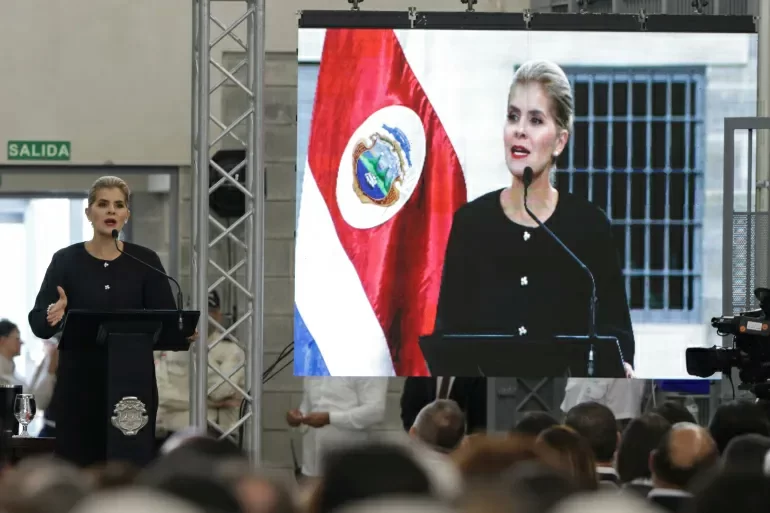
Costa Rica has inaugurated a new high-security mega-prison designed to hold up to 5,100 detainees, marking a major policy shift in the country’s escalating fight against organized crime and record-high homicide rates driven by expanding drug trafficking networks. The new facility, named the Centro de Alta Contención contra el Crimen Organizado (CACCO), was officially opened by President Laura Fernández in Alajuela on Wednesday, built at a total cost of roughly $36 million.
Modeled directly after the tough prison framework implemented by Salvadoran President Nayib Bukele, who has led a sweeping, nationwide crackdown on criminal gangs since 2022, the new facility is intended to solve a persistent security gap: preventing top organized crime leaders from continuing to coordinate illicit activities from behind prison walls. President Fernández framed CACCO as a landmark step in Costa Rica’s anti-crime campaign, noting that the government aims for the complex to become an international benchmark for high-security prison management. The first transfer of detainees to the facility is scheduled for the end of October, and the 5,100 capacity equals roughly 20% of Costa Rica’s current total prison population, bringing much-needed relief to the country’s overcrowded correctional system.
Long recognized as one of the safest nations in Latin America, Costa Rica has seen a sharp and worrying rise in violent crime over the past decade. The increase is largely fueled by turf wars between rival drug trafficking groups fighting for control of profitable smuggling routes running through Central America toward North American consumer markets. In 2023, the country recorded a historic high of 905 homicides. While the total dropped slightly to 876 in 2024 and 873 in 2025, the violence remains a top political and public safety crisis that has put intense pressure on the Fernández administration to deliver results.
Officials say the primary goal of the new high-security prison is to strengthen state control over the correctional system, cutting off the ability of criminal networks to operate freely inside prison walls and coordinate with outside factions. The opening of CACCO fits into a growing regional trend across Latin America, where a growing number of political leaders have adopted harsher anti-crime policies, including mass arrests, harsher sentencing, and large-scale maximum-security prisons, all following Bukele’s widely discussed model in El Salvador.
Bukele’s government has credited its emergency rule-era gang crackdown, launched in March 2022, for driving a dramatic drop in El Salvador’s homicide rate, and the policy has earned widespread popular support from Salvadoran citizens who lived for decades under gang violence and extortion. However, human rights organizations have repeatedly raised urgent concerns about the approach, documenting widespread arbitrary arrests, mass detentions, weakened legal safeguards for suspects, and allegations of abuse and mistreatment in custody. Conditions in El Salvador’s own 40,000-inmate mega-prison, the CECOT, have also come under sustained international scrutiny.
These concerns have sparked broader debate around Costa Rica’s new policy: the core question is not only whether stricter high-security detention can reduce crime rates long-term, but also whether the government can maintain access to fair trials for suspects and uphold protections against human rights abuses amid the crackdown. It remains to be seen how much CACCO will contribute to a sustainable reduction in violent crime in Costa Rica, as the facility’s core design centers on isolating high-risk criminal leaders and disrupting their connections to transnational networks. For a country long known for its peaceful, democratic reputation and respect for human rights, the opening of the mega-pricing marks a clear course change on public safety policy. The Fernández administration now faces the core challenge of tackling organized crime effectively without eroding the rule of law and the fundamental human rights protections that have long defined Costa Rica’s national identity.