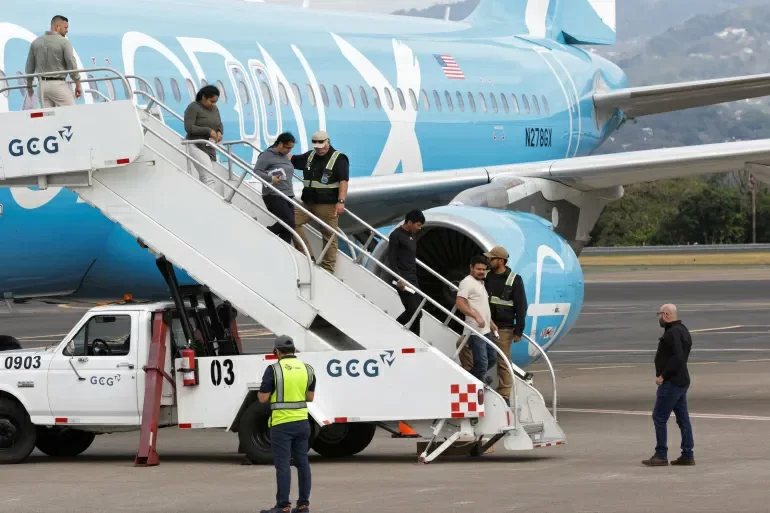
On Tuesday, Jamaica welcomed its first group of 22 non-national migrants deported from the United States, marking the first transfer completed under a controversial bilateral agreement reached with the administration of U.S. President Donald Trump. The deal designates Jamaica as a temporary transit hub for migrants who will ultimately be routed to their countries of origin or other final destinations.
The transported group included 15 men and 7 women who originated from Ecuador and one European nation. They touched down at Kingston’s Norman Manley International Airport. According to Jamaica’s Minister of National Security and Peace, Horace Chang, one additional migrant was denied entry upon arrival, while two others were withdrawn from the transfer process before it was finalized. No children were included in the group. The remaining 22 migrants completed entry processing after landing, then were transported by bus under police escort to an undisclosed location.
Under the terms of the arrangement, migrants are granted a maximum 90-day stay in Jamaica. Chang confirmed that the official goal is to coordinate their return to their home countries within a 14-day window. The International Organization for Migration (IOM), a United Nations agency, has been tasked with managing the migrants’ reception, accommodation, and onward travel arrangements. The Jamaican government has capped arrivals at 25 migrants every two weeks, and the entire program will be paused if 10 migrants submit asylum claims or request other forms of humanitarian protection. Officials have also stressed that no migrants with criminal records will be accepted under the program, and all arrivals have undergone both medical screenings and comprehensive security checks.
The bilateral agreement between Jamaica and the United States was formalized as a memorandum of understanding in June, with final implementation procedures settled in September. Jamaican authorities have repeatedly emphasized that the country only serves as a transit point, and the Jamaican government will not bear any associated costs. Per the agreed implementation rules, the U.S. will cover all service costs administered by the competent international organization leading the transit process.
The arrival of the first migrant group has reignited widespread criticism of the agreement across Jamaica. The country’s main opposition party, the People’s National Party (PNP), is demanding that the governing administration release the full text of the agreement, disclose transfer schedules and security protocols, and submit the deal for parliamentary review.
Fitz Jackson, the PNP’s national security spokesperson, called it unacceptable that the Jamaican public has been barred from seeing the terms of a deal that carries potential risks to the country’s national security. The opposition has pushed for clarity on multiple key points, including where the migrants are being housed, who is overseeing their care, and what legal liability Jamaica will face if a destination country refuses to accept the migrants. Opposition leader Mark Golding has also publicly questioned what tangible benefits Jamaica will gain from the agreement.
Jamaica’s Foreign Minister Kamina Johnson Smith has defended the arrangement, saying the government negotiated robust safeguards to protect Jamaica’s national interests and security. However, she acknowledged that the U.S. has refused to approve the public release of the full memorandum.
Damion Gordon, a political scientist at the University of the West Indies, has called on the government to increase transparency and conduct a thorough review of the legal obligations Jamaica has taken on. Gordon warned that the country could face unexpected legal and moral liabilities if the planned repatriation of migrants does not go according to schedule.
These concerns tie into broader global pushback against the U.S. policy of deporting non-citizen migrants to third countries with which the migrants may have no established ties. Human rights organizations and legal advocates have challenged the legality of such deportations, particularly when migrants are not given adequate opportunity to prove they would face danger if sent to a third country. The U.S. Supreme Court has temporarily allowed the Trump administration to continue third-country deportations while legal challenges proceed, but the core question of the policy’s legality remains unresolved.
Jamaica is now part of a growing network of countries that have reached deals with Washington to host and transit third-country deportees. According to Third Country Deportation Watch, a joint initiative of Refugees International and Human Rights First, at least 35 countries have signed similar agreements with the U.S.
This first transfer to Jamaica has turned abstract debate over the deal into a concrete policy issue. Over the coming weeks, stakeholders will be watching closely to see if the government can uphold its promised safeguards, if all migrants can be repatriated within the agreed timeline, and if the opposition will succeed in winning greater public access to the terms of the bilateral agreement.