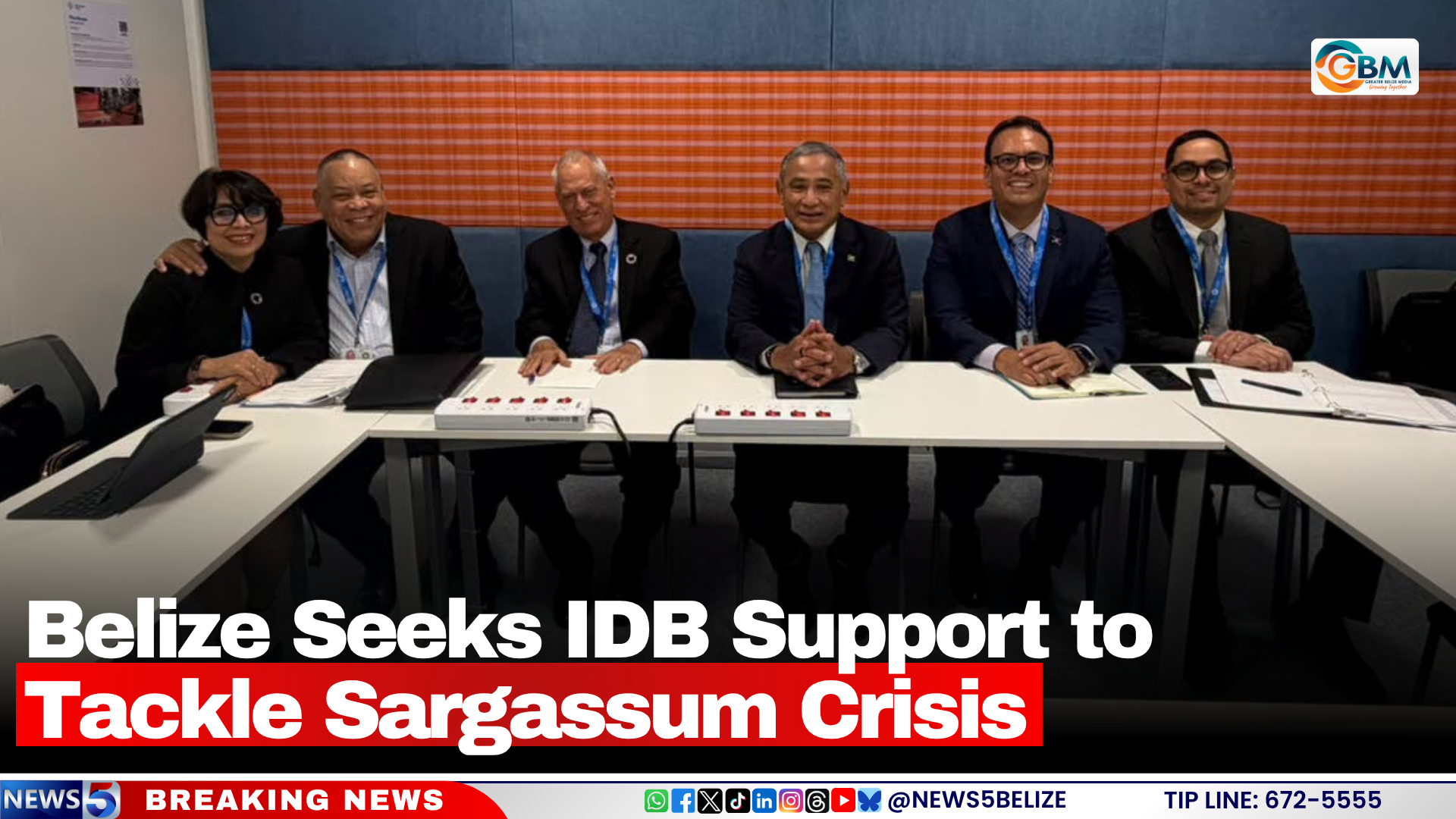
Against the backdrop of the 2026 World Bank-IMF Annual Meetings held in Bangkok, Thailand, Belize has placed its pressing environmental and energy challenges at the center of bilateral talks, pushing for expanded partnership with the Inter-American Development Bank (IDB) to tackle two critical priorities: strengthening national energy security and mitigating the escalating sargassum crisis.
During high-level discussions between Belizean Prime Minister John Briceño and IDB President Ilan Goldfajn, the two sides covered a broad agenda of development priorities for the small Central American nation. On the energy front, talks centered on solutions to skyrocketing domestic electricity costs, plans to expand sustainable energy generation capacity, critical upgrades to core energy infrastructure, and deeper integration of Belize’s energy grid with regional networks. Additional specific conversations included targeted support for state-owned utility provider Belize Electricity Limited (BEL), a planned submarine cable infrastructure upgrade serving the popular coastal town of San Pedro, and new avenues for scaled-up technical and financial investment from the IDB in Belize’s energy transition.
However, the most urgent topic raised by the Belizean delegation was the widespread sargassum influx that has already wreaked havoc on the country’s coastal communities, framed explicitly as both a national and transboundary regional crisis. Prime Minister Briceño’s administration highlighted that heavy sargassum accumulation has already devastated key tourism hotspots including San Pedro and Hopkins, where iconic shorelines like Hopkins Beach are visibly eroding and retreating due to sustained algal blooms. Beyond the immediate blow to the $1.8 billion tourism sector that forms the backbone of Belize’s economy, the crisis carries cascading risks to public health, coastal ecosystems, and household livelihoods across the country.
To build a comprehensive, long-term response to the crisis, the Belizean government is pushing for the global development community to formally reclassify large-scale sargassum events as a qualifying disaster risk, a shift that would unlock greater access to concessional financing and technical support. To date, the government has already directed public investment toward four core response pillars: offshore sargassum collection infrastructure, integration of sargassum waste into renewable energy production, development of carbon credit frameworks tied to sargassum mitigation, and research into commercializing valuable by-products harvested from collected algal biomass. In collaboration with domestic private sector stakeholders, the administration is currently exploring pilot waste-to-energy projects that would convert collected sargassum into grid-compatible electricity, turning a costly environmental hazard into a potential energy resource.
Following the bilateral talks, IDB President Ilan Goldfajn acknowledged the cross-border scope and growing severity of the sargassum crisis, affirming the bank’s commitment to advancing potential support frameworks. The IDB will now deploy its specialist technical teams to assess possible intervention models, ranging from grant financing for pilot projects to technical assistance for policy and infrastructure development, aligning with Belize’s existing mitigation and adaptation plans.