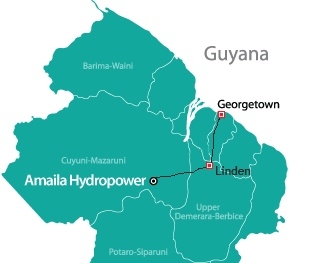
Uncertainty over the economic and technical viability of Guyana’s proposed 165-megawatt Amaila Falls Hydro-power (AFHP) plant has deepened following a new World Bank report that highlights growing climate-driven risks to hydropower infrastructure across Latin America and the Caribbean.
In its October 2026 *Latin America & the Caribbean Economic Update*, the multilateral development bank warns that prolonged droughts, amplified by climate change, are posing severe threats to regional power generation capacity, given that hydropower accounts for nearly half of the region’s total electricity output. Areas facing the highest vulnerability include northern South America, the Andean region, and Central America – territories that include both Guyana and neighboring Suriname, which is already prepping for power shortages caused by plummeting water reserves at its own hydropower facility.
The report notes that when droughts cut hydropower output, countries are forced to rapidly replace lost clean energy generation with expensive, fossil fuel-powered thermal plants that run on imported fuels. Past major drought events in 1997–1998 and 2015–2016 saw sharp drops in hydropower output across the region, triggering cascading economic costs that included higher energy prices, fiscal strains from emergency response subsidies and infrastructure repairs, and downward pressure on overall economic output. The World Bank adds that while regions experiencing extreme rainfall may see temporary boosts to reservoir levels, the net impact of more frequent extreme weather is overwhelmingly negative: intense flooding often damages transmission and distribution infrastructure, disrupts power networks, and forces emergency reservoir releases that flood agricultural and productive lands, adding further to economic and fiscal burdens.
This climate warning comes as the Guyanese government reviews construction bids for the AFHP project, with cost estimates ranging from US$416.8 million to US$800 million. Critics of the project have long questioned whether the Kuribrong River, which will feed the plant, can reliably support the project’s full 165 MW generation capacity amid shifting climate patterns, and the new World Bank analysis has amplified these concerns.
Sharma Solomon, natural resources spokesperson for the opposition coalition A Partnership for National Unity (APNU), argues that existing hydrological data collected in 1975 and 2011 does not reflect decades of climate and environmental change that have altered rainfall patterns in the region. He is calling on the government to commission fully updated hydrological and climate assessments before committing billions of dollars to the large-scale infrastructure project.
“Guyana cannot commit billions of dollars to a project of this magnitude without current, verifiable data demonstrating its long-term viability,” Solomon told Demerara Waves Online News. He added that updated research is needed to confirm the river’s reliable dry-season flow, the reservoir’s actual storage capacity, and the dam’s long-term consistent generating potential.
Janette Bulkan, a professor of forest resources management at the University of British Columbia, echoes these concerns, pointing to a 2016 assessment from Norwegian engineering consultancy Norconsult that first flagged major uncertainties around water availability for AFHP. Since that report was published, Bulkan notes, Guyana’s interior has already experienced clear impacts of global climate change: longer and more severe dry-season droughts, more intense storm events, and an overall decline in annual rainfall. She adds that there is no public evidence that the recommended long-term continuous water flow monitoring on the Kuribrong River has been restarted, leaving critical data gaps that put the entire project at risk of becoming a costly “white elephant.”
The 2016 Norconsult report explicitly outlined these risks, stating that the AFHP reservoir’s limited live storage capacity means the plant will operate nearly as a run-of-river facility, dependent on consistent river inflow to generate power. “The inflow estimate to the AFHP reservoir in the dry months is uncertain. It is clear, however, that the low season inflow will not be sufficient for continuous full capacity generation,” the report read. Norconsult recommended that the government resume continuous water flow monitoring for two to three additional years before securing a new lead project sponsor, to collect enough data to accurately estimate long-term energy output and reduce investment risk for all parties involved.