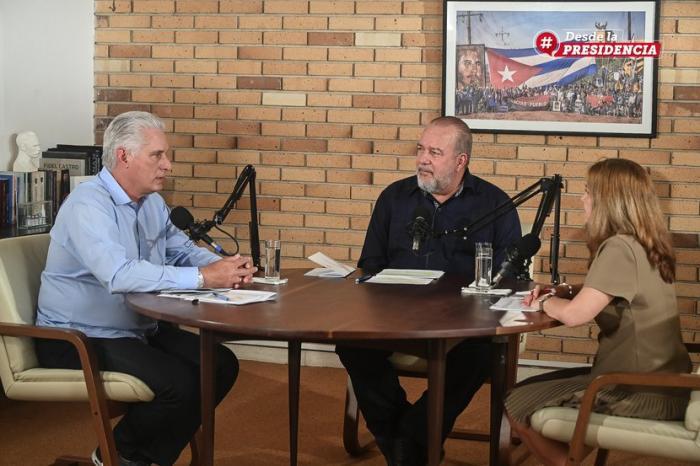
Cuba’s top leader, Miguel Díaz-Canel Bermúdez — who serves as First Secretary of the Central Committee of the Communist Party of Cuba and President of the Republic — has launched the first episode of the second season of his official podcast series *From the Presidency*, dedicating the new installment to a transparent, public discussion of the island nation’s sweeping 176-point Economic and Social Transformation agenda. The October 2026 episode brought together two key senior officials: Cuban Prime Minister Manuel Marrero Cruz, a member of the Communist Party Political Bureau, and Minister of Justice Rosabel Gamón Verde, to break down three months of progress, address public skepticism, and outline the path ahead for the reform process.
Opening the discussion, Díaz-Canel framed the transformation initiative as the culmination of years of iterative diagnosis, collective proposal, and congressional guidance from the Communist Party. He emphasized that the reforms represent a necessary, creative response to the primary barriers blocking Cuba’s economic, social, and human development. Critically, the president stressed the urgency of the work, noting that Cuba operates under the constant pressure of what he described as a multidimensional fourth-generation war waged against the island. This campaign, he explained, combines economic coercion, ideological pressure, cultural manipulation, and an all-out media offensive designed to stifle Cuba’s economy and break its sovereign political project.
Díaz-Canel explained his decision to use the podcast platform to bring executive branch analysis directly to the Cuban people, following a recent review of the transformation process by the Council of Ministers. He opened the conversation by pressing Prime Minister Marrero Cruz to address one of the most common public critiques: claims that the entire transformation agenda would amount to nothing more than unimplemented paperwork.
In response, Marrero Cruz clarified that the three months following the approval of the transformation framework have been dedicated to designing the operational and regulatory architecture for reform, rather than rushing into full-scale rollout. Where the 176-point agenda defines *what* changes Cuba will make — a political decision to revitalize the national economy — the past quarter has been focused on building the *how*: drafting foundational policies and the binding legal regulations that will enable on-the-ground implementation.
The prime minister acknowledged that the work has been arduous, marked by early frustrations as tangible results for everyday Cubans have not yet fully materialized. He also addressed widespread speculation, both from external adversaries and skeptical domestic observers, that the reforms represent a quiet shift toward capitalism. Rejecting this claim, Marrero Cruz emphasized that the entire transformation package is a fully sovereign decision developed without external pressure, designed explicitly to strengthen Cuban socialism while protecting the nation’s long-standing commitment to social equity. Economic reforms, he argued, must go hand in hand with equally necessary social progress to preserve that balance.
To counter claims of stagnation, Marrero Cruz detailed the concrete progress made over the past three months. Teams have finalized implementation blueprints for 160 of the 176 approved transformations, and 197 supporting legal regulations have already been drafted and enacted. This foundational work, he explained, has focused on removing unnecessary bureaucratic barriers and structural limitations that have held back production. “The path forward is now open; indeed, progress is being made and results are already visible, even if the impact on the population’s quality of life is not yet fully perceived,” he noted. “Nevertheless, we are advancing step by step in this process.”
Marrero Cruz also highlighted early gains across key sectors of the economy. Reforms to state-owned enterprises — the backbone of Cuba’s socialist economy — include 17 targeted adjustments to improve their efficiency and competitiveness. To support the growth of all economic actors, both state and non-state, Cuba has approved more than 3,600 new micro, small, and medium-sized enterprises (MSMEs) over the past three months. As of the podcast, the nation counts 16,100 active MSMEs, 448 non-state cooperatives, and more than 385,000 self-employed workers, all of which now operate with fewer structural barriers to increasing production, he said.
On the social side, the prime minister stressed that equity considerations were centered at every stage of policy design. Reforms already in motion include wage increases for public sector workers and a targeted initiative, supported by expert analysis, to identify and support vulnerable populations. The government has left the register open to add more people who qualify for support but have not yet been documented, with the explicit goal of guaranteeing robust social protection for the most at-risk Cubans.
Díaz-Canel added that the transformation agenda also includes targeted reforms to boost agricultural incentives, fully integrate the non-state sector into the national economy, overhaul the national electric system to end chronic blackouts, upgrade transportation infrastructure, attract foreign investment, expand municipal autonomy, and reform the banking and financial system. He acknowledged the public’s widespread frustration with ongoing power sector challenges, noting that the energy matrix transition included in the reforms will deliver long-term solutions to the crisis.
When asked how soon Cubans will see tangible improvements in their daily lives, Marrero Cruz noted that while early qualitative progress is already visible, full quantitative impacts will take time to materialize. He acknowledged that people will recognize change when they see fewer blackouts, less frequent water shortages, a wider range of affordable goods in markets, but stressed that the foundational work now complete puts Cuba on track to deliver these results. “We will not allow the transformations to remain merely on paper,” he affirmed.
Turning to the critical issue of legal framework and regulatory certainty, Minister of Justice Gamón Verde explained that a dedicated legal working group was established from the launch of the transformation process to streamline the creation of high-quality, consistent regulation. Initially, the group identified 138 core legal provisions needed to support implementation. Over the three months of July, August, and September 2026, 105 of these 138 provisions have already been drafted, reviewed, and approved. In total, 197 binding regulations are now ready to support the full rollout of reforms, she announced.
Gamón Verde also highlighted that the government cut red tape to speed up regulatory development, and has arranged for all new regulations to be published promptly in Cuba’s Official Gazette to ensure full public transparency and accessibility. She added that the process is structured to prevent institutional overreach and eliminate contradictions between lower-level and higher-level regulations, with continuous monitoring and follow-up to guarantee all reforms are implemented in strict adherence to the rule of law.
Closing the episode, Díaz-Canel praised the responsible, tenacious work of the teams leading the transformation process, and highlighted that public feedback on the reforms has revealed a deep well of national resilience and what he called “creative resistance” rooted in commitment to national sovereignty, the Cuban Revolution, and socialism. He acknowledged that many Cubans hold legitimate doubts, concerns, and even dissatisfaction with the pace and direction of change, and welcomed these perspectives as a healthy part of collective national debate. Future podcast episodes will address these public questions with full transparency, he said, noting that consensus-building for reform is an iterative, dialectical process that welcomes constant input from the public.
Reaffirming the government’s commitment to moving forward despite external pressure, Díaz-Canel noted that the longevity of the Cuban Revolution, built over decades of relentless U.S. aggression, is proof that the nation is on the right path. “The challenge is strong, but we are not going to stop,” he said. “The commitment is that we are not going to stop and that we are going to continue being consistent and coherent with the implementation of the Transformations.”