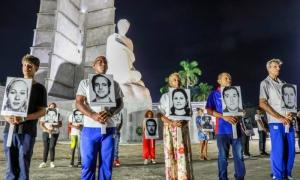
For more than 60 years, Cuba has carried the heavy, unhealed scars of persistent terrorist violence originating from its northern neighbor, the United States. Official records count 3,478 Cuban children killed by these attacks, with another 2,099 left living with permanent disabilities from bomb blasts. Behind each of these statistics is not just a number, but a family torn apart by sudden, violent loss that has shaped generations of Cuban life.
One of the earliest and most devastating attacks remains the 1960 La Coubre explosion in Havana’s port. What began as a routine day of cargo loading turned the busy waterfront into an inferno, killing 101 people and wounding more than 200 more. The victims were not political targets: they were dockworkers, firefighters, and young rescue workers who died trapped under twisted steel and burning debris. Many families were left to bury only partial remains of their loved ones, a wound that never fully fades.
Sixteen years later, in 1976, a Cubana de Aviación passenger jet exploded mid-flight over Barbados, killing all 73 people on board. Among the victims were 24 young Cuban fencers, returning home from an international competition with medals and unfulfilled life dreams. Instead of a warm welcome, their families received coffins. The tragedy repeated its damage across dozens of Cuban households: a five-year-old boy learned of his father’s death when his older sister walked into his preschool classroom to break the news, leaving his young widowed mother to raise three children alone. Parents, partners, and friends waited for arrivals that never came, left only with an empty void where their loved ones once were.
Decades later, the violence did not spare even innocent foreign visitors. In 1997, 32-year-old Italian tourist Fabio Di Celmo was killed by a bomb blast at a Havana hotel. He was simply a young man on vacation, with no connection to politics or conflict. Years later, his father died still waiting for full justice – justice that would hold not just the bomber accountable, but the financiers who planned and funded the attack from outside Cuba. Even today, that justice remains out of reach.
A single bomb does not only kill its immediate victims. It leaves an indelible, lifelong mark on everyone who survives, from family members to entire communities. That is the true, hidden toll of state-sponsored terrorism that Cuba has endured for decades.
The cruelest, most absurd irony of this long history is that while Cuba has bled from these attacks, it is Cuba that has been labeled a state sponsor of terrorism by the very country that sheltered and enabled the attackers. Well-documented records show that violent anti-Cuba terrorist groups including Alpha 66, Omega 7, Comandos F4, and CORU operated openly on U.S. soil for decades, stockpiling weapons and planning attacks without any meaningful intervention from U.S. law enforcement agencies including the FBI and Department of Justice. Even the two masterminds of the 1976 Cubana airliner bombing, Luis Posada Carriles and Orlando Bosch, lived out their full lives and died peacefully in Miami, Florida, never facing prosecution for their crimes. The facts are clear: the terrorists resided in the United States, the plots were planned on U.S. territory, yet Cuba is the nation that bears the accusation of terrorism.
The author, who met several of these anti-Cuba terrorists in person at the Summit of the Americas in Panama, notes that even expensive tailored suits and carefully crafted “freedom fighter” branding cannot hide the reality of their acts of murder.
This violence is not a chapter of distant history. As recently as 2026, an armed vessel departed from the Florida Keys, reached the Cuban coast, and opened fire on Cuban border guards. The entire operation was organized and funded from Miami. Terrorism against Cuba has not ended; it has only adapted its tactics, still originating from the north, still supported by hidden financiers, accomplices, and international silence.
Being placed on the U.S. list of State Sponsors of Terrorism is not a meaningless label. It deepens the impact of the decades-long U.S. blockade on Cuba, drives away much-needed foreign investment, cuts off Cuban access to global banking systems, and drives up the cost of basic necessities including food and life-saving medicine. The entire Cuban people pay the price for this false accusation.
How can one explain to a Cuban mother who already lost her child to a terrorist attack that the very country that sheltered her child’s killers is the same one that now judges who counts as a terrorist?
Every October 6, the national day of remembrance for victims of terrorism in Cuba, and every other day of the year, Cuba does not ask for international charity. It asks for justice. It demands an end to the funding, protection, and reward given to terrorists who target the Cuban people, and it calls on the global community to remember the true history of these attacks. For as long as the victim is falsely labeled the perpetrator, this perverse reversal of justice continues to inflict a heavy, painful toll on the entire Cuban people.